

FRACTIONAL EXECUTIVE SERIES | PRODUCTIVE PROSPECTING
He had everything a fractional professional is supposed to have.
Deep, trust-based client relationships built over years of credibility and genuine care for the people he served. A track record that spoke for itself. A network full of people who respected his expertise and valued his perspective.
Referrals were coming in.
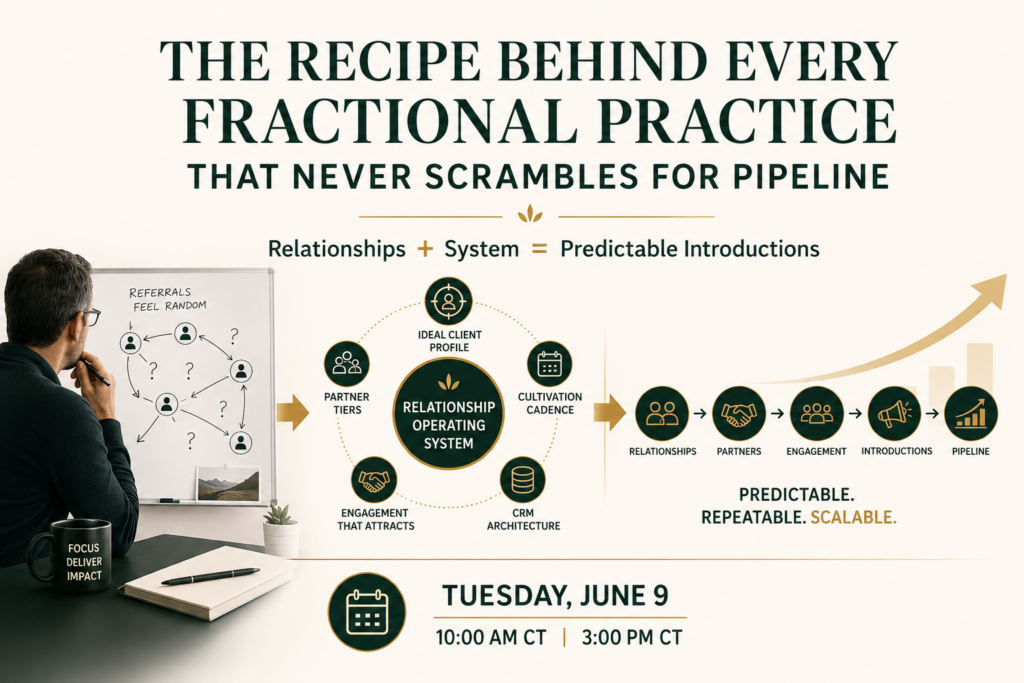
They just felt random.
No framework behind them. No way to replicate what made them happen. No system for knowing when the next one would arrive — or whether it would at all. He was exceptional at the work. The business development piece was running on instinct and luck.
And he knew it.
“I didn’t feel confident that I was developing a strategy that was actually cultivating referrals. It felt very random.”
If that sentence landed somewhere specific for you — keep reading.
It’s Not the Content. It’s the Relationships.
Here’s what most fractional professionals get wrong about pipeline.
They treat it as a content problem. Post more. Be more visible. Write more articles. Show up more consistently on LinkedIn.
And some of that matters. But it’s not the foundation.
The foundation is the relationships. The right people in your network. Cultivated intentionally. With engagement activities designed to attract ideal clients — to both of you.
The fractionals who never scramble for pipeline aren’t necessarily the most prolific content creators. They’re the ones who built the right architecture around the right relationships — and then let that architecture do the work whether they’re in delivery mode or prospecting mode.
The Recipe
There are five ingredients behind every fractional practice that generates consistent introductions without chasing them.
Know exactly who your perfect client is. Not a demographic. A specific, vivid picture of the person whose problem you solve better than anyone else — specific enough that when the right name comes up, you both recognize it immediately. Until that picture is clear, your referral partners are guessing on your behalf.
Know who has access to those clients. Not everyone in your network. The specific people whose relationships create natural on-ramps to your practice. The colleague whose work puts them in front of the same buyer at a different moment in the lifecycle. The professional whose expertise complements yours without competing with it. Your partner tier — defined, not assumed.
Cultivate those partners with intention. Not random check-ins. Not occasional coffee. A defined rhythm of outreach that keeps you relevant between referrals — that brings value to the relationship whether or not there’s an immediate opportunity attached. Partners who hear from you only when you need something eventually stop hearing from you at all.
Create engagement activities that attract ideal clients to both of you. This is the move most fractionals never make. The event, the introduction, the collaborative content, the room you build together — designed to serve the people you both want to reach. When your referral architecture creates visible value for your partners’ clients, introductions stop feeling like favors and start flowing like outcomes.
Have the architecture to make it repeatable. Get your relationships out of LinkedIn and into a system you control. A CRM infrastructure that holds the context, tracks the cultivation, and tells you when it’s time to reach out — not because you remembered, but because the system surfaced it.
What Changes When the System Is in Place
The organization development consultant I mentioned at the top of this piece built out his referral partner tiers. Defined his platinum client profile. Built a content engine anchored to his ideal client’s actual pain points rather than his own expertise. Paused his podcast — not because it wasn’t working, but because he finally had the clarity to rebuild it with intention.
And then something happened that wouldn’t have happened before.
A natural referral partnership surfaced — a former colleague whose work creates a direct on-ramp to exactly the clients he most wants to serve. Not because he got lucky. Because he had the system to recognize and activate it when it appeared.
He mapped out a full 90-day campaign. Reverse engineered from close date to content runway. A paid workshop offer. An event designed specifically for referral partners to recruit into. A funnel connecting all of it.
“The content was more transformational than I thought — I can see levels to this system I haven’t even reached yet.”
That’s not a short-term fix. That’s a practice that keeps building.
Tuesday’s Conversation
The Relationship Operating System is the architecture that holds the recipe together.
Not five separate habits. One designed infrastructure — built around the right relationships, cultivated with intention, activated through engagement that creates value for everyone in the room.
This Tuesday, June 9th, I’m walking through what it is, how it’s structured, and where it fits in your overall prospecting effort. Not a build session. The foundation.
If your referrals feel random despite having genuinely good relationships — this is the conversation worth being in.
Two sessions available. Morning and afternoon.
→ REGISTER FOR PRODUCTIVE PROSPECTING — JUNE 9TH: [LINK]