

Your Resume Isn’t Why They Don’t Call You Back
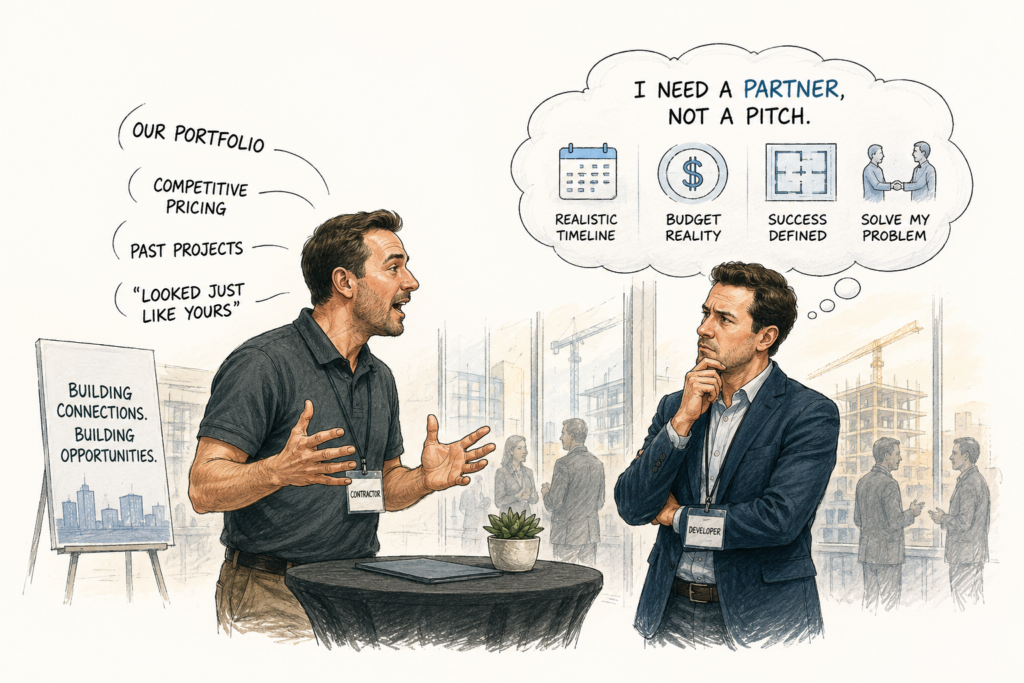
The contractor walked into the networking event with a prepared pitch. He talked about his portfolio. His competitive pricing. His past projects that “looked just like” what the developer builds. He wanted an opportunity to bid.
The developer never got a word in.
Here’s what actually happened in that conversation: the contractor demonstrated, in real time, exactly what it would be like to work with him. Not impressive. Not collaborative. Not interested in understanding the developer’s constraints, timeline, budget reality, or what success actually looks like on their end.
That contractor showed up to sell himself. The developer was looking for a partner who could solve a problem.
The Industry Pattern You Already Know
This wasn’t an isolated networking fail. It’s how the entire construction industry operates—from the website to the job site.
Your website showcases beautiful spaces. Your case studies highlight projects you’re proud of. Your networking pitch leads with your capabilities. Your proposals detail what you’ll do and why you’re competitive. Your job site interactions center on your process, your timeline, your standards.
All of it is about you.
Meanwhile, the buyer is trying to figure out if you understand their constraints. If you’ll actually listen to what matters to them. If you’ll show up ready to solve their specific problem—not execute your own vision of what the project should be.
The Behavior Runs Deeper Than Marketing
This isn’t a website problem or a case study problem. It’s a structural behavior problem that runs through every touchpoint:
- The networking conversation assumes the buyer wants to hear about your past projects.
- The proposal assumes your competitive pricing and timeline are the deciding factors.
- The job site interaction assumes your process is the reference point for success.
- The problem-solving assumes you already know what the real problem is.
The industry isn’t broken because contractors lack impressive resumes or can’t point to beautiful work. It’s broken because the entire system is built around what the contractor wants to sell, not what the buyer actually needs to solve.
And buyers can feel that. They feel it in the room when you’re talking about yourself instead of asking about them. They feel it in proposals that lead with your strengths instead of their constraints. They feel it on the job when you’re defending your process instead of adapting to their reality.
What That Contractor Really Demonstrated
He walked into that room and proved—without meaning to—that he had no intention of being curious about the developer’s world. No plan to collaborate. No interest in bringing proactive solutions to the table. No attempt to understand what would actually make this project successful from the developer’s perspective.
He did all of that in a five-minute networking conversation.
Most contractors do it quietly, over months, through their marketing materials and their interactions and their proposals. This one just did it out loud.
The developer didn’t learn that the contractor had great projects in his portfolio. He learned exactly what it would be like to work with him.
What Actually Moves a Buyer
Your resume doesn’t move them. Your portfolio doesn’t move them. Your competitive positioning doesn’t move them.
What moves them is evidence—real, behavioral evidence—that you give a damn about solving their problem. That you listen more than you pitch. That you ask questions before you propose solutions. That you show up genuinely curious about their constraints instead of confident in your capabilities.
That’s the customer experience. And in construction, it’s almost entirely invisible because the industry has spent decades leading with the wrong thing.
The contractor at that networking event had an opportunity to demonstrate partnership. Instead, he demonstrated exactly why he shouldn’t get the bid.
He just did it accidentally.
And we wonder why the industry lives in the continuing pattern of ‘racing to the bottom’ contractors leave them no choice….
We can do better.