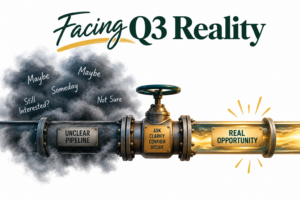

Here’s a trap almost every contractor falls into at some point, usually without realizing it: you assume that if you just keep doing good work and landing bigger jobs, the business itself gets more valuable. Backlog grows, revenue grows, everything looks healthy on paper. And yet if you actually stepped back — sold the company, stepped away for a year, handed the reins to someone else — a lot of that “value” would evaporate almost immediately, because it was never really attached to the business. It was attached to you, this quarter, and whatever you happened to be bidding.
That’s the trap. A full pipeline feels like progress. It’s not the same thing as enterprise value, and mixing the two up is why a lot of genuinely successful contractors have a great year every year and still don’t have a business that’s worth more than it was five years ago.
What Enterprise Value Actually Is
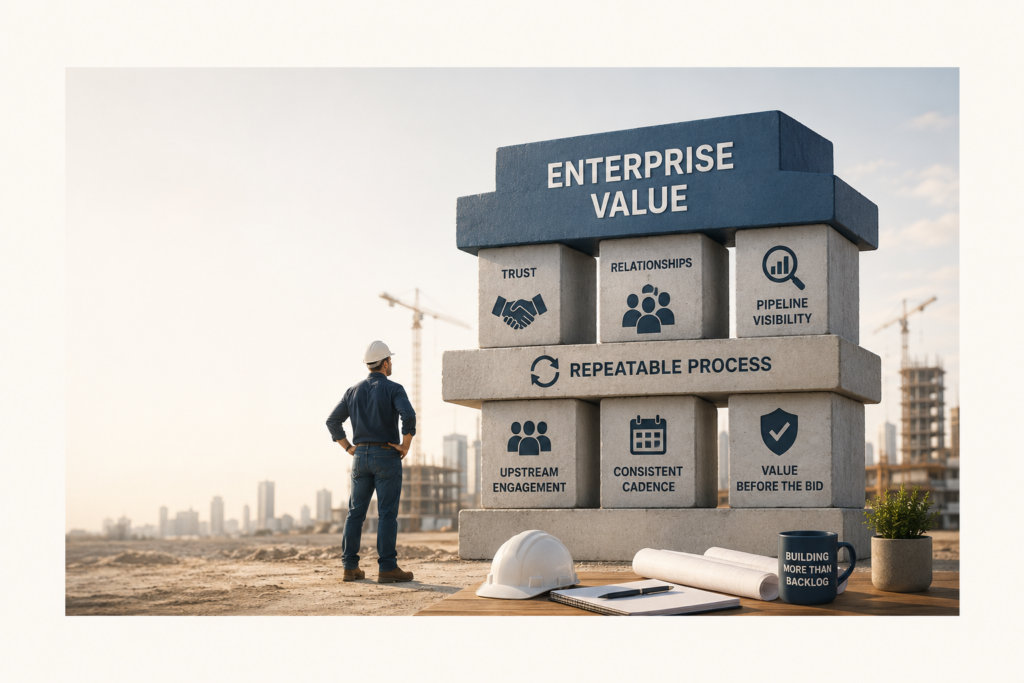
Enterprise value is what’s left when you’re not in the room. It’s relationships that keep producing work whether or not you personally chase them down this month. It’s pipeline visibility that extends past the current backlog — not “we’re busy through Q3,” but “we already know roughly what’s coming in 2028.” It’s the kind of thing a buyer would actually pay for, because it doesn’t disappear the moment ownership changes.
Revenue, by contrast, can be entirely dependent on you personally showing up, bidding hard, and winning. That’s a job, even if it’s a well-paying one. It’s not an asset.
Why “Speaking It Into Being” Doesn’t Work
Here’s where it gets frustrating for a lot of contractors: everybody knows relationships matter. Go look at ten contractor websites and you’ll find some version of “we build long-term partnerships” on at least eight of them. Saying it costs nothing. It also does nothing, because enterprise value doesn’t respond to declared intent — it responds to a repeatable process, executed consistently, over years.
You can’t decide on a Tuesday that you’re now a relationship-driven contractor and have it be true by Thursday. That’s the part that’s easier said than done. Real upstream positioning — being embedded with developers, owners, and GCs before a property’s even under contract, let alone out to bid — takes an actual system behind it: specific people you’re intentionally investing in, a real cadence for staying in front of them, a defined way you demonstrate value before there’s ever a deal to negotiate. Without that system, “we value relationships” is just a sentence on a website, and the business ends up right back where it started — dependent on however aggressively you can chase the next bid.
Process, Not a Slogan
The contractors who actually build enterprise value aren’t doing anything mystical. They’ve just replaced the slogan with a process. They know exactly who their small handful of key upstream relationships are. They have a real rhythm for staying in front of those people — not sporadically, not “when we think of it,” but built into how the business runs. And they can point to specific, demonstrated ways they’ve added value to those relationships before a single dollar was on the table, which is the entire reason those relationships keep producing work without a fight over price every time.
We’re finishing up a detailed case study with one of our contractor clients built entirely around this shift — moving from construction-cycle-dependent revenue toward something with real staying power, by treating upstream relationships as a system to build, not a claim to make. In the owner’s own words, the goal was simple: “I wanted to work on things that grew our enterprise value through the sales funnel and how we approach it from all aspects of our business.” That’s a process conversation, not a marketing conversation. Full case study coming soon.
The Question Worth Asking
If you stepped away from your business for a year, how much of your current pipeline would still be there when you got back? If the honest answer is “not much,” you don’t have an enterprise value problem you can fix with better marketing copy. You have a process you haven’t built yet — and that’s a very different, very solvable problem, once you stop trying to say your way into it.