

The capital markets are tightening. Financing that used to pencil out cleanly on a project doesn’t anymore. Buyers and developers with real money on the line are getting more careful about which projects they move forward with — and some contractors are already adjusting to that. Most haven’t noticed yet.
That gap is about to matter more than it has in years.
Two Ways Contractors Are Leaving Money on the Table
Here’s a pattern worth being honest about, because it shows up constantly, in two opposite directions:
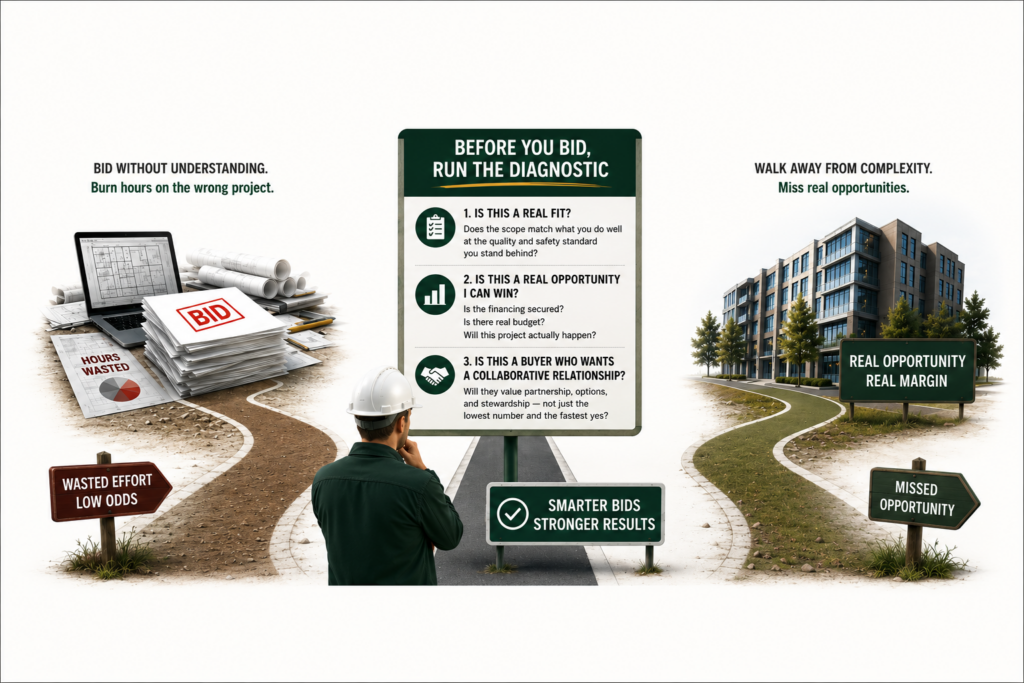
The superficial yes. A set of plans comes in. It looks straightforward enough. Instead of actually working through whether it’s a genuine fit — whether the scope matches what you’re equipped to deliver well, whether the buyer’s financing is actually secured, whether there’s real margin for the unexpected — the bid gets built on a glance and a gut feeling. Hours go into a bid for a project nobody actually diagnosed first or determined where they could bring value warranting margin.
The reflexive no. A set of plans comes in that looks complicated. Instead of actually evaluating it, it gets set aside. Too much hassle, probably not worth it, moving on to something simpler. No diagnostic happens here either — just an assumption dressed up as a decision.
Both of these are effort misallocated in opposite directions. And both come from the exact same missing step: nobody ran a real diagnostic before deciding what to do with the opportunity.
The superficial yes burns hours on projects that were a poor fit, poorly understood, or never had strong odds of closing in the first place. The reflexive no walks away from real opportunities — money that was actually available — because complexity got mistaken for a bad bet without anyone checking.
Either way, the buyer ends up with fewer good options, and the contractor ends up with less revenue than they should have.
Diagnostic Minutes Before Bid Hours
Here’s the shift worth making: before you invest the hours it takes to actually build a bid, invest a few minutes running a real diagnostic. Not a glance. Not a gut check. An honest answer to three questions that can only be gained in a conversation with the buyer:
Is this a project I’m genuinely well-suited to deliver? Not “can I technically do this,” but does the scope actually match what you do well, at the quality and safety standard you want your name attached to — or does it stretch you into territory where something’s likely to slip?
Do I have a real chance of winning this, and is the opportunity actually real? Is the buyer’s financing secured, or are they still shopping the idea around hoping the numbers work out? Is there genuine budget for the scope they’re describing, or is this a project that’s going to collapse under its own assumptions before it ever breaks ground?
Is this a buyer who actually wants a collaborative relationship to get this done? Some buyers just want the lowest number and the fastest yes. Others are looking for someone to manage the project, protect their interests, lay out real options, and act as a steward of their resources, not just execute a scope. That second kind of buyer is the one who will actually value what you bring beyond the labor and materials — and it’s the only kind of buyer negotiated work at real margin makes sense with.
This last question matters more than it sounds like. Negotiated work, better margins, less bid-and-hope pressure — every contractor says they want that. But that kind of relationship isn’t requested. It’s earned, one diagnosed project at a time, by being the contractor who actually showed up as a steward instead of a vendor. You don’t get invited into that kind of relationship by talking about wanting it. You get invited into it by being recognizably worth it on the projects where it counted.
Time spent with your buyer to determine the answers to these questions before committing to a bid changes everything downstream. Some projects that looked easy get a second, more careful look — and either get a stronger bid because you actually understood the risk, or get passed on for the right reasons instead of no reason at all. Some projects that looked too complex to bother with turn out to be exactly the kind of opportunity worth the extra diagnostic time, because the complexity was hiding real margin, not real risk. And some buyers reveal themselves early as exactly the kind worth building a real relationship with, instead of just another bid to win and forget.
The Market Is Already Sorting Contractors Into Two Groups
Some contractors are paying attention to what’s shifting in the capital markets right now and adjusting how they spend their time accordingly. They’re running the diagnostic before the bid, being more deliberate about which opportunities are actually worth pursuing, and showing up to the projects they do bid with a real understanding of the risk involved.
Others haven’t noticed the shift at all. They’re still bidding the way they did when capital was loose and buyers had more room for error — reflexively saying yes to the easy-looking stuff, reflexively passing on anything that looks complicated, and burning hours on projects that were never diagnosed in either direction.
In a market with less room for anyone’s mistakes, that gap is going to show up in who’s actually winning work over the next year. Not the contractors bidding the most. The ones bidding the smartest.