

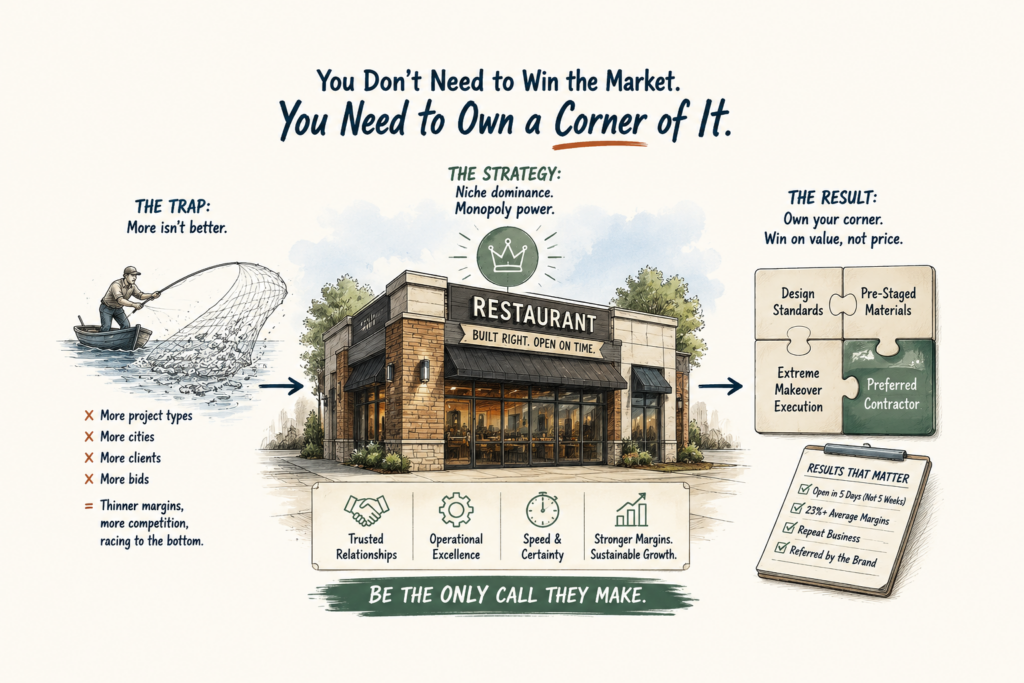
The Trap Most Contractors Fall Into
There’s a version of “more” that’s slowly killing margins in this industry.
More project types. More cities you work in. More clients. More bids.
The thinking goes: a bigger net catches more fish.
But what it actually does is spread you thin, commoditize your offer, and put you in a race you can never win — the race to the lowest number on the bid sheet.
There’s another way to build. And it starts with a concept borrowed from something you probably played as a kid.
Monopoly Control: The Overlooked Strategy for Enterprise Value
In the game of Monopoly, Boardwalk is the top property on the board. But the players who win aren’t always the ones who own Boardwalk.
They’re the ones who own all the orange properties. Or all the light blues. A complete set in a specific neighborhood, or my husband’s strategy, the entire side of the board where he then builds hotels on every property – where every player who lands there pays him and goes bankrupt. But I’m not bitter about it at all….
That’s what niche dominance looks like in Monopoly and contracting.
You’re not trying to be the best commercial contractor in Kansas City. You’re trying to be the only contractor a regional restaurant chain calls when they need a refresh done right, done fast, and done without sacrificing a weekend of sales.
Broad categories are battlegrounds. Narrow niches are monopolies waiting to be claimed.
How a Contractor Turned a Manufacturing Mindset Into a Market Monopoly
One of my clients came into contracting from manufacturing sales — not from the trades.
That background turned out to be his superpower.
In manufacturing, you don’t win on price. You win on throughput — on how efficiently you move materials through a system, eliminate delays, and protect the customer’s operation. He brought that same thinking to the restaurant renovation space.
Here’s the problem he uncovered in discovery with a regional chain prospect:
They had been putting off a true front-of-house refresh for three years. Not because of budget. Not because of vision. Because they couldn’t identify a slow period they were willing to sacrifice. Weekend sales were sacred. So they’d been doing cosmetic patches — fresh paint, new lighting, updated furniture — but never the real transformation the brand needed.
He listened. And then he built a solution no one else in the market was offering.
The “Extreme Makeover” Model: Speed as the Product
He didn’t just sell construction. He sold certainty — specifically, certainty around timeline.
Borrowing from lean manufacturing, he negotiated directly with suppliers to have materials on hand: tile, cabinetry, fixtures, casework, art — staged and ready to deploy. No lead time surprises. No “the cabinets are three weeks out” conversations mid-project.
He then designed his project model around what he called the Extreme Makeover approach. Crews scheduled in sequence, trades overlapping where possible, every stage mapped to the minute — from demo to punch list to final cleaning.
The execution: get the keys Sunday night. Open for business Friday morning.
What he was selling wasn’t just a renovation. He was selling four lost days instead of four lost weeks.
For a restaurant operator, that math is everything.
Then He Went One Layer Deeper
Once he had a repeatable model, he didn’t stop at independent operators.
He approached a major franchise brand directly — learned their updated design standards, their required refresh specifications, their approved suppliers. Then he negotiated to get those materials into his pre-staged inventory system.
The result: he was referred to individual franchise owners as the preferred contractor — the one who knew the brand specs, could deliver on time, and had already solved every supply chain problem before the conversation even started.
His crews got faster with every project. His systems got tighter. His relationships with suppliers got stronger.
And his margin?
Averaged 23%+ on these jobs.
That’s not a “lowest bid wins” margin. That’s a “nobody else can do what I do” margin.
What’s Your Natural Niche? Start With Who You Already Are.
Most contractors start niche discovery by looking outward — at the market, at competitors, at what’s trending.
Start inward first.
Your entire professional background — every job, every industry, every frustration you’ve solved, every system you’ve watched work or fail — is a catalog of potential superpowers. The contractor in this story didn’t invent anything. He translated.
He brought two things from his manufacturing career into the trades that most contractors never develop:
Relationships built on trust, not transactions.
He was a natural connector — the kind of person vendors, suppliers, and franchise decision-makers wanted to do business with. That wasn’t a contracting skill. That was a career-long identity he carried into a new arena.
A kaizen mindset.
For those unfamiliar: kaizen is a Japanese manufacturing philosophy built around continuous, incremental improvement. Not dramatic overhauls — the smallest edges, compounded. Every process gets examined. Every inefficiency gets questioned. Every step that doesn’t add value gets eliminated or tightened.
He didn’t just absorb this philosophy himself. He built it into his operation. He brought in coaches with actual lean manufacturing backgrounds to train his crews and project managers. The job site became a system, not just a collection of trades showing up.
And when he turned that lens toward his biggest operational problem — material availability — kaizen gave him the answer: just-in-time inventory. Carry only what you need, exactly when you need it. He negotiated with suppliers not just for pricing, but for availability commitments. Materials staged. Timelines protected. The project could run at full speed because the fuel was already in the tank.
The Professional Inventory Exercise
Before you look at a niche, look at your entire background. All of it — not just the contracting chapters.
Ask yourself:
- What industry or role did I come from that gave me a lens most contractors don’t have? Manufacturing. Finance. Operations. Hospitality. Military. Retail. Every one of these carries transferable systems thinking.
- What did I learn to solve before I ever swung a hammer? Procurement. People management. Customer service under pressure. Vendor negotiation. Process documentation. Scheduling under constraints.
- Where have I already built trust at scale? Relationships are infrastructure. Who do you know — really know — and in what world do they operate?
- What does my team do better than the average crew on the street? Not what you wish they did better. What do they actually execute with consistency and precision right now?
- Where does the job site slow down most often — and do I have a background that speaks directly to that bottleneck?
The smallest edges are where real advantages live.
A contractor who came up through retail operations might have an extraordinary gift for managing the client experience during an occupied renovation. A contractor who spent a decade in logistics might build the most reliable material delivery system in their market. A contractor who served in the military might run the tightest, most accountable job site in the region.
None of these require you to reinvent your business. They require you to recognize what you already are — and then build a market position around it.
Your Vendors Aren’t Vendors. They’re Partners.
Here’s a mindset shift that most contractors never make — and it costs them at the margin level every single time.
If you are grinding your suppliers on price at every turn, commoditizing the relationship, running three quotes to squeeze out another two percent — you have recreated inside your own operation the exact dynamic you’re trying to escape in your sales process.
You are the low-bid guy. To them.
Think about that for a moment. The same race to the bottom you resent when a prospect treats you like a number on a spreadsheet? Your suppliers feel that every time you call. And they respond accordingly — slowest delivery window, least flexible terms, no early notification when supply gets tight, no favors when you’re in a pinch.
The contractor in this story made a fundamentally different choice. He approached his suppliers the way he wanted prospects to approach him — with the intent to build something durable, not to extract a transaction.
That meant sharing his project pipeline so suppliers could plan ahead. Paying on time, consistently, without having to be chased. Bringing them into the strategy — explaining why he needed materials staged in a specific way, so they understood what they were helping him build. Loyalty when a supplier came through, and honest conversation when they didn’t.
In return, he got what no amount of aggressive negotiation could buy: priority. When materials were scarce, his orders moved to the front. When a project timeline shifted, his suppliers worked with him instead of against him. When he needed a new product spec for a franchise refresh, he had a relationship strong enough to negotiate preferred access.
That’s not vendor management. That’s a competitive moat.
The Parallel Is Not an Accident
This is worth sitting with, because it’s one of the most clarifying frames in business:
The way you treat the people downstream from you is a direct reflection of how you understand value.
If you believe you create value through pressure — squeezing margin out of every link in the chain — you will always be in a fight. With suppliers. With subs. Eventually with clients.
If you believe you create value through collaboration — by making every partner in your system more capable, more confident, and more invested in the outcome — you build something that compounds over time.
Kaizen isn’t just a job site philosophy. It’s a relationship philosophy. Continuous improvement doesn’t happen in isolation. It happens when everyone in the system is paying attention to what’s working and what isn’t — and trusts each other enough to say so.
His suppliers knew what he was building. His subs knew what he expected and why. His crews had been trained in the same operating principles. Everyone was rowing in the same direction because he had made it worth their while to do so.
That’s the real leverage of niche dominance. It’s not just that you get better over time. Your entire ecosystem gets better with you.
The Honest Audit
Look at your current supplier and subcontractor relationships and ask:
- Am I a client they want to grow with — or one they tolerate?
- Do they call me when something good becomes available, or only when I reach out first?
- Have I ever explained my business strategy to a supplier and invited them into it?
- Would my subs say I’m the GC they’d call first if they had a choice?
If the answers are uncomfortable, that’s useful information. It means the margin you’re leaving on the table isn’t just in your bids — it’s in your relationships.
And if you’re ready to go to work on identifying your natural niche, grab my Niche Workbook HERE and get started with yours.
The contractor who commands 23% margin isn’t just efficient on the job site. He has built a system where every partner has a reason to make him successful.
The Bottom Line
Enterprise value — real, transferable, sellable business value — isn’t built by winning more bids.
It’s built by becoming irreplaceable in a defined space.
A client who calls you because you’re the only one who does what you do is not comparing you to anyone else. That’s the difference between margin and survival.
Stop trying to win the whole board.
Own your neighborhood.