

You’re Networking. But Do You Have a Pipeline?
There’s a difference between being busy and building something.
Most professional services providers – CPAs, attorneys, financial advisors, consultants – are not short on activity. They’re attending the events. They’re having the coffees. They’re connecting on LinkedIn. They’re showing up.
And yet, when I ask them where their next client is coming from, the answer is usually some version of: “I’m not sure. Something will come through…hopefully….maybe…”
That’s not a pipeline. That’s hope with a calendar.
Activity feels like progress. It isn’t always.
Here’s what I see constantly in professional services: smart, genuinely talented people who are out hustling, visible, engaged, relationship-oriented, but whose business development has no structure underneath it.
They go to the networking breakfast. They meet someone interesting. They follow up once. Maybe twice. And then the connection quietly fades because there was no system to hold it, no next step that mattered, no reason for the relationship to deepen.
Six months later they’re at another breakfast, meeting someone new, starting the cycle over.
This isn’t a work ethic problem. It’s an architecture problem.
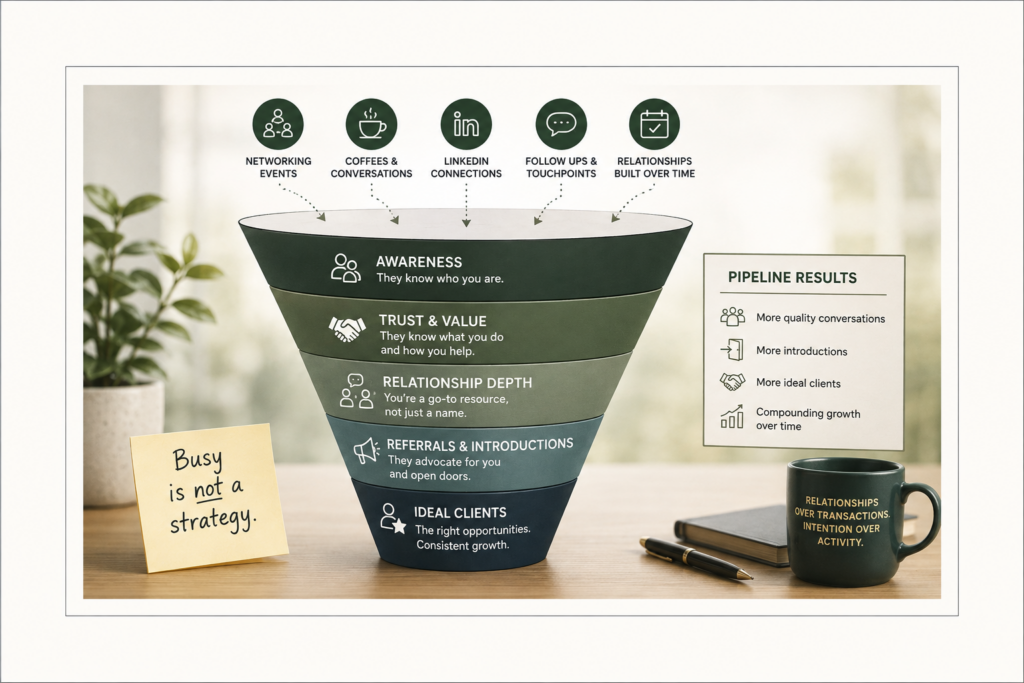
A pipeline isn’t a list of people you’ve met. It’s a set of relationships that are actively moving, deepening, referring, creating introductions, because you’ve given them a reason to. The difference between activity and pipeline is intention. And intention requires a system.
What a relationship-driven pipeline actually looks like
It starts with a different question.
Most people approach networking with some version of: “Who might need what I do?” That’s a reasonable question. But it’s the wrong starting point.
The better question is: “Who already has the relationships I want access to and needs me to produce their best outcome?”
In professional services, your best clients rarely find you through a Google search. They find you through someone they already trust. An accountant who mentions you to a business owner. An attorney who refers you to a family going through a transition. A banker who puts your name in a room where a decision is being made.
Make no mistake, they do their research online, but go to trusted counsel when it’s time for a decision.
Those people, your Centers of Influence, are not just referral sources. They are your pipeline infrastructure. And building that infrastructure is a very different activity than attending events and hoping something shakes loose.
Here’s what it requires:
Clarity on who belongs in your network. Not everyone you meet is a Center of Influence. Some people are great connections. Some are future clients. Some are neither. A relationship-driven pipeline starts with being intentional about who occupies the highest tier of your attention, the people whose trust, when earned, creates compounding access to the clients you most want to serve.
Consistency that creates trust. Referrals don’t come from people who vaguely remember meeting you. They come from people who know exactly what you do, who you do it for, and why you’re the right person. That clarity doesn’t come from one coffee. It comes from repeated, relevant contact over time, contact that leads with value, not asks.
A reason to refer that’s bigger than obligation. The weakest referrals come from people who refer you because you asked. The strongest come from people who refer you because doing so reflects well on them, because they know you’ll take care of the person they send your way, and that the introduction raises their standing in the relationship. When you understand that, you stop chasing referrals and start building the conditions that make them inevitable.
The compounding math of relationship infrastructure
Here’s what makes this worth the investment.
A transactional approach to business development requires constant input. You stop working it, the pipeline empties. Every new client requires a fresh effort.
A relationship-driven pipeline compounds. A Center of Influence who trusts you deeply doesn’t refer you once. They refer you repeatedly, to different clients, over years. They mention your name in rooms you’ll never enter. They vouch for you before you’ve said a word.
That’s not networking. That’s infrastructure. And infrastructure, once built, works whether you’re in it or not.
The professionals who seem to always have a full practice, who never appear to be selling, who get the call when something important is happening, they’re not lucky. They built something. And they built it before they needed it.
Practicing what I teach: The ask that could change someone’s trajectory
If you know someone who is evaluating what’s next, a senior leader considering a transition, someone who has left corporate and is figuring out how to package their expertise into a practice, think of them right now.
We’re kicking off the 5 Day to Fractional Bootcamp on the 24th of August. It’s built for exactly that person: the one with real expertise, real relationships, and a genuine question about whether there’s a better model for the next chapter of their career.
Five days. Pure clarity on whether a fractional practice is the right move, and what it actually takes to build one that holds. In roughly 1 hour per day participants will evaluate what fractional services would look like as their next career move.
If someone comes to mind, share this blog and LINK to Register with them. It might be the most useful thing that lands in their inbox this week.
To your influence,
Breandan