
My dad spent his career in technology, working on the big mainframes, the AS/400 systems that filled entire rooms. He had a genuine gift for it. He could spot an error in a line of code that everyone else had missed. He built programs that did things most people couldn’t imagine a computer doing at the time.
What he never learned to do was sell any of it.
I watched personal computers evolve during those years, from machines that took up a desk to laptops, then tablets, then something that fits in your pocket and outperforms all of it. I remember conversations with my dad about where technology was heading, and I suggested more than once that he move toward what we’d now call a managed services model. He was resistant. There was real angst about the change, a sense that the way he’d always worked was still the way that mattered.
Then Y2K happened, and his career disappeared almost overnight.
A Forced Pivot, Without a Forced Sale
The mainframe world he’d built his identity around didn’t just slow down. It essentially vanished, all at once, in a way nobody fully prepared for. The pivot got forced on him. What didn’t get forced on him, unfortunately, was the other half of what he needed: the ability to sell himself, to go find customers, to make his value visible to people who didn’t already know him.
He did genuinely excellent work after that pivot too. One of his first clients in that new chapter stayed with him for 37 years. Longer than a lot of marriages last. That tells you everything about the quality of what he delivered, and nothing changes the fact that finding the next client, and the one after that, was never something he figured out how to do comfortably.
My dad had a saying he used constantly, and even now, with dementia taking so much else from him, it’s one of the things he still says without prompting: TANSTAAFL. There ain’t no such thing as a free lunch.
I think about that phrase more than almost anything else when I think about Emotional Equity. Bring value. Contribute to people genuinely, before you ask for anything. And also, just as importantly, make it clear how people can help you in return. Because they will. But you have to actually help them help you. Nobody does that by accident, and nobody does it by simply being good at the work and waiting to be noticed.
Watching the Pattern Repeat
I say all of this because what happened to my dad in the late 90s is happening again right now, and not just in technology.
The room-sized computers of his early career got replaced by something that fits in your hand and does more. The same thing is happening across professional services today. AI is taking over the routine, mundane parts of a huge range of work, research, drafting, analysis, synthesis, the tasks that used to require a person and now increasingly don’t.
And I’m watching a lot of professionals make the exact same justifications my dad made. Some version of “this is how I’ve always done it, and it’s worked, so it’ll keep working.” Meanwhile the ground underneath that assumption is shifting, the same way it shifted underneath mainframe programmers, whether anyone wanted it to or not.
Here’s the actual question worth asking, the one my dad never got around to answering differently: what are you going to do about it?
His answer, in the end, was to retire.
Mine has been different. I’ve made it a habit to actively look for where opportunity is actually living, and to pivot toward whoever needs what I have to offer, can genuinely use my advice, and is willing to pay for it. That’s meant a real shift in my services, my market, or how I deliver, roughly every four years for most of my career. And that cycle is compressing fast now that AI is in the picture. Four years might be generous for how often this kind of check needs to happen going forward.
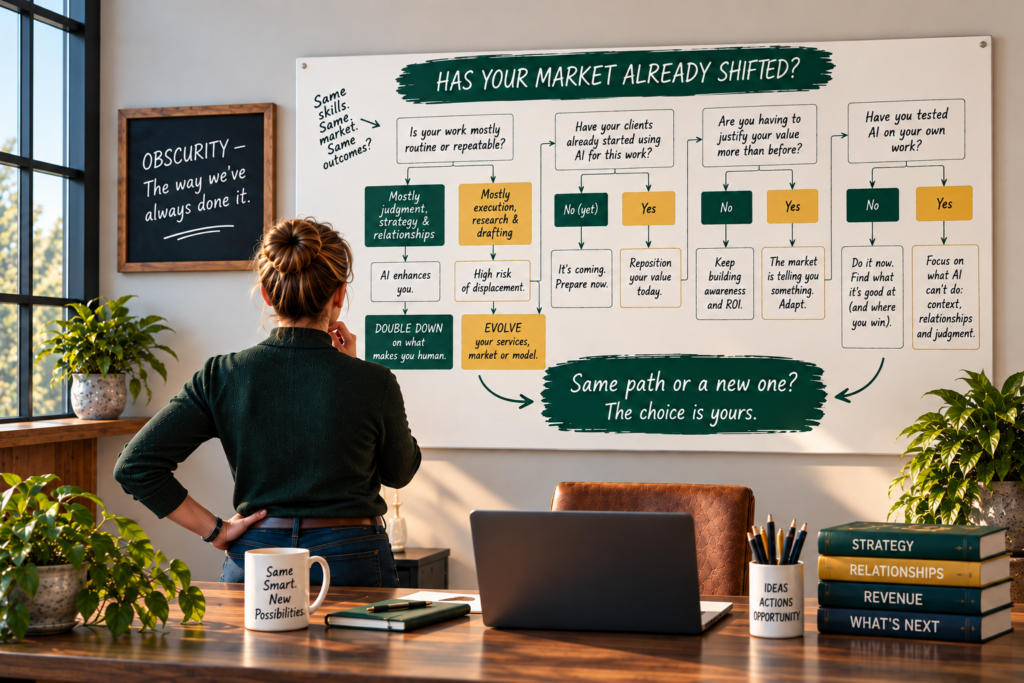
Four Ways to Tell If Your Market Has Already Shifted Underneath You
You don’t have to wait for your own version of Y2K to find out if this is happening to you. Here’s how to actually check.
Separate your work into what’s routine and what’s judgment. Be honest about which parts of what you do are execution, research, drafting, standard analysis, and which parts require real context, relationship, and judgment that a machine genuinely can’t replicate yet. If most of what you’re currently charging for lives in the first category, that’s worth knowing now, not after a client figures it out first.
Ask your clients directly, not hypothetically. Go have the real conversation. Ask a handful of your best clients whether they’ve already started using AI tools for pieces of what they used to hire you for. Most people are afraid to ask this question because they’re afraid of the answer. The fear doesn’t change what’s true. It just delays finding out.
Notice what you’re having to justify that you never used to. If you’re explaining or defending part of your value in a way you never had to a few years ago, that’s rarely a coincidence. It’s usually the market quietly telling you something’s changed, well before anyone says it to your face.
Actually test the tools on your own work. Don’t assume, in either direction. Sit down and see how close a well-used AI tool actually gets to your core deliverable. If it gets close, that tells you exactly where the real value you provide has to live now, and it’s probably not where it used to.
The Light at the End of the Tunnel Might be a Train
Here’s what I’m actually watching happen right now, not as an abstraction, but in real conversations. A lot of the professionals coming to me about career transition are analysts. Finance people. Skilled, credentialed, genuinely good at their jobs. And a meaningful share of what they’ve built a career doing is exactly the kind of work a well-prompted AI tool can now do in a fraction of the time.
Law is right behind them, moving slower than almost any other profession toward admitting it. A huge amount of what junior and even mid-level legal work has traditionally involved, research, first-draft documents, contract review, summarization, is already well within reach of the tools available right now. The profession’s caution about adopting AI is understandable given the stakes of getting it wrong. That caution is not the same thing as the underlying shift not happening. It’s happening either way. The only question is who notices first, the professional or the client footing the bill.
I don’t say any of this to be alarmist. I say it because my dad genuinely believed, right up until it happened, that the way he’d always worked would keep being enough. He wasn’t foolish. He wasn’t lazy. He was good at his job, in a world that was changing faster underneath him than he was willing to look at directly.
There’s an old joke about seeing light at the end of the tunnel. Sometimes it’s daylight. Sometimes it’s a train. A lot of professionals right now are looking at that light and assuming it’s the first one, because assuming that is a lot more comfortable than checking.
The Choice My Dad Didn’t Get to Make Twice
My dad was brilliant at the work and never built the skill of making that brilliance visible to the people who needed it. When the ground shifted the first time, that gap cost him more than it should have. When AI is reshaping this industry the way personal computing reshaped his, the same gap will cost a lot of genuinely talented professionals more than their skill alone deserves.
There is no such thing as a free lunch. Bringing real value has never been enough on its own; it never was for my dad, and it isn’t now. You have to help people know it’s there, and help them know how to bring you in. That’s not a compromise of the work. It’s the other half of it.
The four questions above aren’t hypothetical. They’re the difference between checking now, on your own terms, and finding out later, on someone else’s.