

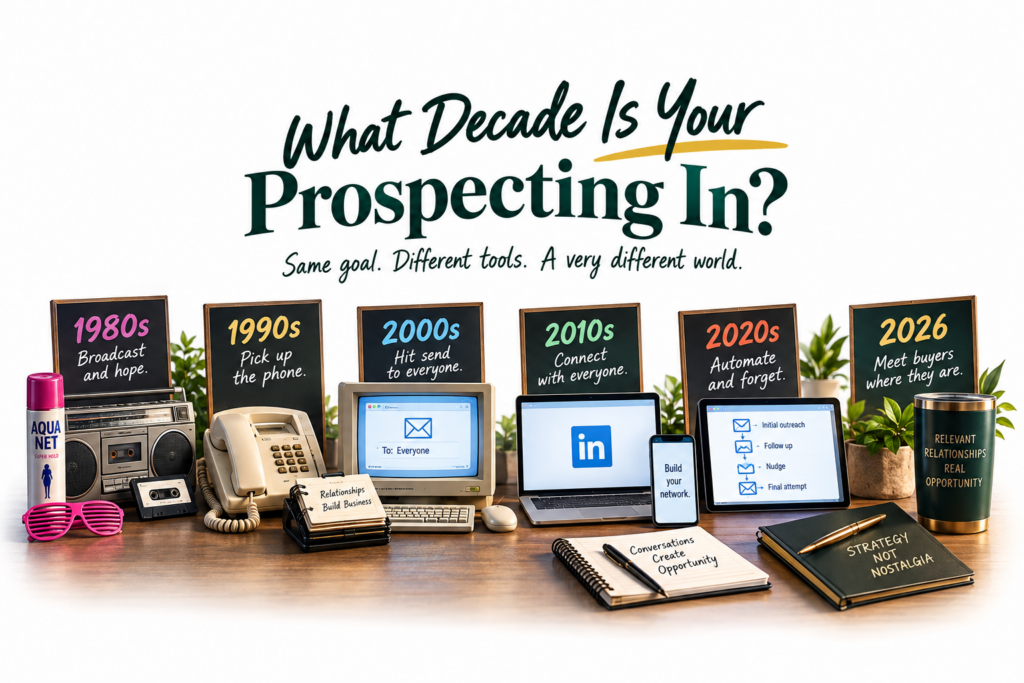
I’m heading to a fundraiser this weekend with a theme of music through the ages. Guests are supposed to pick an era and commit to it, and I’ll admit, some decades have aged better than others.
I’ve personally mastered the big hair, the backcombed bangs, and enough Aqua Net to be a minor air quality concern. There’s still a can sitting in my bathroom, which should tell you everything about how seriously I’m taking this. David’s going as close to John Travolta as a sequined jacket and a week of secretly practicing his Staying Alive moves in the kitchen can get him.
Everybody seems to have an era they’d relive without much convincing. I don’t. Every decade had its highlights, but I’d rather look forward than back, in music and in pretty much everything else.
Here’s the thing though. Just like hairstyles made their rounds and eventually went out of style, so has prospecting. And a lot of you are still fully committed to an era you haven’t updated in years, whether you’ve noticed or not.
A Quick Tour Through Prospecting’s Eras
I remember when you could actually cold call someone and reach them. A real person, on the other end of a real phone call, more often than not. Email was just starting to show up as a serious tool. LinkedIn existed, but plenty of people talked about it with real skepticism, the same tone reserved for anything unproven. And a broadcast fax was still, unbelievably, a legitimate way to get a message in front of a room full of prospects at once.
Every one of those eras had a dominant move. Cold calling era: pick up the phone and dial until something landed. Early digital era: blast an email list and see what stuck. Early social era: connect with everyone possible and hope volume did the work. Each one made sense for its moment, the same way the mullet made sense in 1985.
None of them make sense now, run exactly the way they used to, and yet a surprising number of professionals are still running some version of one of them, unchanged, in 2026.
Easier Technology, Harder to Actually Get Through
Here’s what’s genuinely strange about where we are right now. The tools available today are more powerful than anything available in any of those earlier eras. You can research a prospect in minutes, personalize outreach at a scale that used to take a full team, and reach almost anyone through half a dozen different channels.
And it’s harder than ever to actually get through.
Inboxes are more crowded. Cold calls get screened before they ring. LinkedIn messages compete with everyone else who also figured out LinkedIn messages work. The tools got easier. The actual job, cutting through and landing somewhere real, got harder, and a lot of prospecting approaches haven’t adjusted to that tension at all. They’re still optimized for an era when the tools were the hard part, not the noise.
A Few Eras Worth Checking Yourself Against
See if any of these sound uncomfortably familiar. And to be clear, this isn’t only about which channel you’re using. Some of the most dated approaches out there have nothing to do with outreach tools at all.
The cold call loyalist. Still treating the phone as the primary weapon, dialing through lists the way it worked twenty years ago, without accounting for how differently people screen calls now.
The spray and pray broadcaster. The email-blast era never fully ended for this group. Same message, wide list, hoping volume makes up for the lack of any real personalization or targeting.
The connection collector. Stuck in the early LinkedIn era where growing the network was the whole strategy, without ever building an actual system for what happens after someone accepts the connection request.
The set-it-and-forget-it emailer. Running an automated sequence built years ago, untouched since, on the assumption that if it worked once, it still works exactly the same way today.
The great listener who never closes the loop. This one’s sneakier, because it looks like good work. A genuinely strong consultative conversation, real discovery, real questions, real listening. And then nothing connects it back. The buyer walks away having felt heard, without ever being shown, clearly, how what you actually offer solves the specific thing they just told you. Great discovery that never gets translated into a real value proposition just produces a buyer who liked talking to you and still doesn’t know why they’d hire you over anyone else who also seemed nice.
The professional circler-back. If your follow-up language still leans on “just circling back,” you’re running an era of prospecting that’s already been retired once, publicly. A few years ago, that exact phrase got repeated so often by a White House press secretary that it became a national punchline, parodied on late night television until it basically couldn’t be said with a straight face anymore. If a phrase becomes a punchline once, it doesn’t need repeating in your follow-up emails today. Buyers hear it exactly the way the rest of the country did: as filler, not substance.
The off-the-shelf pitcher. Same solution, same pitch, regardless of where this particular buyer actually is. Doesn’t matter if they’re just starting to explore the problem or three conversations deep and ready to talk specifics, the pitch doesn’t move. This is prospecting stuck in an era where the seller talked and the buyer was expected to fit themselves into whatever was being offered, instead of the offer actually meeting the buyer where they are.
If you found yourself in any of these, you’re not alone, and it’s not really a character flaw. It’s just easy to keep running whatever worked the last time it clearly worked, long after the conditions that made it work have quietly changed underneath you.
Why This Costs More Now Than It Used To
A stale approach used to just mean slower growth. You’d still get some results, just not as many as someone with a sharper strategy. That’s not quite true anymore.
Buyers today are more cynical, less loyal, and quicker to tune out anything that reads as generic or dated. An approach stuck in an earlier era doesn’t just underperform quietly in the background. It actively signals, to a buyer who’s gotten good at spotting this, that you haven’t kept up. And in a market where trust is harder to earn than it used to be, that signal costs you more than it would have five or ten years ago.
A Quick Gut Check
Before anything more formal, ask yourself a few honest questions. Has your core prospecting approach changed meaningfully in the last two to three years, or is it the same basic motion with a newer tool layered on top? When something isn’t working, do you know why, specifically, or do you just try harder at the same thing? If a buyer today compared how you reach out to how your best competitor reaches out, would yours look current, or would it look like it’s still running on an older operating system?
If any of those left you a little uncertain, that uncertainty is worth actually resolving instead of carrying around.
Find Out for Sure
I put together a short assessment for exactly this: What Decade Is Your Prospecting In? A few minutes, a handful of honest questions, and a clear read on which era your current approach is actually still living in, whether you meant to or not.
Once you know which decade you’re stuck in, the next question is whether you actually know your numbers well enough to know if it’s working. That’s next week.