

TRUSTED ADVISOR | PROFESSIONAL SERVICES
Everyone Thinks They’re a Trusted Advisor. Here’s the Test.
I had a conversation last week that I haven’t been able to stop thinking about.
The person on the other end of the call was sharp. Twenty-plus years of industry experience. Deep expertise in a specialized, high-demand space. A network that included some of the most influential people in his market. He knew the landscape, knew the players, knew exactly where the opportunity was moving.
And in every single answer he gave me, he accepted the buyer’s process completely.
Upstream or downstream of the deal flow? After, he said. Always after. They bid to sub-contractors, sub-contractors bid to generals, and whoever gets selected, gets selected. That’s how it works.
What do his conversations with clients look like? Specific to the job. Whatever’s in front of them right now. Not business strategy, just the project.
What’s the next step to explore a potential partnership? Let’s grab lunch and see if there’s a fit. No other qualification, no understanding of who I serve and how it aligns with his target.
He’ll be flying blind.
He had every ingredient to be a trusted advisor. He was operating as a very informed vendor.
And the thing is — he had no idea of what potential influence he has.
The Gap Between Believing and Behaving
Ask almost any professional whether they’re a trusted advisor to their clients and the answer is yes. Immediately. Confidently.
Ask them what they brought to their last client conversation that the client didn’t ask for — insight, intelligence, a reframe, a connection, a perspective that shifted how the client saw their own situation — and the answer gets quieter.
Because most professionals have confused being trusted with being a trusted advisor.
Being trusted means your clients believe you’ll deliver what you promise. It means they’ll call you back. It means your relationship is solid and your reputation is intact.
Being a trusted advisor means something different entirely. It means your clients call you before they’ve defined the problem. It means your perspective shapes how they think, not just what they do. It means you are in the conversation that precedes the decision — not the one that executes it.
Most professionals are trusted. Very few are trusted advisors. And the gap between the two is entirely behavioral.
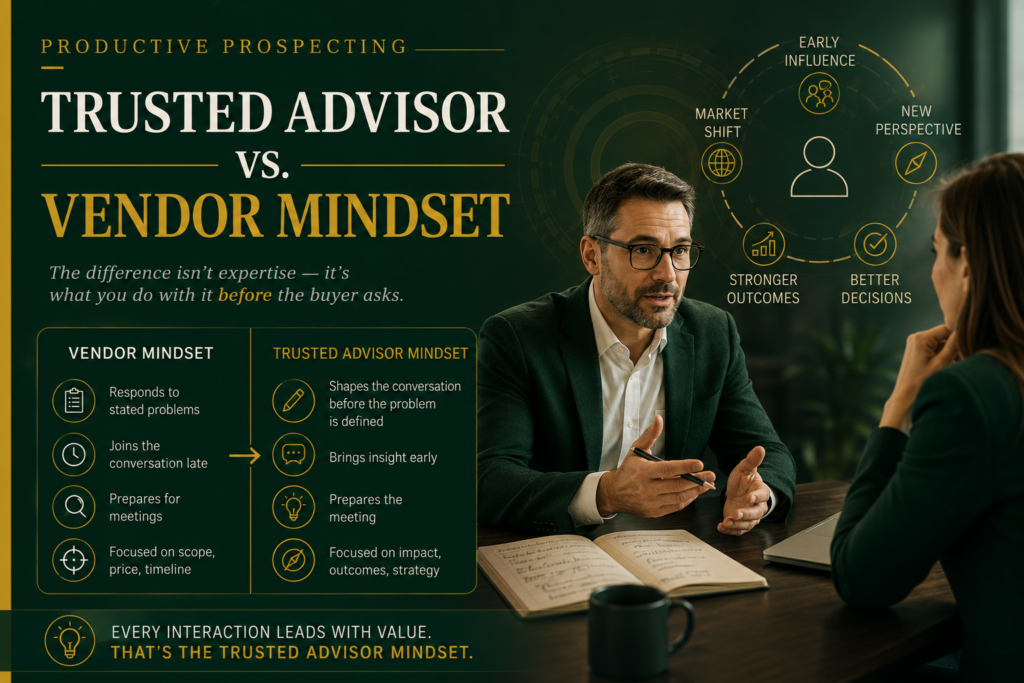
What Vendors Do. What Trusted Advisors Do Instead.
Vendors respond to stated problems. A client comes with a defined need, a scope, a budget, a timeline. The vendor responds to it. They may do brilliant work within that scope. But the scope was already set before they arrived.
Trusted advisors show up before the scope is written. They’re in the conversation where the problem gets defined, which means they influence what the problem actually is. They bring something to the table that the buyer didn’t know to ask for — and that changes the entire trajectory of the engagement.
Vendors follow the buyer’s process. They accept the RFP, the timeline, the evaluation criteria, the shortlist structure. They compete within the rules the buyer established.
Trusted advisors help write the rules. Not manipulatively — by being present and valuable early enough that their perspective shapes how the buyer thinks about the decision.
Vendors prepare for meetings. Trusted advisors prepare the meeting. They arrive with something worth the hour — an observation, a market shift, a connection between what the client is experiencing and what they’ve seen work elsewhere. The meeting is valuable because of what they brought, not just because of what the client asked.
The behavioral difference isn’t expertise. It’s timing and intentionality.
Every Interaction Leads With Value
Here’s the discipline that separates trusted advisors from everyone else:
They never show up empty-handed.
Not in a transactional way — not a gift or a gimmick or a forwarded article to stay top of mind. A genuine, specific, relevant piece of value that demonstrates they were thinking about this person’s world when nobody asked them to.
A market shift that changes the context for a decision the client is navigating. An introduction to someone who solves a problem the client mentioned three months ago. A perspective on something the client is about to encounter that they don’t know is coming yet.
This is what “levery touchpoint leads with value” actually means in practice. It’s not a communication philosophy. It’s a discipline of preparation — of knowing your clients’ worlds well enough that you always have something worth bringing.
And it’s what makes a client stop thinking of you as a service provider and start thinking of you as a resource they can’t afford not to have access to.
The Brilliant Vendor in the Room
Back to my conversation last week.
Here’s what made it striking: this person had everything he needed to be extraordinary in his market. The knowledge, the relationships, the credibility. His network alone — if deployed with intention — could have put him upstream of deal flow he was currently chasing from downstream.
But the habit of accepting the process — of showing up after the stated need, of keeping conversations job-specific, of treating a potential strategic partnership as a lunch to see if there’s a fit — was so ingrained that he couldn’t see the alternative.
He wasn’t failing. He was doing what everyone in his industry does. Competing hard in a hard-bid situation and hoping the quality of his work carried him through.
The professionals who break out of that pattern don’t do it by working harder within the process. They do it by refusing to accept the process as fixed.
The question isn’t whether you’re good at what you do. It’s whether the people who need what you do know it before they’ve already chosen someone else.
Productive Prospecting: The Live Masterclass — June 9th
This is the behavior we’re building on June 9th.
Not the concept of being a trusted advisor — the actual system that makes it repeatable. How to structure your relationships so you’re upstream of the conversations that matter. How to design every interaction so it leads with value, not availability. How to move from being someone clients call when they have a problem to being someone they call before the problem is named.
Free. Live. One working session. You’ll leave with and understanding of what influence really IS, not just the intention of influence.
REGISTER FOR JUNE 9 — PRODUCTIVE PROSPECTING MASTERCLASS — [LINK]
If you’ve been waiting for the thing I said was coming — this is it.
And if you’re in construction, trades, or know a GC or contractor in your network — there’s a companion event on June 4th with Dan Stalp of Sandler Training built specifically for the trades. The same trusted advisor conversation, applied to how construction business actually gets won.
CONTRACTOR SALES MASTERCLASS WITH DAN STALP — JUNE 4 — [LINK]
Forward this to the best contractor you know. The seat is free.
The gap between a vendor and a trusted advisor isn’t expertise. It’s what you do with that expertise before anyone asks you to.
To your influence, Breandan