
You had the meeting. It went well. They nodded in the right places, asked about timing, and said “send me something.” You sent it. Then nothing happened. No yes, no no, and no reply.
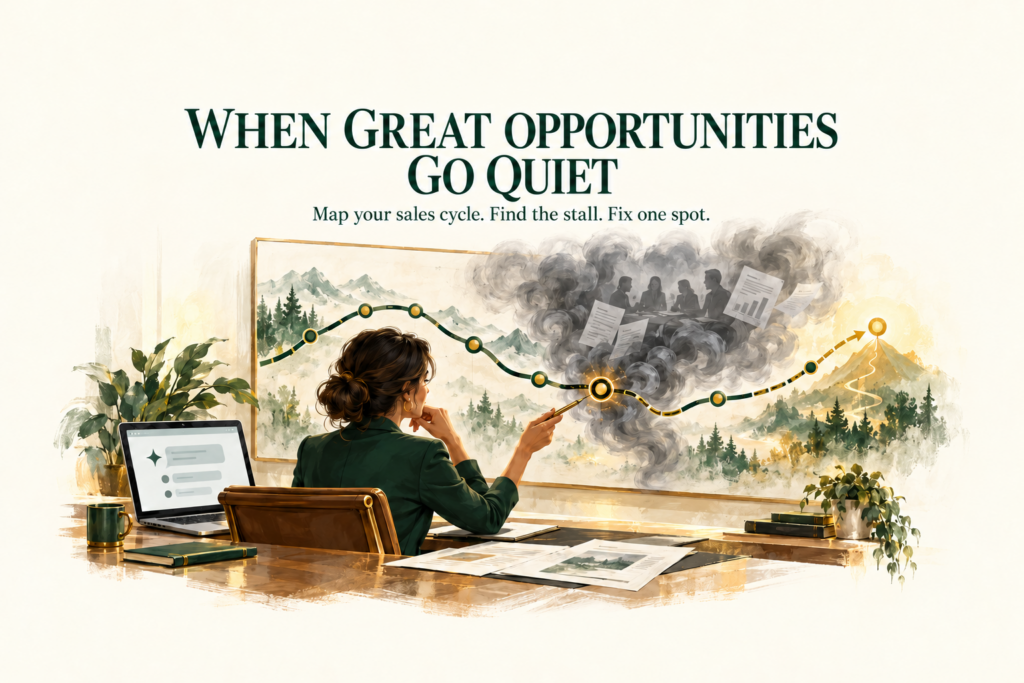
That opportunity is still in your pipeline, still looking like fire. It’s smoke.
If this has happened more than once this year, the problem probably isn’t the prospects. Today’s buyers behave differently than the ones your sales process was built for, and your process needs a fresh look.
Buyers ghost early, and they come back later
Silence used to mean no. Now it often means “not yet.” A priority shifted, a budget cycle hasn’t opened, or they simply aren’t ready to decide. A silent evaluation costs them nothing, and an awkward “no” costs them something.
The buyers who vanish in March often resurface in September, but only if you stayed present in the meantime. If you treated the silence as a rejection and dropped them, they’ll hire the person who didn’t.
Professionals tend to be worse at this than salespeople. Salespeople at least have a cadence they’re held to. Most of us have a good conversation, send a proposal, wait politely, and move on.
Three touches versus twelve
Most buyers hear from us about three times, if they’re lucky. But business typically happens after twelve or more interactions with you. That means many prospects drop out of the process nine touches before they were ready to buy. They didn’t reject you. You just weren’t there.
Closing that gap is not a nice-to-have. It’s an adjustment your marketing needs, because those missing touches are where trust gets built. Each one should lead with value: an insight, an introduction, a resource, something that earns the next conversation rather than just asking for it.
Finding pain isn’t enough
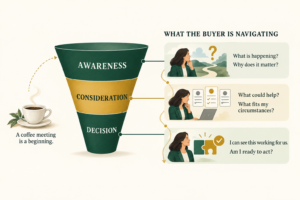
We were all trained to find the pain. That still matters, but it only gets you halfway. The buyer also has to see themselves in your solution. They need to picture the result they want and understand how your process gets them there. If they can describe the problem but can’t picture life after working with you, they’ll stay with the problem they know.
The committee you can’t see
You used to look for the CEO or the owner, win that person over, and the deal moved. Now the decision maker may not even be in the room. You’re facing a committee, and some of its members you’ll never meet.
One of them might be an end user who reads your proposal and raises a concern about implementation. Nobody wants a failure on their watch. So rather than argue the point, the committee does the safest thing available: nothing.
The deal doesn’t get rejected. It just …stops…
How to find where your buyers stall, using Claude
You don’t need software or a CRM export. You need your recent deal history and about an hour. Claude is useful here because it’s patient with messy notes, it spots patterns across them, and it won’t protect your feelings about your own process.
Step 1: List your stalled deals. Gather 10 to 12 recent opportunities, including some you won and at least four that went quiet for 30 days or more. For each, jot down how it started, what happened at each stage, how many times you interacted, the last thing the buyer said or did, and who else you know was involved. Rough notes are fine.
Step 2: Map the cycle you actually run. Paste your notes into Claude and ask:
“Based only on what actually happened, map the stages my sales cycle really follows from first contact to signed work. For each stage, tell me what usually triggers movement and how long deals spend there.”
The cycle you describe and the cycle you run are rarely the same. Expect a stage you never named, something like “proposal goes out and I wait.”
Step 3: Find where deals stop.
Ask:
“Where did the stalled deals stop moving? What did they have in common before they stalled that the won deals didn’t? Separate patterns that repeat from things that happened once.”
Look for clusters. Most people find their stalls bunch up at one or two stages, often right after the first meeting or right after the proposal.
Step 4: Test each stalled deal against how buyers behave now. Ask Claude to score every stalled deal on four questions:
- The touch gap: How many meaningful interactions did this buyer have with me, and how many gave them something of value?
- The committee: Did I know everyone who would weigh in, including the people who would use or implement this?
- The outcome: Could the buyer describe the result they wanted and how my process would get them there?
- The next step: Was there one on the calendar that the buyer agreed to?
Step 5: Score your live pipeline. Run the same test on every opportunity you currently count on and rank them from most likely moving to most likely smoke. Some of what you’ve been counting on is fire. Some is smoke. Knowing which is worth more than a bigger pipeline full of false hope.
Don’t overhaul everything
Resist the urge to rebuild your whole process. Pick the one spot where buyers stall most often and go to work there.
If deals die after the first meeting, maybe you start asking before you leave, “Who else will weigh in on this, and should we include them next time?” If they die after the proposal, maybe you add a short implementation overview that answers the end user’s concern before it’s raised. Make one adjustment, run it for three or four weeks, and look again. Keep adjusting until opportunities are moving.
Take the Friction Finder with you
Claude helps you see the pattern in your own deals. To make the exercise easier to run, I built a nine-page worksheet called the Friction Finder. It follows the same path as this post, with room to write it all down:
- Stalled Deal Audit for your top five quiet opportunities
- Touch Gap tracker that shows how far each deal is from twelve interactions
- Friction Checklist covering process, committee, outcome, trust, timing, overwhelm, and silence
- Committee Map to find the people who could say no without ever meeting you
- Outcome Vision Test to see whether buyers can picture themselves in your solution
- Stage Stall Map to pinpoint the one spot where your cycle breaks
- Client interview questions, including “What almost made you walk away?”
- Value-first plays to revive deals that went quiet
- Fix One Spot plan with a four-week scorecard
Use it alongside the Claude walkthrough or on its own. Either way, you’ll know where your pipeline is breaking down and what to adjust first.
Download the Friction Finder here: [DOWNLOAD LINK]
And if you want a second set of eyes on your results, grab a time on my calendar: [CALENDAR LINK]