

The Conversation That Changes the Trajectory of a Practice
I bet you’ve been here before
You know the conversation.
You turn to your spouse at 5:45pm and ask what they want for dinner.
They say they don’t know, what do you want?
You make a suggestion. They’re not feeling it. You make another. Also no. You land on something neither of you really wanted and spend the next 45 minutes mildly disappointed, wondering why a simple question is this hard.
Nobody was being difficult. Everyone was hungry. The problem wasn’t the options.
It was that nobody wanted to make the wrong call.
Your ideal client is having the exact same conversation inside their company every single day. And if you don’t understand that — really understand it — nothing else in your business development approach is going to work the way it used to.
What Changed — And Why Nobody Wants to Say It Out Loud
The pandemic didn’t just disrupt supply chains and office buildings. It fundamentally rewired how buyers make decisions.
The default used to be cautious optimism. The default now is skepticism.
Not of you specifically — of everything. Institutions, experts, markets, advice, promises. The buyer who sits across from you has been burned, misled, overwhelmed, and exhausted in ways that didn’t exist five years ago. And then world events compound it — economic instability, political noise, a relentless cycle of urgency that makes every priority feel temporary and every decision feel riskier than it should.
Every day is another Episode of Catastrophe Bingo, 2026 Edition.
The professional still running a 2019 playbook into a 2026 buyer is not failing because they aren’t good enough. They’re failing because the environment changed and the approach didn’t.
The Three Realities of Your Buyer Right Now
Understanding what’s actually happening on the other side of the table changes everything about how you show up.
They are distrustful. Not of you specifically — of everything. The follow-up sequence, the nurture campaign, the perfectly crafted proposal — all of it lands in a context where the buyer’s guard is already up. You are not the problem. You are arriving after a long list of disappointments they didn’t ask for.
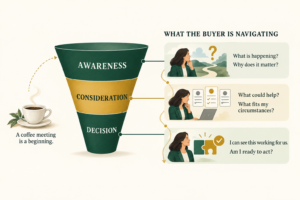
They cannot determine their priorities. When everything feels urgent and unstable, nothing gets prioritized. Your buyer is not avoiding a decision about you — they’re avoiding decisions about everything. You are competing not just with your peers but with your buyer’s own paralysis.
They are overwhelmed by choices. The explosion of fractional, consulting, coaching, and advisory services post-2020 means your buyer has more options than they can process. More options don’t create confidence — they create paralysis. The professional who gets hired is rarely the one who presents the most compelling case. It’s the one who creates the most clarity and confidence that they were the right answer for their most pressing challenges.
They Know They’re Hungry. They’re Afraid to Order.
Here’s what’s actually happening inside the companies you’re trying to reach.
The leaders sitting across from you know something needs to change. The business is telling them — through inconsistent revenue, through team friction, through a pipeline that feels like a coin flip, through a facility that’s showing its age, through a team that’s stretched past what’s sustainable.
They are hungry. They know it.
But they’ve watched enough wrong moves play out around them. Made enough decisions that didn’t land the way they expected. Lived through enough instability to know that moving in the wrong direction doesn’t just disappoint you.
It costs you. Publicly. In front of the people who are watching.
So they wait. They ask around. They collect more information. They open another browser tab. They schedule a discovery call and then reschedule it. They tell themselves they’ll decide next quarter when things settle down.
Things don’t settle down.
And meanwhile you’re trying to reach them with a follow-up sequence.
What Stopped Working — And Why
More outreach asks an overwhelmed person to do one more thing.
More content adds to a noise level that is already deafening.
More follow-up signals persistence to you and pressure to them.
The coffee meeting that used to feel like connection now often feels transactional — because everyone’s guard is up and small talk doesn’t cut through the weight people are carrying.
Visibility without trust is just more noise in an already noisy world.
The 2019 playbook assumed a buyer who was open, optimistic, and ready to move. That buyer still exists — but they’re harder to find, slower to decide, and far less willing to take a risk on someone they don’t already trust.
The Conversation That Actually Cuts Through
What cuts through distrust is not a better pitch. It’s a better question.
What cuts through overwhelm is not more options. It’s clarity.
What cuts through paralysis is not more pressure. It’s someone who helps the buyer — or the professional — see their situation more clearly than they can on their own.
The conversation that changes the trajectory of a practice is not a sales conversation. It’s a clarity conversation.
It starts with someone who isn’t invested in your current story — who can hear what you’re saying and also what you’re not saying. Who asks the questions nobody else is asking: Where is your pipeline actually coming from? What would your referral partner say if someone asked them to describe what you do? What’s the one thing you keep meaning to fix that would change everything?
That kind of conversation doesn’t add to the noise.
It cuts through it. And in this environment, clarity is the scarcest resource your buyer has.
What the Right Conversation Produces
A clear, honest picture of where your practice actually stands — not where you hope it stands.
The one or two specific things that, seen clearly and acted on, shift everything. A positioning sentence that finally travels. A referral relationship that gets activated instead of left warm to eventually grow cold. A meeting habit that becomes non-negotiable instead of aspirational. A service relationship that becomes a referral source instead of a transaction.
These are not complicated. They are specific.
And specificity is what the overwhelmed buyer — and the overwhelmed professional — desperately needs right now.
The professionals who got there fastest didn’t work harder. They got clear sooner. In a room with the right people asking the right questions.
Something Is Coming
In a world where your buyer is overwhelmed, distrustful, and paralyzed by choice — the professional who creates clarity wins. Every time.
The conversation that changes the trajectory of your practice is not accidental. It’s designed. And it doesn’t happen in a blog post or a follow-up email.
It happens in a room — live, specific, and built for the environment we’re all actually operating in right now.
I’m building that room. More next week.
To your influence,
Breandan