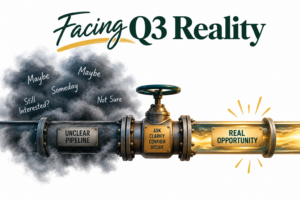

This week a client told me, “I am meeting people, but they aren’t closing, and what I do is so specialized, the timing has to be just right for them to engage.”
Sound familiar?
If you’re a fractional executive or independent professional, I’d bet it does. The conversations go well. The interest feels real. Then the opportunity goes quiet, and you’re left guessing: send another note, keep waiting, or let it go?
I’ve been talking about what’s changing in how buyers behave. They ghost early, decisions get made by committees you never meet, and deals stop without anyone saying no. You may be asking the obvious question: what do I do about it?
The answer is pretty straightforward. Give them what they need.
That means treating prospects the way they want and need to be treated, not the way your calendar or your nerves would prefer.
You’ve been expecting a microwave
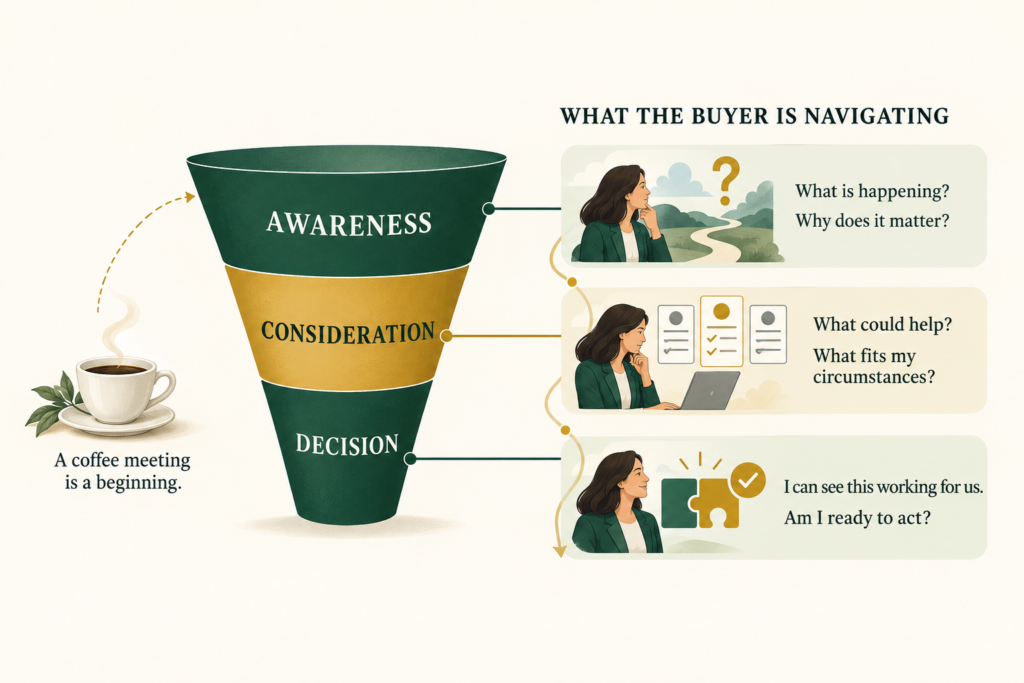
Most fractionals and other professionals completely forget that the middle of the funnel exists. We expect a microwave setting on our sales funnel: meet, pitch, close, done in ninety seconds.
Real buying doesn’t work that way.
The top of the funnel is where awareness happens. They learn about you. Even if someone with influence referred you, they probably still have questions. Or maybe it isn’t about you at all. You likely don’t know what’s happening inside their business or their life. They may have several things pulling on their time and money and simply not have the bandwidth to take on one more thing right now.
That isn’t rejection. That’s timing. And when your work is specialized, timing matters even more.
The middle is where consideration happens
The middle of the funnel is where you uncover obstacles and go to work with the prospect, designing their ideal solution. Notice the word with. You aren’t handing them the answer. You’re designing alongside them, so they understand your thought process and your approach, and begin to see themselves inside your solution.
That happens through the questions you ask and the discovery you lead. It isn’t showing up and throwing up everything you know in the first meeting and hoping something sticks. A data dump makes you feel prepared. It makes the buyer feel overwhelmed, and an overwhelmed buyer does the safest thing available: nothing.
Good discovery sounds more like this:
- “What’s pulling on your time and budget right now?”
- “What would need to be true for this to become a priority?”
- “Who else would feel the impact of this, and what would they want to see?”
- “When this is working well, what’s different for you?”
Those questions do two jobs. They tell you what the buyer needs, and they help the buyer picture the outcome.
Follow-up is part of discovery
Most buyers hear from us about three times, if they’re lucky. Business typically happens after twelve or more interactions. That gap isn’t about being pushy. It’s about staying useful until their timing arrives.
Every touch should lead with value: an insight tied to something they told you, an introduction to someone helpful, a resource that speaks to a concern they raised, an answer to an objection before it comes up again. If your message only asks for something, it doesn’t count.
There’s also a committee behind the person you’re talking to. When someone brings in a fractional executive, the CEO may be sold, while the CFO wonders about scope and the team wonders what changes for them. Nobody wants a failure on their watch. So the deal doesn’t get rejected. It just …stops…
Your follow-up has to serve the people you haven’t met, too.
How to find where yours stall, using Claude
You don’t need software or a CRM export. You need your recent conversations and about an hour. Claude is useful here because it’s patient with messy notes, it spots patterns, and it won’t protect your feelings about your own process.
Step 1: Gather 10 to 12 recent conversations. Include a few that became clients and at least four that went quiet. For each one, jot down what they said they needed, what you sent, how many times you interacted, who else was involved, and what they said about timing.
Step 2: Map the middle. Paste your notes into Claude and ask:
“Based only on what actually happened, map the stages between my first conversation and a signed engagement. For each stage, tell me what moved the buyer forward and how long deals spent there.”
Step 3: Separate “not ready” from “not convinced.” Ask:
“For each stalled opportunity, tell me whether the evidence points to timing and bandwidth, or to an obstacle I never uncovered, such as scope, a stakeholder concern, or an unclear outcome.”
This step matters most for specialized work. A buyer who isn’t ready needs patience and value. A buyer who isn’t convinced needs better discovery. Treating them the same is why so many follow-up plans fail.
Step 4: Build a follow-up plan around what each buyer needs. Ask:
“For each stalled opportunity, suggest six value-first touches over 90 days, based on what the buyer told me about their timing, obstacles, and the people involved.”
Step 5: Fix one spot. Don’t rebuild your whole process. Find the stage where buyers stall most often, make one adjustment, run it for three or four weeks, and look again.
Take the Friction Finder with you
To make this easier, I built a worksheet called the Friction Finder. It follows the same path as this post and gives you room to write it all down:
- A stalled deal audit for your top five quiet opportunities
- A touch gap tracker that shows how far each one is from twelve interactions
- A committee map to find the people who could say no without ever meeting you
- An outcome vision test to see whether buyers can picture themselves in your solution
- Value-first plays to revive deals that went quiet
- A fix-one-spot plan with a four-week scorecard
It works with or without Claude.
Download the Friction Finder here: [DOWNLOAD LINK]
And if you’d like a second set of eyes on what you find, grab a time on my calendar: [CALENDAR LINK]