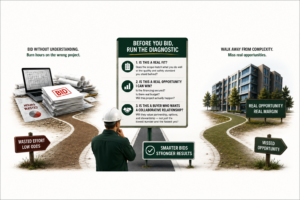


You Submitted 20 Bids Last Month. How Many Did You Win?
It’s the Friday before the Fourth. Your pipeline looks full, your estimating team is heads-down, and somewhere in a stack of submitted bids is the work that’s going to carry you through fall.
That feeling of momentum is real. But before you shut it down for the long weekend, run this number.
Take the last 30 days. Count every bid you submitted. Now count how many you won.
For most contractors, that ratio is somewhere around 10 percent. One win for every ten submissions. Some weeks it’s better. Some months it’s worse. But 10 percent is the industry reality for competitively bid work — and most contractors have accepted it without ever asking what that number is actually costing them.
Here’s the math nobody runs.
A competitive bid takes somewhere between 8 and 15 hours of real work. Estimating, reviewing specs, pricing materials, formatting the submission. If you have people doing that work at a fully loaded cost of $75 to $100 an hour, you’re spending $600 to $1,500 per bid — before you know whether you have any chance of winning.
Multiply that across 20 bids a month and you’re spending $12,000 to $30,000 to win 2 jobs.
That’s your cost of sale. Most contractors have never written that number down.
Now consider what’s coming.
AI is about to make bid creation nearly frictionless. What takes your estimating team two days will take two hours. That sounds like a productivity win — and it is, right up until every other contractor has the same capability.
When bid creation becomes effortless, buyers don’t get better bids. They get more of them. A lot more. Forty bids where there used to be eight. Submissions that are technically identical because they were built from the same tools and the same templates.
Sound familiar? Look at your LinkedIn feed. Every post about leadership, every “here’s what I learned” article, every piece of content about building a great team — they’re all starting to look the same. Because they’re being written by the same tools.
That’s what your bid stack is about to look like from the buyer’s side.
Here’s what doesn’t change. Hiring managers figured this out years ago. Automated systems now screen thousands of resumes in seconds. The technology is sophisticated. The results are efficient.
And most positions still get filled through someone’s network. Because when the stack gets too tall to read carefully, people trust the relationship over the document.
Buyers of construction services will do exactly the same thing. They’ll use whatever tools help them manage the volume. Then they’ll call the contractor they already know.
The question worth sitting with over the long weekend isn’t how to submit better bids. It’s how to be the contractor they already know — before the bid ever goes out.
That’s a different kind of productivity. And it’s worth thinking about before the end of summer.
More on this in the coming months. If this landed for you, forward it to someone who needs to hear it.