

PROFESSIONAL SERVICES | RELATIONSHIP OPERATING SYSTEM
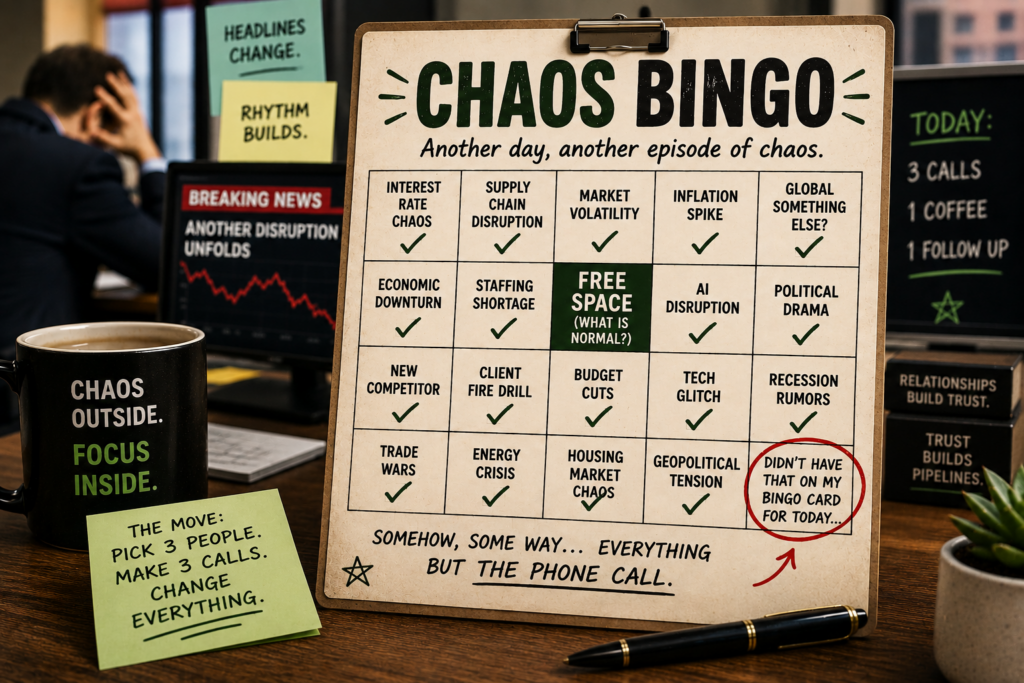
Somewhere in the last few years, we collectively agreed to call constant uncertainty “the new normal.”
A strange economy. Interest rates that should have slowed things down and somehow didn’t. Supply chains that broke and then just… stayed broken, quietly, as a permanent condition rather than a crisis. Markets that are strong in some places and brutal in others, often within the same zip code.
It’s a lot. And if you’ve noticed a low hum of numbness underneath your own business development lately — you’re not imagining it, and you’re not alone in it.
There’s a real psychological reason for it. When the unexpected becomes the expected — when one more disruption stops registering as a disruption and starts registering as Tuesday — the nervous system stops mobilizing the way it used to. That’s not laziness. That’s not lack of discipline. That’s a protective response to absorbing too much “and now this too” for too long.
The danger isn’t the chaos itself. It’s what the chaos quietly gives us permission to stop doing.
The Big Swing and the Quiet Follow-Through
Here’s a pattern I’ve watched play out — in myself, and in nearly every professional I’ve coached through a stretch like this.
When the rhythm breaks, we don’t usually stop working. We just start working differently. We trade the slow, steady, unglamorous activity — the one-on-one conversation, the follow-up call, the quiet cultivation of a referral relationship — for the bigger swing. The event. The launch. The big push that produces a visible result fast.
And sometimes the big swing pays off. It feels good when it does — there’s a real dopamine hit in a big win, a full room, a great connection made in public. That feeling is real, and it’s seductive, because it’s fast.
But the big swing was never supposed to replace the smaller thing. It was supposed to supplement it.
The fractionals — and frankly the agencies, the consultants, the advisors of every kind — who keep their pipeline steady through periods like this aren’t the ones swinging hardest for the big win. They’re the ones who kept making the calls. Who kept the quiet 1-1 conversations going even when nothing about the week made them feel urgent or exciting.
Consistency doesn’t get a dopamine hit. That’s exactly why it’s the first thing chaos talks us out of.
It’s Not Harder. It Just Feels Harder.
Here’s the part worth sitting with honestly: the actual mechanics of business development haven’t gotten harder. People still buy from people they trust. Referrals still happen the same way they always have — through repeated, genuine contact over time. The math hasn’t changed.
What’s changed is our tolerance for the quiet, patient, low-stimulation work that builds it.
I’m working right now with people who are finding consistent success in this exact environment — the same uncertain economy, the same noisy headlines, the same collective exhaustion everyone else is operating inside of. The difference isn’t that the chaos doesn’t touch them. It’s that they didn’t let the chaos talk them out of their rhythm.
And once you’re in rhythm, it’s genuinely not as hard as it feels from the outside of it. The hardest part is always the restart.
The Smallest Possible Next Step
If any of this is landing because you’ve felt your own version of it — here’s the antidote, and it isn’t a system overhaul.
It’s a list and a phone.
Pull up the people in your world you haven’t had a real conversation with in 30, 60, 90 days. Not a LinkedIn comment. Not a “thinking of you” text. An actual conversation. Pick three. Call them today.
That’s it. That’s the whole move. Apathy doesn’t get broken by motivation — it gets broken by one small, completed action that proves to you the rhythm is still there, waiting to be picked back up.
If You’re Ready to Build the Structure That Holds the Rhythm
This is exactly the gap Trust Lab is built to close — not more hustle, not another big swing, but a referral architecture and a cadence that keeps the quiet, compounding work happening even when the world is loud and uncertain and giving you every excuse to skip it.
The next cohort opens Monday. If you’ve been circling this decision, this is the week it gets made one way or the other.
→ Book a strategy session: [BOOKING LINK]
→ Trust Lab — opens Tuesday: [TRUST LAB LINK]
To your influence, Breandan