
FRACTIONAL EXECUTIVE SERIES | PRODUCTIVE PROSPECTING
My business partner Mark said something to me once that completely shifted how I think about selling professional services.
“You have to do something for at least a year for people to know you’re serious about it.”
I sat with that for a minute.
Then I asked the obvious question.
What’s magical about a year?
Mark — who is usually right about these things, though I don’t tell him that nearly as often as I should — walked me through the math.
How often does your network actually see you? Not how often you think they see you. How often they actually encounter you — in a coffee meeting, a LinkedIn post, a phone call, an event, a referral conversation, a resource you sent that solved a problem for one of their clients.
Map it out honestly.
If you grab coffee every six months — that’s two interactions a year.
If you post occasionally — the algorithm surfaces you to your network a handful of times if you’re lucky.
If you follow up when you remember — some people hear from you. Most don’t. Rarely at the moment it matters.
Add it up.
Now compare it to this:
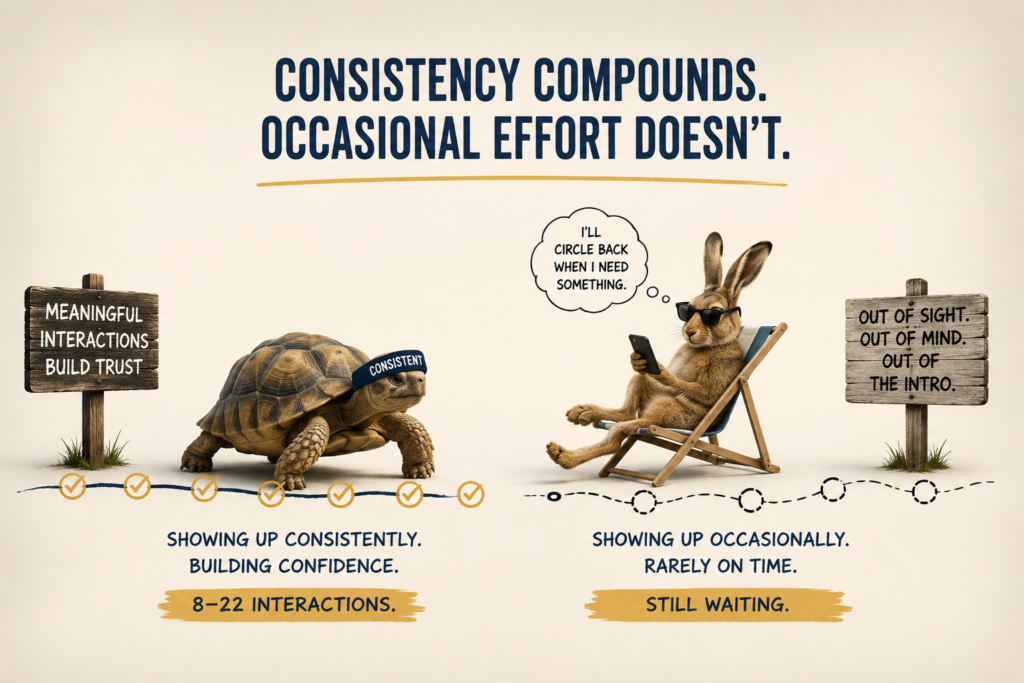
Research on B2B buying behavior consistently shows that it takes somewhere between 8 and 22 meaningful interactions before someone has enough confidence in you to refer you to their most important relationships.
Eight to twenty-two.
At the frequency most fractionals show up — how long does it actually take to accumulate that many interactions with the people who matter most to their practice?
Do the math.
The year isn’t magical.
It’s just how long it takes when you’re showing up occasionally.
Why the Fractional Space Makes This Even Harder
Mark made another observation that landed just as hard.
Too many fractionals do this work until someone offers them a real job.
And the people in their network know it.
They’ve made the introduction. They vouched for someone. They put their reputation on the line for a fractional who — three months later — took a full-time role and left their client hanging.
Not out of malice. Out of uncertainty. Out of the quiet anxiety of inconsistent pipeline that makes a steady paycheck feel like relief rather than retreat.
But the person who made the introduction absorbed the damage.
Their client felt abandoned. Their judgment got questioned. The relationship they’d spent years building took a hit because they bet on someone who wasn’t fully committed.
That experience doesn’t disappear. It becomes a filter.
Before your network refers you to anyone they genuinely care about — they need to be confident you’re in this. Not just available. Not just talented. Committed. In the way that makes an introduction feel like a gift rather than a gamble.
And here’s the thing about that confidence:
It can’t be declared. It can only be demonstrated.
Through consistent presence. Through showing up when there’s nothing immediate in it for you. Through being genuinely invested in their world long before anyone needs anything.
Month after month.
Until the evidence is undeniable.
The Math Nobody Does
Let’s make this concrete.
Your network needs 8 to 22 meaningful interactions to reach the confidence threshold that produces a genuine referral.
Now look at how often the average fractional shows up in their referral partner’s world:
| A coffee meeting every six months — 2 interactions per year. A LinkedIn post that reaches them once a month if the algorithm cooperates — 12 interactions per year, most of which register as background noise rather than meaningful contact. A follow-up call when the pipeline gets light — 3 or 4 times a year, always when you need something. A resource or introduction when you happen to think of it — maybe 2 or 3 times a year. |
Total meaningful interactions with your most important referral partner in a given year: somewhere between 8 and 15. If you’re doing well.
Which means the fractional who is doing everything right — occasionally — is just barely accumulating enough interactions to reach the confidence threshold with one or two partners.
In a year.
If nothing interrupts the pattern.
Now imagine what consistent looks like.
Four to six protected hours every week. Aimed at the right relationships. With a designed system that creates meaningful touchpoints — not random activity, not pipeline checks dressed up as relationship building, but genuine value delivered at the right moment to the right person.
At that frequency, the math changes entirely.
You’re not waiting a year to reach the confidence threshold.
You’re building toward it in months — with multiple partners simultaneously — because the interactions are accumulating at a pace that occasional effort could never sustain.
The Blinding Flash of the Obvious
Here’s what Mark and I landed on that day.
The reason it feels like it takes a year to build a referral relationship isn’t that people are slow to trust.
It’s that most fractionals are slow to show up.
The year isn’t the timeline for trust to build.
It’s the timeline for enough interactions to accumulate at the pace most fractionals maintain.
Change the pace — protect the time, aim it at the right relationships, bring something genuine every time — and you change the timeline.
The trust builds faster.
The confidence threshold arrives sooner.
The introductions start coming from people who aren’t just willing to refer you — they’re eager to.
Because you’ve given them enough evidence to be certain.
Consistency Isn’t a Discipline Problem. It’s a Math Problem.
Most fractionals who struggle with inconsistent pipeline aren’t doing nothing.
They’re doing something — occasionally.
The LinkedIn post here and there. The networking event once a month. The follow-up when the calendar allows. The referral partner coffee when both schedules cooperate.
All the right activities.
None of the frequency that makes them work.
And here’s the part that’s genuinely uncomfortable:
The relationships that feel like they should be producing referrals by now — the ones you’ve been nurturing for two or three years — may still be stuck below the confidence threshold because the interactions never accumulated fast enough.
You didn’t fail the relationship.
You just didn’t show up often enough for the math to work.
That’s fixable.
It doesn’t require a heroic reinvention of how you operate. It doesn’t require sacrificing your summer or your weekends or the parts of this life you chose fractional to protect.
It requires four to six hours a week — protected, consistent, aimed at the right people with the right things at the right moments — and a system that makes sure those hours produce the interactions that move the people who matter through the trust curve.
Week after week.
Until the math works in your favor.
Eleven Days.
Trust Lab starts July 7th.
This is the last cohort of 2026.
Thirteen weeks of building the system that makes the math work — the referral architecture, the partner cultivation rhythm, the meaningful touchpoint sequence that accumulates interactions at a pace that produces confidence rather than leaving it to chance.
No more random acts of networking, imagine having a purpose to each and every conversation.
Seven seats remaining.
Mark would probably say you’ve known about this long enough to know whether you’re serious.
He’d be right.
| If you want to talk about what the system looks like for your specific practice and whether Trust Lab is the right next step — I’m here. Twenty minutes. No pitch. A real conversation about what consistent actually looks like for where you are. → Book a strategy session: [BOOKING LINK] → Trust Lab — July 7th, last cohort of 2026: [TRUST LAB LINK] |
To your influence, Breandan
Breandan Filbert | Managing Partner, SalezWorks