

I’m going to tell you something we don’t usually say out loud: Freeway to Fractional has not been the revenue driver we thought it would be.
We’ve been deep in rebuilding it this month, and that sentence is the honest starting point for why. Not “we’re excited to announce some updates.” We built a program, ran it, cherished the community it created — and then had to sit with the fact that it wasn’t working the way we designed it to. One of my mentors, Dan Stalp, has a phrase for what that forced us to do: eat our own dog food. Practice on ourselves the same clarity we tell our clients to go find.
So that’s what this year has actually been.
The Fractional Cha-Cha
Here’s a pattern I watch play out constantly with professionals making the leap to fractional work: two steps toward one focus, one step back, a shuffle sideways into something else. This quarter it’s fractional CFO work. Next quarter, ops. Somewhere in there, a detour into “advisory services” because a friend suggested it sounds more premium.
I don’t say this to make fun of anyone — I say it because it’s genuinely hard to build momentum on ground that keeps shifting. If you change what you do every few months, nobody around you can hold a clear picture of it. Not your network, not your past colleagues, not the people who’d otherwise refer you. You can’t get referred for something people can’t describe.
Real fractional work takes the opposite of the cha-cha. It takes staying in one product, market, or focus long enough to actually produce results with it — and long enough to find out honestly whether you even like doing it. Both of those take time. Neither happens by quarter three of constant pivoting.
What 17 Conversations Told Us
While I’ve been sitting with the “why,” Mark’s been doing something more concrete: he sat down with 17 people who went through the original course. Not a survey — real conversations. What they loved. What helped. What they liked but didn’t need. And critically, what they wished had been part of the experience but wasn’t.
A pattern emerged fast, and it wasn’t subtle: people didn’t need “everything about running a fractional business.” They needed to get from a standing start to actual revenue, quickly, without wandering through material that didn’t apply to where they were yet. We’d built a comprehensive program. What 17 people were actually asking for was a fast, clear on-ramp.
That’s the outcome we’ve rebuilt the whole experience around: get a new fractional to revenue quickly. Not soup to nuts. Not everything Mark knows about being a world-class CFO, tempting as that is to cram in. Just what it takes to get off the starting blocks and into the race.
This Isn’t for Everyone, and That’s the Point
Here’s the part that took real clarity to say plainly: this program is not for a bookkeeper to decide they’re ready to be a strategic CFO. It’s not for a sales professional to reach for a VP title because they’ve watched someone else do the job. It’s not for a graphic designer to become a CMO because that’s the title they’ve always pictured for themselves.
I listened to an internet ‘guru’ this week who teaches how to become a ‘YouTube Millionaire’ talk about how with the help of AI you can coach on anything.
And THAT right there is why we have the cynical market we have today.
That might sound harsh. It’s not meant to be — it’s meant to be honest. Fractional work isn’t a chance to become something new with the help of Claude. It’s a chance to repurpose real, already-proven competence into a service that works across a range of clients and situations. If the underlying skill isn’t already there, no course fixes that, and pretending otherwise does nobody any favors — least of all the client who hires someone still figuring out the basics of a role they’ve never actually held.
What the course can do is help someone who’s genuinely good at what they do turn that skill into something productized — consistent, repeatable, sellable — instead of a service that changes shape with every new client and leaves everyone, including the fractional, a little unsure what they’re actually offering.
The Pricing Trap Almost Everyone Falls Into
One thing that came up again and again in Mark’s conversations: pricing. Almost every new fractional makes the same mistake. They take their old salary, divide it by roughly 2,000 working hours a year, and land on a billable rate.
That number has nothing to do with the client’s actual outcome. Nothing to do with what the work enables them to accomplish. Nothing to do with the years it took to build the judgment being hired. It’s just old-employee math wearing a new-business costume, and it quietly locks people into undervaluing themselves before they’ve even started.
What We Actually Discovered About Ourselves
Somewhere in all of this — the honest revenue conversation, Mark’s 17 interviews, redesigning around one clear outcome — we ended up looking hard at our own fractional work, too. Somewhere in the years of building courses, running a community, and coaching other people through this leap, I had quietly let my own fractional practice slide. Not on purpose. Just the natural drift that happens when you’re heads-down building something else.
Eating our own dog food meant admitting that and stepping back in — actually doing the fractional work myself again, not just teaching it. And once I did, the answer was obvious fast: this is what we’re genuinely great at. Mark has always had a strong fractional practice, but returning my own focus to real fractional engagements wasn’t a detour from rebuilding the course. It’s an enhancement.
A Question Worth Sitting With
If any of this landed, here’s the exercise I’d actually sit down and do, the same way we had to:
- Look at the last 12–18 months of your own work. Has it stayed in one product, market, or focus long enough to produce real results and tell you honestly whether you like doing it — or has it been the cha-cha?
- Be honest about what you’re repurposing. Is the thing you’re offering as “fractional” built on competence you’ve already proven, or a title you’re hoping to grow into on someone else’s dime?
- Look at how you priced your last engagement. Did that number come from old salary math — divided by 2,000 hours — or from the actual impact you created?
You should be able to answer all three in under five minutes. Most people also haven’t ever sat down to ask them.
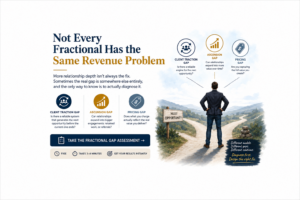
If you actually do this exercise, hit reply and tell us where you landed. We’ll read every single one, and if something in your answers points to a real gap — in focus, in positioning, in pricing — we’ll tell you directly what we see. No pitch, no funnel. Just the same honesty we had to give ourselves this month.