
Call him John. Not his real name, but the situation is real, and it’s more common than you’d think.
John supports businesses preparing for a transition. He gets them profitable, builds real enterprise value, and helps ownership understand everything that could affect a future sale. He’s genuinely excellent at this. Clients trust him with one of the most consequential moments in their business’s life.
Here’s the thing about that work, though: it has a shelf life built into it by design. The whole point of the engagement is to get the business ready for a transaction and then move on. When the transition happens, the engagement is, by definition, over. That’s not a flaw in how John runs his practice. That’s what the work actually is.
Why “Just Build Deeper Relationships” Doesn’t Fix This
The standard advice for inconsistent revenue is usually some version of: build deeper relationships, expand the engagement, increase what each client is worth to you over time. And for a lot of fractionals, that’s exactly the right fix.
For John, it’s more complicated. To meaningfully increase what a single client relationship is worth to him, he’d need to either get involved earlier, doing work further from what he’s actually great at and loves doing, or expand into supporting needs beyond his core expertise, diluting the focus that makes him valuable in the first place. Both of those come with real costs. His available share of a client’s wallet is naturally capped by the nature of the work itself, not by a lack of effort or relationship-building on his part.
Trying to force an ascension model onto a practice like John’s isn’t the fix. It’s solving for the wrong gap.
The Gap That Actually Matters for a Practice Like His
For John, the real issue isn’t what happens within a single client relationship. It’s what happens between them.
Every engagement has a natural, predictable endpoint. That’s fine, and even by design. What’s not fine is if there’s no reliable system generating the next opportunity by the time the current one closes. Without that, every closed engagement creates a gap in cash flow, not because the work wasn’t valuable, but because nothing was lined up to follow it.
For a practice shaped like John’s, the missing piece is almost always client traction: a consistent, repeatable engine that reliably produces the next opportunity, timed closely enough to the current engagement’s end that revenue doesn’t collapse in the space between them.
This doesn’t mean John has to change what he does. It means the traction engine has to be designed into how he delivers the work, not left to chance. A natural point in every engagement where he asks which other business owners in the client’s network might be a few years out from the same transition. A milestone built into the process where a referral conversation makes sense, not as an afterthought, but as part of the delivery itself. None of that changes the work John loves doing. It just stops leaving what happens next up to luck.
These Gaps Aren’t Discovered. They’re Designed, or They’re Not.
Here’s the deeper point underneath all of this: nobody sets out to build a practice that resets to zero every time, or one that never captures the full value it creates. Nobody decides on purpose to leave revenue inconsistent. It happens by default, because the service delivery itself was designed to do one thing well: deliver the current engagement. Nothing about the design accounted for what comes after.
That’s the real distinction between a practice with a gap and one without one. It’s not talent, and it’s usually not effort. It’s whether the next step, whatever that looks like for your specific business model, was actually built into how the work gets delivered, or whether it was left to hope.
Ascension isn’t something that happens because a client likes you enough. It happens because the engagement was designed with a visible next step built in. Pricing that captures real value doesn’t happen by accident either. It requires the delivery model to actually track and demonstrate the value created, not just the hours spent. Client traction doesn’t happen because you’re due for some good luck. It happens because something in how you work was built to produce the next opportunity on a schedule, not a prayer.
None of these gaps are really about what you’re missing. They’re about what was never designed on purpose.
This Is Exactly Why the Gap Has to Be Diagnosed, Not Assumed
The point of John’s story isn’t that ascension is a bad idea, or that client traction is the universal answer either. It’s that what needs to be designed depends entirely on what your business model actually supports, and guessing wrong means spending real time and energy designing for a gap you don’t actually have.
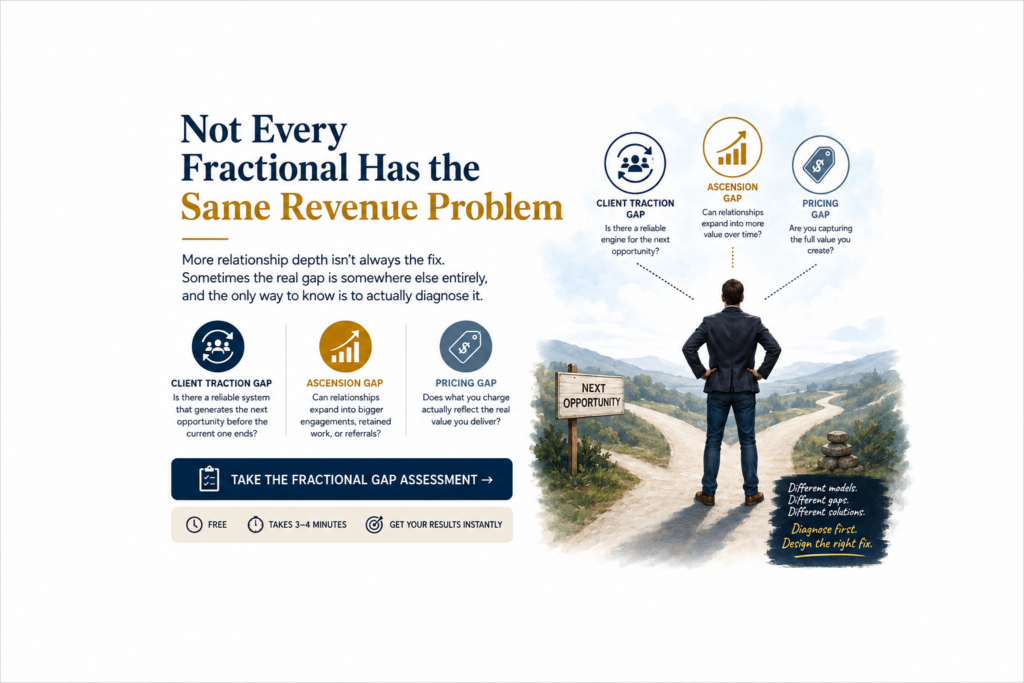
In the work we’ve done across dozens of fractional practices, the missing piece of design almost always lands in one of three places:
Client traction. Whether there’s an actual repeatable system generating consistent opportunities, timed to keep revenue steady between engagements, or whether every new client happens because of luck, timing, or a referral that fell into place.
The ascension gap. In practices where relationships can genuinely expand over time, whether they actually do — into bigger engagements, retained work, or referrals — or whether every engagement resets to zero even though the work itself would support something more.
Pricing and value capture. Whether what you charge actually reflects the value you deliver, or whether you’re pricing based on time and effort while the client walks away with outcomes worth significantly more than what you billed for.
A Free Way to Find Out What’s Missing From Your Design
This is exactly why we built the Fractional Gap Assessment. It’s free, it takes about 3-4 minutes, and instead of leaving you to guess, or apply generic advice that might not even fit your business model, it tells you directly which piece of design is missing from how you deliver your work.
If you’ve been doing genuinely good work and still can’t explain why revenue never quite feels consistent, this is worth four minutes of your time.
[Take the Fractional Gap Assessment →]
The fix isn’t the same for everyone, because the design that’s missing isn’t the same for everyone. Finding out which one is actually yours is the part most fractionals never get around to.