
CONTRACTOR BUSINESS DEVELOPMENT | BEYOND THE BID
A fractional executive told me something this week that stopped me cold.
He’s been struggling to find new clients. His strategy: scan LinkedIn for companies posting about growth, watching for businesses hiring employees, looking for signals that an organization might need fractional leadership support.
Smart, right?
Except by the time a company is posting those signals — the decision about which path they’re taking is already made. The fractional conversation they might have had is already behind them. The window where his influence was most available closed weeks ago.
He doesn’t have a prospecting problem.
He has a timing problem.
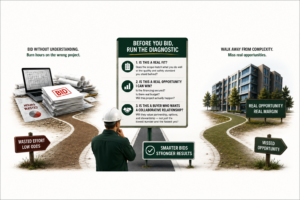
And if you’re a contractor waiting for the bid invitation to arrive before you start building a relationship — so do you.
The Bid Invitation Isn’t the Beginning. It’s the End.
Here’s what most contractors believe about how projects are won:
A bid invitation arrives. You submit a strong proposal. You sharpen your pencil. The best price wins — or if you’re lucky, the best relationship does.
That’s not wrong. It’s just describing the last ten percent of the process.
By the time the bid invitation exists — the scope is written, the budget is set, the mental shortlist is forming, and the decisions that actually determined the outcome were made in conversations you weren’t part of.
The negotiated work — the projects that never go out to bid, the relationships where price is never the deciding factor, the calls that come before anyone is talking to contractors — that work was won before the bid invitation was ever drafted.
Not at the bid table.
Months before anyone sat down at one.
The Visible Signal Is the Late Signal
Every contractor in your market is watching for the same things.
The RFP that gets published. The project announcement. The facility director who posts about an upcoming renovation. The developer who files a permit.
These signals are visible. They’re also simultaneous — every competitor in your market sees them at exactly the same moment you do, with exactly the same information.
Which is why the only differentiator left by the time the signal appears is price.
The invisible signal is different.
The facility director who just got board approval to explore a capital improvement — before the scope exists. The developer who just acquired a property — before the project is conceived. The business owner whose lease renewal is coming up in eighteen months — before anyone has asked a single contractor for input.
None of these people look like buyers yet.
Every one of them is in the window where your influence is most available — where the relationship you build now becomes the reason the project never goes out to bid.
Why This Feels Overwhelming — And the One Thing That Makes It Not
Getting upstream sounds like being everywhere with everyone before anything is visible.
That’s impossible. Nobody has the bandwidth for it. And contractors who try end up scattered — showing up randomly in conversations that never go anywhere, building relationships with no clear direction, wondering why the strategy isn’t working.
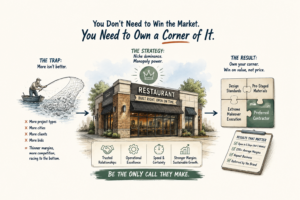
The strategy only works when it’s aimed at one specific profile.
Not “commercial property owners.” Not “facility managers in the healthcare sector.” The exact buyer — vivid, specific, deeply understood.
The one whose world you know cold:
What their tenants or occupants need that they haven’t fully figured out yet. What their capital planning cycle looks like and when the decisions get made. What a delayed project costs them personally — not just financially, but professionally. What they’re reading and researching during the months before they talk to anyone. Who they call when they need a recommendation. What question they’ve been carrying around that nobody in the trades has ever thought to answer.
When you know that profile that specifically — you know where to show up. You know who to cultivate. You know what to bring to the conversation that nobody else is bringing.
That’s not overwhelming. That’s focused.
And it’s the difference between chasing every visible signal in your market and being the contractor who’s already in the room before anyone else knows there is one.
The Strategy Shift in One Sentence
Stop marketing to buyers who are ready.
Start building relationships with the people who see your ideal buyer before they’re ready.
The CRE advisor who knows which properties are changing hands before the announcement. The property manager who hears about capital improvement conversations before the board approves them. The architect who’s in the room when the project is being conceived. The wealth advisor whose client just sold a business and is about to deploy capital into real estate.
These aren’t your clients. They’re your upstream partners — the people whose relationships create natural on-ramps to your exact ideal buyer, before any signal is visible to anyone.
That’s the referral architecture that produces negotiated work.
Not a better bid. Not a lower price. Not a more polished proposal.
The right relationship, at the right moment, before anyone else knew the moment existed.
This is where demand for your unique solution is created.
Where Do You Currently Stand?
If you want to know which part of this game your business is playing right now — the diagnostic takes five minutes and tells you exactly where you are relative to where the negotiated work actually gets won.
→ TAKE THE CONTRACTOR DIAGNOSTIC: [LINK]
When your results raise a conversation worth having — I’m here for it.
→ BOOK A STRATEGY SESSION: [BOOKING LINK]