
CONTRACTOR GROWTH | RELATIONSHIPS
You know him. Maybe you are him.
He’s at every networking breakfast. He’s joined four associations this year. His card is in 300 pockets across the metro. He’s hustling, grinding, showing up — and his pipeline still looks like a coin flip. Some months are great. Some months he’s wondering where the next job is coming from.
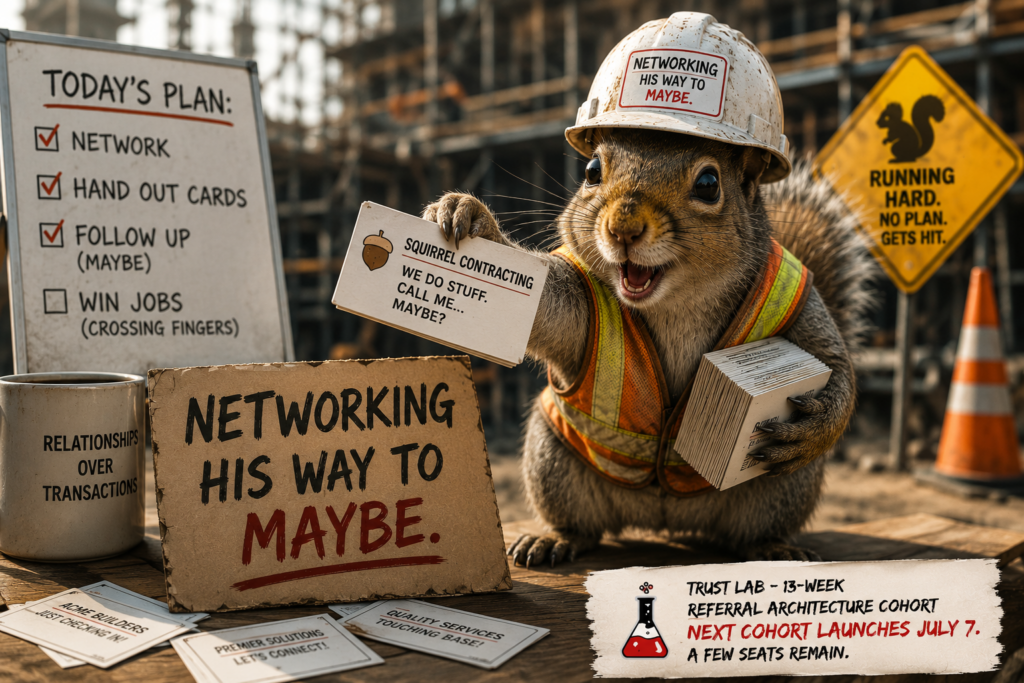
This is what I call the Blind Squirrel Sales Strategy. Keep running long enough and you’ll stir something up – if you don’t get hit by a car first.
It’s not a strategy. It’s hope with business cards.
The Problem With Presence Without Purpose
Contractors are told to network. Show up. Be visible. Get your name out there.
And so they do. They attend. They connect. They follow up with a quick email that says “just checking in” — and nothing happens.
Here’s the hard truth: activity is not the same as strategy. Presence is not the same as relationship. And a business card exchange is not a connection.
Most contractors are transactional by default. Every conversation circles back to scope, rate, and availability. They’re selling before they’ve earned the right to be heard. And the people across the table can feel it.
What Relationship Actually Means
A referral gets you a meeting. Influence gets you a client.
The difference between the two lives entirely in how well you understand the person you’re trying to serve — before you ever talk about what you do.
Relationship isn’t about being likable. It’s about being genuinely useful to someone’s actual life and goals. And that requires you to do something most contractors skip entirely: ask better questions.
Three questions that will change every sales conversation you have:
• What is this person’s why? Not why they need a contractor — why do they do what they do? What gets them out of bed? What does success look like for them in five years?
• What are they being graded on? Whether they’re a property manager, a facilities director, or an owner/developer — there is a performance metric they live and die by. Your job is to find it and help them get an A.
• What does this facility mean to their portfolio? Is it a flagship? A problem property? A long-term hold or a flip? That answer changes everything about how you position your value.
These questions take time to ask and longer to answer. That’s the point. The insight you gain inside those answers is your true value proposition — and no one else is doing this work.
On Time and On Budget Is Not a Differentiator
Every contractor in your market says the same thing: on time, on budget, competitive pricing, quality work, great communication.
So does your competitor. And the guy two counties over who’ll do it for 15% less.
If everyone does it, that’s not a differentiator.
That’s the price of admission. It gets you considered. It does not get you chosen.
What gets you chosen — and re-hired, and referred — is what you bring above the line. The strategic lens. The proactive eye that catches the leaking toilet before it becomes a mold remediation. The quarterly planning conversation where you help a client think through their capital needs for the coming year before they’re in crisis mode.
That’s not maintenance work. That’s advisory work. And advisory work commands advisory relationships — which means fewer bids, shorter sales cycles, and clients who call you first.
The Contractors Who Win Do This Differently
The contractors who have built genuine, predictable pipelines aren’t necessarily the ones working the hardest. They’re the ones who have done the work to understand their clients at a level that makes them irreplaceable.
They show up to annual planning conversations, not just service calls. They know what’s keeping their client’s CFO up at night. They’ve helped a property manager look brilliant in front of their ownership group. They’ve turned a facilities tech’s 40% time-drain problem into a solved one.
That kind of relationship doesn’t come from a networking event. It comes from a deliberate approach to building influence — understanding who you serve, what they need before they ask, and how to position yourself as the partner rather than the vendor.
It takes time to build. But once it’s built, it compounds.
Trust Lab — 13-Week Referral Architecture Cohort Next cohort launches July 7. A few seats remain. This is where contractors stop running and start building a referral engine that works while they do. Reach out to Breandan directly to claim your seat.
To your influence, Breandan
“A referral gets you a meeting. Influence gets you a client.”