

PROFESSIONAL SERVICES | RELATIONSHIP OPERATING SYSTEM
The conversation was everything you hoped it would be.
Genuine connection. Real chemistry. The specific kind of exchange where both people lean in and time moves differently. You left energized — certain this was the beginning of something worth building.
And then life happened.
A client needed something. A deliverable ran long. The follow-up got pushed to Wednesday. Wednesday became next week. Next week became a LinkedIn connection request and a fading memory of what made the conversation feel so significant.
Three months later you’re in another room. You see them across it. You smile. They smile.
You have the same conversation you had before.
Because that’s all either of you has to work with.
The connection was real. The confidence was never built.
And there’s a difference between those two things that most people never fully understand.
Why Most Marketing Misses the Buyer Completely
There’s a reason most professionals struggle to build confidence in new relationships.
Their marketing — and their follow-up — is built on the wrong foundation.
Walk through any professional’s LinkedIn profile. Read their capabilities deck. Look at the follow-up email they send after a first meeting.
Almost all of it answers one question:
Why should you hire me?
Credentials. Accomplishments. Client results. Years of experience. Areas of expertise. Testimonials that sound exactly like every other testimonial in the industry.
All of it technically accurate. All of it professionally presented.
And almost none of it connects with what the buyer actually cares about.
Because the buyer isn’t asking “why should I hire you?”
They’re asking something much more personal than that.
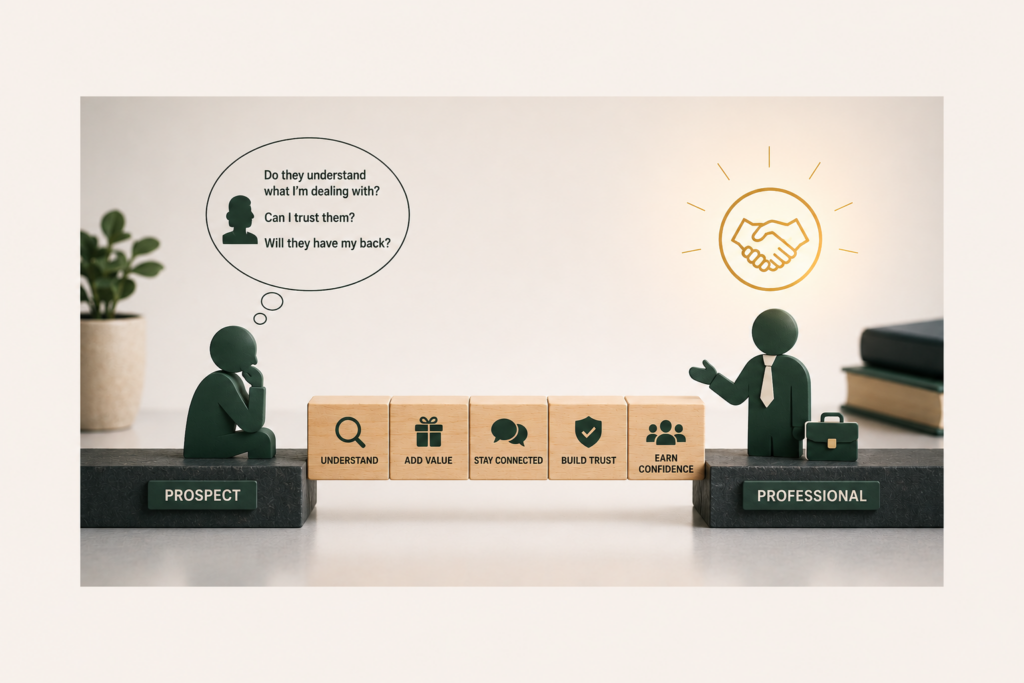
“Do you understand what I’m actually dealing with? Do you see my problem the way I see it? Do you know what keeps me up at night — not the category of problem, but the specific texture of this one, in this business, at this moment?”
That question doesn’t get answered by a credentials list.
It gets answered by demonstrated understanding. By the insight that makes the buyer stop and think — this person has been paying attention. By the specific, relevant, genuinely useful thing you bring to their world that has nothing to do with selling and everything to do with serving.
Most professionals were never taught this.
They were taught to make the case for themselves.
Which is why the follow-up email after a great first meeting reads like a brochure. Why the LinkedIn post sounds like every other LinkedIn post in the industry. Why the coffee invitation three weeks later feels like a pipeline check dressed up as genuine interest.
Not because the professional doesn’t care.
Because they never learned to lead with the buyer’s world instead of their own.
What Your Buyer Is Actually Thinking After the First Conversation
Here’s what nobody tells you about the moment after a great first meeting.
Your buyer left the room with a question they didn’t ask out loud.
Did I just meet someone worth trusting?
Not worth liking. Not worth following on LinkedIn. Worth trusting — with a referral, with a client relationship, with their reputation attached to your name.
That question doesn’t get answered in the room. It gets answered in what happens after.
Most professionals never realize this. They optimize for the conversation — the positioning, the impression, the first meeting performance. They leave the room feeling like the work is done.
It isn’t.
The work is just beginning.
Because your buyer is sitting with their uncertainty right now. Wondering if their instinct about you was right. Waiting — consciously or not — for evidence that the person they met is as genuine as they seemed and as invested in their world as they implied.
Most professionals never provide that evidence.
They disappear into delivery. Into their next event. Into the next right room.
And the buyer’s question goes unanswered.
Which means the relationship goes nowhere.
The Pattern That Kills More Relationships Than Anything Else
A young professional said something to me recently that stopped me cold.
“It was all kind of a blur. Hey Gary. We did business once. Going our separate ways.”
He was describing his relationships before he understood what building them actually required.
A transaction with good manners attached.
That pattern isn’t unique to him. It’s the default for most professionals — not because they don’t care about relationships, but because nobody showed them what the space between conversations is supposed to look like.
The follow-up email that says “great to meet you” and nothing specific.
The LinkedIn connection with no message.
The coffee invitation with no clear purpose that feels like a pitch dressed up as relationship building.
None of these answer the unspoken question.
All of them confirm what the buyer was starting to suspect.
Maybe this is just another transactional relationship.
What Buyers Actually Need to Build Confidence
The professionals who convert great first conversations into great long-term relationships understand something most of their peers don’t.
Buyers need to be onboarded.
Not sold to. Not followed up with. Onboarded — into a genuine experience that answers the question they’re carrying and builds the confidence that makes the relationship real.
What that looks like for a new referral partner:
The first thirty days aren’t about generating introductions. They’re about building the trust that makes introductions feel safe.
A second conversation that goes deeper than the first — not to pitch, to understand. Something brought to their world that has nothing to do with business. An introduction made for them before they’ve made one for you. The moment they realize this isn’t a transaction — it’s a genuine investment in their success.
When that experience exists, introductions don’t feel like favors. They feel like the natural outcome of a relationship that was built to produce them.
What that looks like for a new client:
The first thirty days aren’t just about delivering. They’re about making the client certain they made the right choice.
One unexpected touchpoint that demonstrates you’ve been thinking about their situation beyond what was in the scope. A question that shows you understand their world at a level that surprises them. A moment that makes them think — I didn’t just hire a professional. I found a partner.
That moment doesn’t happen by accident.
It happens because someone designed the experience that created it.
The Question That Reveals Whether You Have This
Think about the last three relationships that started with real promise and quietly faded.
Not the ones that ended badly. The ones that just stalled. The conversations that felt significant and then somehow never became anything.
What did you do in the first thirty days after the initial conversation?
Not what you intended to do.
What you actually did.
If the honest answer is “not much” — the relationship didn’t stall because the connection wasn’t there. The connection was real.
It stalled because the confidence was never built.
Because the unspoken question went unanswered.
And confidence doesn’t build itself.
The System That Makes This Consistent
Here’s the challenge with everything above:
Done well it feels like a full-time job.
A designed onboarding sequence for every new client. Intentional touchpoints for every new partner. Genuine value delivered before anyone asks. Outreach triggered by their world rather than your calendar. Marketing that leads with their questions rather than your credentials.
It’s a lot — unless you have a system.
The professionals generating the most consistent introductions and the most enduring client relationships aren’t working harder than everyone else. They built an architecture that knows what to do with every new relationship from day one — the touchpoints, the timing, the value, the sequence that moves a new connection from interested to confident to committed.
That system doesn’t require more hours.
It requires design.
And once it’s built — every right room produces the results the conversations deserved. Because the question your buyer is carrying doesn’t go unanswered anymore.
You built the experience that answers it.
Fifteen Days.
Trust Lab starts July 7th.
This is where the architecture gets built — not as a concept you intend to implement, but as a working system designed around your specific practice, your specific relationships, and the specific buyers you most want to serve.
Last cohort of 2026. Just a few seats remaining.
If you’ve been having the right conversations and watching them quietly disappear — this is why.
And this is where that changes.
If you want to talk about what the system looks like for your specific practice and whether Trust Lab is the right next step — I’m here.
→ Book a strategy session: [BOOKING LINK]
→Productive Prospecting Trust Lab — July 7th, last cohort of 2026: [TRUST LAB LINK]
To your influence, Breandan