

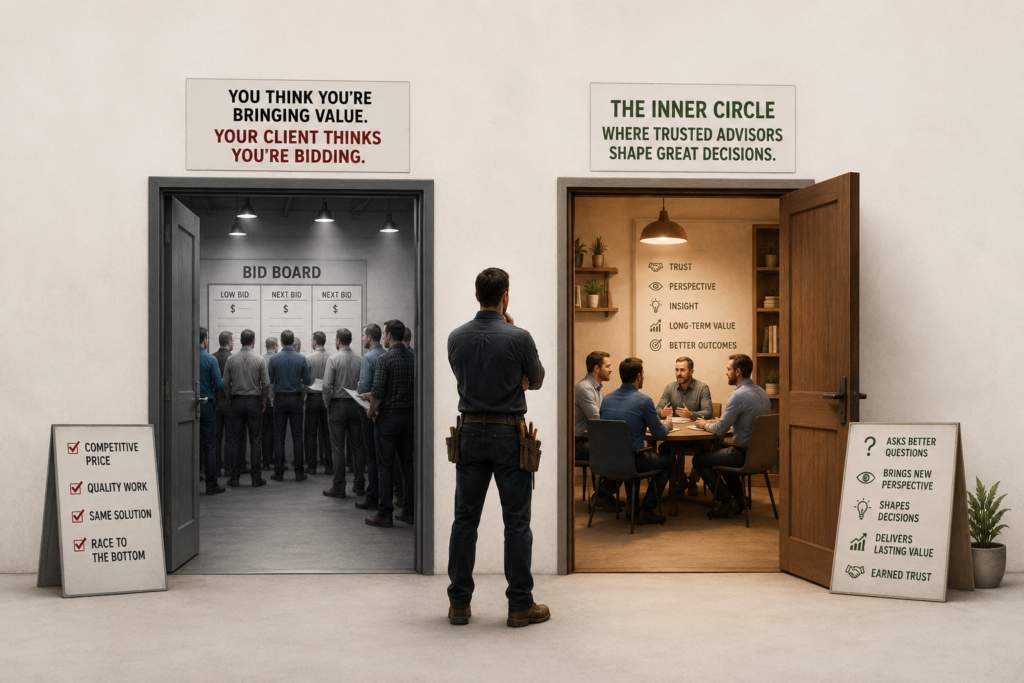
CONTRACTOR BUSINESS DEVELOPMENT | BEYOND THE BID
A contractor I sat down with recently said something that stopped me cold.
“You can spend hours and hours, days, in wrong rooms that aren’t going to lead anywhere.”
A few years into running their own business — having figured out through hard experience what most contractors never name directly — they had identified the core problem with how most people in the trades approach business development.
The wrong room isn’t just a waste of time.
It’s a signal that something more fundamental is off.
How Your Best Clients Actually Make Decisions
Here’s something the marketing industry doesn’t want you to know.
Your ideal client isn’t making their most important decisions based on Google searches.
They’re doing their research online — reading, comparing, educating themselves about options. But when it comes to the decision that actually matters — the capital investment, the new contractor relationship, the significant facility improvement — they’re not trusting an algorithm.
They’re calling two or three people whose judgment they’ve earned trust in over years of relationship.
They’re asking for counsel. Not information.
The peer whose portfolio looks like theirs and made a similar move. The advisor who has seen a hundred versions of this project and knows which approaches deliver and which create problems six months after completion. The trusted professional who has earned a seat in their inner circle — not by being visible, but by being genuinely valuable over time.
That’s where buying decisions actually get made.
In private conversations between people who trust each other.
The question isn’t whether your ideal client can find you online.
It’s whether you’re one of the people they call.
The Value Trap Nobody Talks About
The same contractor who named the wrong room problem so precisely also told me what they bring to clients.
“We do quality work at a competitive price.”
They genuinely believe they’re bringing value. And in a transactional sense — they are. They work hard. They deliver. Their clients trust them.
But here’s what they’re actually offering:
A bid.
A better bid than the last contractor. A more competitive bid than the next one. A bid that keeps them in the conversation as long as their price holds — and puts them back at square one the moment someone else sharpens their pencil harder.
They’re describing the go-giver philosophy with one breath and offering the race to the bottom with the next.
Not because they aren’t talented. Because nobody showed them what non-transactional value actually looks like.
This is the value trap. And almost every contractor reading this has fallen into it at some point.
We talk about relationships. We mean competitive proposals.
We talk about partnerships. We mean preferred contractor status.
We talk about bringing value. We mean doing the same thing as everyone else, slightly better or cheaper.
And we wonder why the inner circle stays just out of reach.
| Quality work at a competitive price is what every contractor in your market is offering. It isn’t a value proposition. It’s a minimum requirement for being in the bid pool. |
The Question That Changes Everything
Here’s what separates a vendor from a trusted advisor.
A vendor answers the question the client asked.
A trusted advisor asks the question the client hasn’t thought of yet.
“The way you’ve defined this project scope is going to create problems in three to five years. Here’s what I’d look at differently.”
“Have you modeled what this improvement does to your tenant retention over five years? Because that changes the ROI conversation entirely.”
“The projects I see deliver the most value aren’t the ones built to the tightest budget. They’re the ones where the owner understood what they were actually buying before the scope was written.”
The buyer didn’t know they needed that question.
Now they can’t un-hear it.
And the contractor who asked it just moved from the bid pool into the inner circle — not because they won a competition, but because they changed how someone thinks.
That’s advisory value.
It has nothing to do with price. It has nothing to do with materials, methods, or competitive positioning.
It has everything to do with whether you understand your buyer’s world deeply enough to see what they can’t see themselves.
How You Earn the Inner Circle
Your ideal client isn’t calling you because you’re competitive on price.
They’re calling you because your perspective makes them more capable of making good decisions. Because somewhere along the way you stopped trying to win their business and started genuinely trying to improve their thinking.
And they noticed.
That’s not a happy accident. It’s not a personality trait some people have and others don’t.
It’s a practice. Built on three things:
| Presence before need. Showing up with something genuinely useful before anyone has asked — before the project exists, before the problem is urgent, before the buyer is ready to make a decision. The contractor who arrives after the scope is written is still a vendor. The one who helps shape the thinking before the scope exists is a partner. |
| Consistency before urgency. The inner circle isn’t built in one impressive meeting. It’s built through dozens of smaller ones — each bringing something real, each leaving the buyer slightly better equipped than before. The relationship that earns a call before the RFP drops was built through years of showing up when nothing was imminent. |
| Insight over information. Your buyer can get information anywhere. What they can’t get everywhere is the perspective of someone who has seen their specific situation from an angle they haven’t considered. That perspective is your most valuable asset. It’s not in your proposal. It’s in your questions. |
The Architecture That Makes This Systematic
Here’s the problem with everything above:
It sounds like it requires either natural talent or infinite time.
It doesn’t.
It requires a designed system — a referral architecture that identifies who your ideal buyer turns to for counsel, builds genuine relationships with those people, and creates the conditions for your expertise to reach your buyer before they’re ready to make a decision.
The contractors winning negotiated work aren’t working harder than everyone else. They’re working inside a system that makes advisory presence the default — not an aspiration they return to when the pipeline gets light.
That system is what Trust Lab builds.
Thirteen weeks. Starting July 7th.
This is the last cohort of 2026. Seven seats remaining.
If you’ve been bringing value — and quietly wondering why it still feels like you’re bidding — this is the conversation worth having.
| Twenty minutes. Your specific market, your specific relationships, and what earning the inner circle actually looks like for where you are. No pitch. A real conversation about what’s possible. → Book a strategy session: [BOOKING LINK] → Trust Lab — July 7th, the last cohort of 2026 |