
The buyer has changed.
I know, I know…Hello, Captain Obvious.
But hang with me for a perspective from a popcorn eating sales coach.
The decision-maker sitting across from you in 2026 is carrying more skepticism, more pressure, and more fear of making the wrong call than any buyer you’ve sold to before. Five years of instability — supply chain chaos, economic whiplash, a relentless news cycle that makes every priority feel temporary — has created a buyer who defaults to caution before they default to yes.
They know something needs to change. They’re afraid of what happens if they move in the wrong direction. They are authorizing the single biggest purchase some of them will ever make — or navigating a decision that could get them fired if it goes sideways.
And you’re showing up with the same pitch you’ve been using for a decade.
The contractors who are winning consistently in this environment aren’t the ones bidding harder or following up more. They’re the ones who have raised their standard — in how they present, how they communicate, how they market, and how they show up in every conversation before the contract is ever signed. In 2026, showing up professionally means something fundamentally different than it did five years ago.
The Lowest Bar in Commercial Construction
Let’s start here.
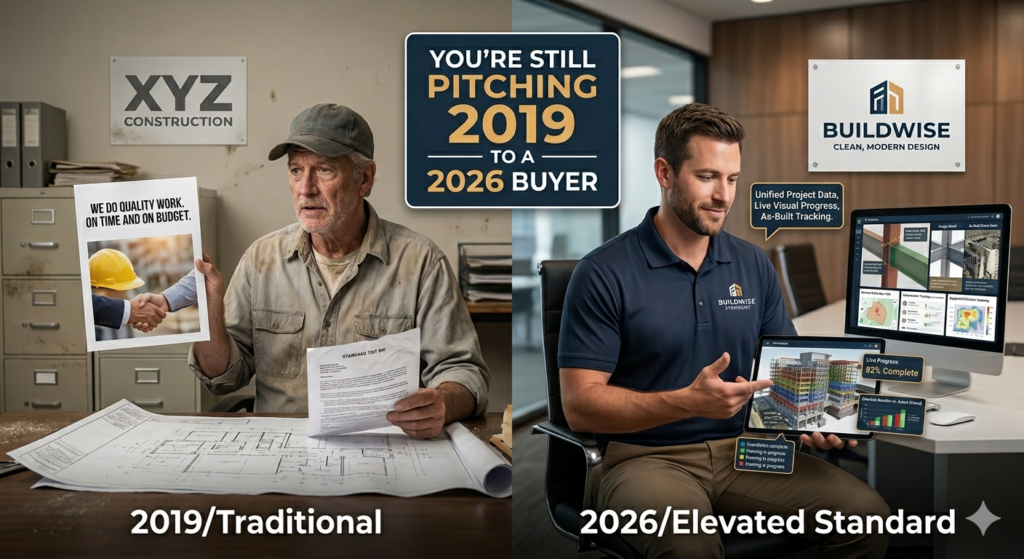
“We do quality work, on time and on budget.”
Every contractor says it. Every proposal leads with it. Every website features it prominently above a photo of a hard hat and a handshake.
It is the bare minimum. It is not a value proposition.
When your differentiator is identical to every competitor’s differentiator, you have no differentiator. You have a commodity position with professional language on top of it.
Look at it from this perspective, is anyone promising on their website, ‘we never hit our budget, deadlines are a running joke, and we return your calls like you’re the ex looking for the alimony check’
You know your buyer has heard this promise hundreds of times. They’ve been disappointed enough times to stop believing it. When you lead with “on time and on budget,” you are asking a skeptical buyer to trust the same promise that everyone makes and that enough people have broken to make the words almost meaningless.
The standard has risen. That phrase is where the conversation starts — not where it wins.
What a Real Value Proposition Sounds Like
A value proposition answers one specific question: what changes for the owner because you were the one who did this work?
Not what you did. What they experienced as a result.
The pain you alleviated: budget certainty in a volatile materials market. Tenant retention through a disruptive renovation. Code compliance achieved without operational downtime. A facility upgrade completed without a single board complaint.
The transformation you enabled: a facility that runs more efficiently and costs less to maintain. A building that commands higher rents because the ownership experience matches the asking price. A campus that serves its residents better because the systems supporting it were designed with their experience in mind.
Specific. Owned. Impossible for the contractor down the street to claim because it’s built on your actual track record — not a generic promise.
This is the message that travels. The one your referral partners can repeat with confidence. The one that makes the right buyer stop and say “that’s exactly what I need.” That’s not marketing language. That’s the moment a prospect becomes a client.
The Onboarding Experience That Proves It Before the Job Starts
Most contractors win the job and then go silent until they show up with a crew.
That silence is not neutral. It is eroding the confidence your buyer just extended to you.
A professional sales effort includes a client onboarding process that lets the owner experience your value proposition before a single nail is driven. Welcome communication that sets expectations clearly and confidently. An introduction to the team — not just names, but roles, responsibilities, and exactly how to reach each person. A project communication cadence they can count on: weekly updates, milestone notifications, issue escalation protocols that remove the anxiety of not knowing.
This is not overhead. This is the proof that you are who you said you were.
Every touchpoint between the signed contract and the first day on site either builds confidence or erodes it. Most contractors are leaving that entirely to chance.
Prompt and Consistent Communication as a Competitive Advantage
The bar for communication in commercial construction is embarrassingly low.
Most contractors are hard to reach, slow to respond, and inconsistent in how they update clients. Most owners have a story about a contractor who disappeared for two weeks in the middle of a project. Most facility managers have experienced the particular anxiety of not knowing what’s happening on a job they’re responsible for.
Being the contractor who responds within 24 hours, who proactively communicates before being asked, who delivers bad news quickly and with a plan rather than hoping nobody notices — that alone separates you from the majority of your competition.
In a market where buyers are already anxious and skeptical, communication is not a courtesy. It is the single most visible proof that you are reliable.
And reliability — more than price, more than credentials, more than reputation — is what the overwhelmed buyer in 2026 is actually purchasing.
Unified Branding That Signals You Have Your Act Together
Your brand is not your logo. It’s the total impression you make before, during, and after every job.
Branded vehicles. Clean uniforms. Professional proposals that are formatted clearly and free of errors. A website that doesn’t look like it was built in 2009. Email signatures that match. Job site signage that looks intentional. A Google Business profile that reflects the company you actually are — not the company you were five years ago.
This matters because your buyer is making a judgment about your competence before they ever see your work. The decision-maker authorizing the largest purchase of their career, or the project that their board is watching closely, needs to believe that you pay attention to detail.
Unified branding is the first evidence they evaluate. It is not vanity. It is proof.
Marketing in 2026 Is Not a Website and Google Ads
A professional website and a online presence is table stakes in 2026. It is not a marketing strategy.
The contractors pulling away from the pack right now have figured out something their competitors haven’t: AI is not a threat to their business. It’s the most powerful competitive tool available to them — and it’s accessible right now, at a fraction of what a marketing team used to cost.
In marketing: AI-assisted content that educates your ideal buyer before they ever call you. Automated follow-up sequences that stay warm and relevant without manual effort. A social presence that demonstrates expertise rather than just announcing availability. Email campaigns that segment and personalize at a scale no contractor could previously manage without a dedicated team.
In operations: AI tools that improve estimating accuracy, streamline project documentation, surface field issues before they become expensive problems, and create communication consistency across every job site simultaneously.
In the office: AI handles the administrative weight — proposals, RFIs, change order documentation, client reporting — freeing your team to focus on relationships and execution rather than paperwork that was eating hours nobody had.
In the field: Communication platforms that keep the office, the crew, and the client aligned in real time — reducing the gap between what’s happening on the job and what the owner knows about it. That gap, historically, is where trust erodes and claims are born.
The contractor who has integrated AI thoughtfully across their operation doesn’t just look more professional. They are more professional. Their proposals are better. Their communication is faster. Their documentation is cleaner. Their follow-up is consistent.
In a market where your buyer is evaluating you before they ever pick up the phone, the digital and operational impression you make is either building confidence or costing you opportunities you don’t even know you’re losing.
The Confidence-Building Conversation
Everything above sets the stage. This is the conversation that closes it.
There is a conversation that separates the contractor who gets trusted from the contractor who gets considered. It is not a sales pitch. It is a demonstration of understanding.
When you can speak to the owner’s specific concerns — budget pressure, board accountability, tenant experience, operational continuity — in their language, before they’ve had to explain it to you, the dynamic shifts entirely. You are no longer a vendor being evaluated. You are a professional who understands their world.
This is the conversation that gives a decision-maker permission to say yes. Because you’ve removed the fear of making the wrong call.
They are not buying construction services. They are buying confidence.
And you either give it to them in the conversation — or they find someone who does.
The Standard Has Risen. This Is What It Looks Like.
The contractors who are building the practices everyone else is watching didn’t get there by being better at construction than everyone else.
They got there by treating their sales effort, their marketing, their communication, and their client experience as professionally as they treat their craft. In 2026, that means a clear value proposition, a brand that builds confidence, communication that proves reliability, an onboarding process that demonstrates competence, and AI tools that give them capabilities that used to require a team twice their size.
This is not a checklist. It’s a standard.
And it’s available to any contractor willing to hold themselves to it.
Stay close — next week I have something specific coming that’s going to help you put this into practice. You’re going to want to be there.
In the meantime, if you want to know exactly where your referral architecture stands right now, take the five-question Referral Readiness Scorecard. Less than five minutes. Something specific to act on today.
Take the Scorecard here: [SCORECARD LINK]
To your influence,
Breandan