

Picture this…
Two versions of Monday morning.
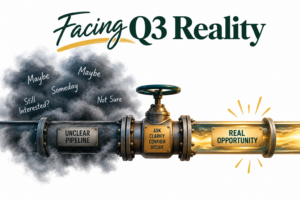
Version one: you open your laptop, stare at your contact list, try to think of someone you haven’t reached out to recently, draft an email you’re not entirely sure about, and spend 45 minutes doing something that feels like prospecting but produces mostly anxiety. You close the laptop feeling vaguely behind. You tell yourself you’ll do better next week.
Version two: you open your laptop and there’s already a message from someone who was introduced to you by a past client, asking if you have availability for a conversation this week.
Same profession. Same market. Same level of expertise.
Fundamentally different experience. The difference between those two Monday mornings is not luck. It’s architecture.
The Self-Promotion Problem — And Why It Feels So Wrong
Most fractionals spent years in corporate doing exceptional work — and waiting to be recognized for it.
They delivered results. Led teams through impossible timelines. Drove outcomes that moved the needle for the organizations they served. Solved problems that had been unsolvable before they arrived.
And too often, the acknowledgment didn’t come. Or it came too late. Too quietly. Or not at all.
So they went fractional. In part because they were done waiting to be recognized. In part because they knew their value and were finally ready to own it on their own terms.
And then someone told them to prospect. To put themselves out there. To promote what they do.
And it felt like the thing they left — performing for an audience that might not applaud, advocating for themselves in a system that had already shown them it wasn’t always paying attention. Standing in front of a room and hoping someone noticed.
The resistance isn’t ego. It isn’t laziness. It’s a deeply earned instinct that says:
“I’ve already proven myself. I shouldn’t have to sell myself.”
That instinct is completely understandable. And it is quietly running their pipeline into the ground.
The Attraction Model — What It Actually Is and Isn’t
Attraction is not passive. It is not “post content and wait.”
Attraction is the result of a deliberate system — positioning, relationships, and referral architecture that generate inbound interest without cold outreach. The fractional who attracts clients consistently has done specific work: their positioning is clear enough that referral partners can describe them accurately, their relationships have been activated rather than just maintained, and their reputation is traveling in rooms they’re not in.
But here’s what most fractionals don’t want to hear: attraction takes time to build. Months, sometimes longer, before the infrastructure produces consistent results.
And while you’re building it, you still need to eat.
The mistake most fractionals make isn’t choosing the wrong strategy. It’s choosing one extreme or the other: hunting reluctantly with an approach that doesn’t fit who they are — or building attraction infrastructure and then waiting passively while the pipeline runs dry. Both feel bad. Neither works consistently. There is a third option.
The Third Option Most Fractionals Never Find
The most effective fractional sales approach is neither pure hunting nor passive attraction.
Let’s call it ‘demand creation’.
Creating Demand is proactive outreach to people who already know you, like you, or have been introduced to you — combined with the positioning and referral infrastructure that keeps new warm relationships flowing in consistently. It is deliberate without being aggressive. It is proactive without being transactional.
This feels different than hunting because it is different. You’re not cold. You’re not forcing. You’re not performing for an audience that may or may not be paying attention. You’re having purposeful conversations with people who are already predisposed to trust you — and building the infrastructure that makes those conversations happen more frequently and more consistently over time.
This is what prospecting looks like for a fractional. And it looks nothing like the self-promotion treadmill that drove most of them out of corporate in the first place.
It requires a system, a cadence, and the confidence to show up consistently. But it does not require you to become someone you’re not. It requires you to be more intentional about being exactly who you already are while engaging the audience that most needs your skillset.
Why the 2026 Buyer Moment Is a Fractional’s Advantage
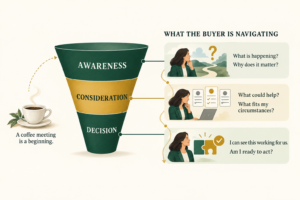
The post-pandemic buyer is skeptical, overwhelmed, and paralyzed by choice. They’ve been burned by promises that didn’t land. They default to caution before they default to yes. And they are looking for one thing above everything else: a reason to trust.
The fractional model is the trust model.
Embedded, senior-level, accountable, skin in the game, no bloated team overhead — the fractional shows up exactly the way the 2026 buyer needs someone to show up. Not as a vendor with a pitch deck. As a professional with a track record and a direct stake in the outcome.
The fractional who knows how to prospect in alignment with who they are — through relationships, through referrals, through warm conversations that build confidence rather than apply pressure — is uniquely positioned to win in this market.
The question is not whether you should prospect. The question is whether you’re doing it in a way that fits the trust-based practice you’re building — and whether you have the system to do it consistently enough to matter.
What the System Actually Looks Like
A clear positioning statement that makes warm outreach easy — because you know exactly what to say, why it matters, and who it matters to. You’re not searching for words in the moment. You have them.
A short, deliberate list of warm relationships to activate — not a cold list of strangers, but the people already in your orbit who are positioned to help or be helped. This list is shorter than you think. And it’s more powerful than any cold outreach campaign you’ve ever considered running.
A weekly cadence of two to three proactive conversations — not pitches, not coffee for the sake of coffee, but purposeful conversations with people who have proximity to your ideal client or who are your ideal client. Every week, without negotiating with yourself about it.
A Demand Creation operating system that keeps new warm relationships flowing in while you’re working the existing ones — so the pipeline compounds rather than depletes.
This is not a hustle. It is a practice. And like any practice — medicine, law, music, athletics — it produces fundamentally different results than hoping.
The Version Two Monday Morning Is Built, Not Found
The fractional who wakes up on Monday to an inbox full of warm introductions didn’t get lucky. They built something — deliberately, consistently, in a way that fit who they are and how they sell best.
They stopped waiting to be recognized and started building the architecture that makes recognition inevitable.
The good news: the system isn’t complicated. It is specific. And specific is learnable.
Something is coming in the next few weeks that is going to give you exactly that — the system, the cadence, and the conversations that move you from anxious to architected.
Stay close. This is the one you’ve been waiting for.
To your influence,
Breandan