
Another round of layoffs hit your feed this week.
You scanned the list of companies. Did a quick mental calculation. Told yourself you’re probably fine.
Maybe you are. But “probably fine” is not a strategy. And the pace at which that calculation is changing should have every knowledge worker paying very close attention right now.
Here’s what’s actually happening — and most people aren’t saying it this plainly.
AI isn’t replacing jobs the way the headlines describe it. It’s not a wave that wipes out a category. It’s quieter than that. More surgical. What it’s actually doing is making your best people dramatically more productive — and making the case for your middle performers harder to justify with every passing quarter.
One strong contributor with the right tools can now do what used to require three. Which means three isn’t a headcount decision anymore. It’s a math problem. And math problems have answers.
If you are anywhere in the middle of your organization’s performance curve, you should be asking yourself a serious question: am I still solving a problem, or am I just familiar?
Familiar used to be valuable. It isn’t anymore.
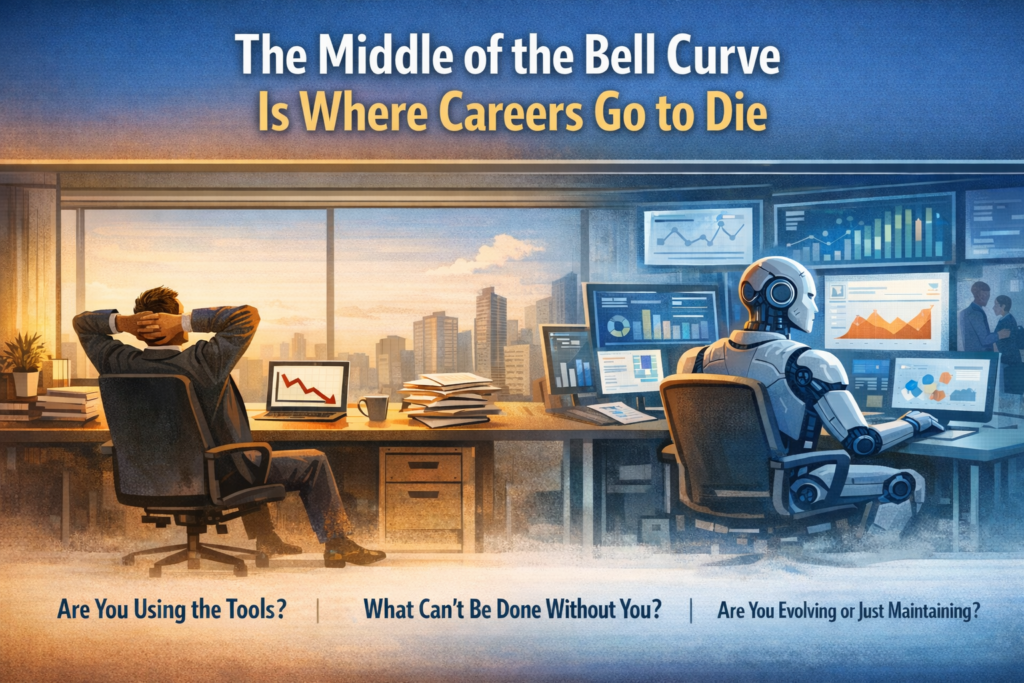
Part One: Are You Actually Using the Tools?
Let’s start with the most straightforward question, because most people are less honest with themselves here than they think.
Reflection: Look at your last five workdays. How many hours did you spend on tasks that a tool could have done faster, better, or entirely on your behalf — and you did it manually anyway?
Not because you had to. Because it’s what you’ve always done.
Research you could have prompted. Summaries you wrote from scratch. Emails drafted word by word that follow a pattern you’ve written a hundred times. Analyses built in a spreadsheet you built in a spreadsheet three years ago.
None of this is a character flaw. It’s just habit. But habit is expensive right now.
The knowledge workers building durable careers are auditing their workflows the way a good CFO audits a budget — looking for every line item that isn’t pulling its weight. They’re not adopting technology for the sake of it. They’re asking a specific question about every repeatable task: could this be done faster, better, or entirely without me — and if so, what does that free me up to do?
That last part matters. The goal isn’t to eliminate your hours. It’s to upgrade them.
Reflection: If you reclaimed five hours a week from tasks technology could absorb, do you know exactly what higher-value work you would do with that time? Or is the answer vague?
Vague is a signal. It means you haven’t yet gotten clear on what your highest value actually is.
Part Two: What Can’t Be Done Without You?
This is the question most people avoid, because it requires a level of honest self-inventory that’s uncomfortable.
AI is exceptionally good at pattern recognition, synthesis, summarization, drafting, and analysis at scale. It does not have your relationships. It does not carry your judgment about a specific client, a specific market, a specific room. It cannot read the unspoken tension in a conversation, navigate a trust repair, or make the call that requires both data and instinct honed over years.
That territory — the human, relational, contextual, judgment-intensive territory — is where your irreplaceability lives.
Reflection: Write down the three things you do in your role that could not be replicated by a well-prompted AI tool. Be specific. Not “I build relationships” — but what specifically do those relationships allow you to do, decide, or influence that no tool can touch?
If that list is hard to build, that is important information. It means your current role may be more execution-heavy than you’ve acknowledged — and execution is exactly what technology is absorbing fastest.
Reflection: Now look at your calendar from the last two weeks. What percentage of your time was actually spent in that irreplaceable territory — versus work that is transactional, repeatable, or process-driven?
For most people, the honest answer is somewhere between “not enough” and “almost none.” The high-value work gets squeezed by the volume work. The judgment gets crowded out by the execution.
This is not a time management problem. It’s a prioritization problem. And it won’t fix itself.
Part Three: Are You Moving, or Are You Maintaining?
Let’s talk about complacency, because it doesn’t look the way most people expect.
Complacency doesn’t look like laziness. It doesn’t look like someone who stopped caring or started coasting obviously. Most complacent knowledge workers are still working hard. They’re showing up, delivering, doing what’s asked.
What they’re not doing is evolving.
They mastered their role two years ago and haven’t fundamentally changed how they work since. They’ve optimized inside a lane that the technology is quietly making obsolete — and they haven’t noticed, because the work still feels full.
Busy is not the same as irreplaceable.
Reflection: What have you learned in the last 90 days that has genuinely changed how you work? Not a webinar you attended. Not a podcast you half-listened to. Something you actually implemented.
If nothing comes to mind, you’ve been maintaining. Maintaining feels productive. It is not the same as growing.
Reflection: Is there a skill, a tool, or a capability gap you’ve been aware of for more than six months that you still haven’t addressed? What story are you telling yourself about why it isn’t urgent yet?
That story is the risk. Not the gap itself — the tolerance for the gap.
The Honest Reckoning
Here’s a simple way to take stock of where you actually are. Read each statement and answer honestly — not aspirationally.
- I can name at least three AI or automation tools I use regularly that have meaningfully changed my output.
- I can articulate — specifically — the work I do that cannot be replicated by technology.
- When I look at my calendar, the majority of my time is spent in that irreplaceable territory.
- In the last 90 days, I have deliberately learned something new and applied it to how I work.
- I am not waiting for my organization to develop me. I am developing myself.
If you said yes to all five: You’re Thriving. You’re not just surviving the shift — you’re positioned to widen the gap between yourself and the field. Stay in motion.
If you said yes to two or three: You’re At Risk. Not in immediate danger, but the clock is running. You have clarity in some areas and blind spots in others. The blind spots are where disruption enters.
If you said yes to one or none: You’re Exposed. This isn’t a judgment — it’s a starting point. But it does mean the window for comfortable, low-urgency change is closing. The good news is that awareness is the prerequisite for everything else, and you have it right now.
The knowledge economy isn’t going away. But the version of it where showing up consistently and doing solid work guarantees your place — that version is already gone.
What replaces it is a version where adaptability is the skill. Where curiosity is the competitive advantage. Where the people who thrive are the ones who got genuinely interested in what’s changing instead of hoping it wouldn’t change too fast.
Sitting still used to be a neutral choice. Now it’s a decision. And it’s one you’re making whether you realize it or not.
Make it on purpose.
Breandan Filbert is Managing Partner of SalezWorks and creator of Productive Prospecting: Trust Lab — built for the professionals who refuse to let the market decide their future for them. Learn more at SalezWorks.com.