
You Can’t Invoice a Framework
The Fractional Executive’s Most Expensive Mistake
Let me tell you about someone I spoke with this week. Smart person. Genuinely talented. Months of work invested in building out a fractional service — the methodology, the deliverables, the onboarding process, the pricing tiers.
One paying client. Not an ideal client — someone who was desperate and willing to sign quickly. The engagement produced lackluster results. And now this person is rethinking their entire sales strategy, confident they can figure it out on their own.
Which, fine. Good luck with that.
But here’s what stopped me cold: this is not a rare story. This is the most common mistake I see from otherwise brilliant fractional executives. And it is absolutely, completely, entirely avoidable.
You cannot build your way to a client. You have to sell your way to a client — and then build what they need.
Build First, Sell Second: Why This Feels Logical (And Isn’t)
I understand the impulse. You come from a world where excellence was the currency. You delivered, and people noticed. You were promoted, referred, recruited — because of the quality of your work.
So when you go fractional, your brain tells you: Get the work perfect. Then show people the work. They’ll see the value. The clients will come.
Except that’s not how it works. Not even a little.
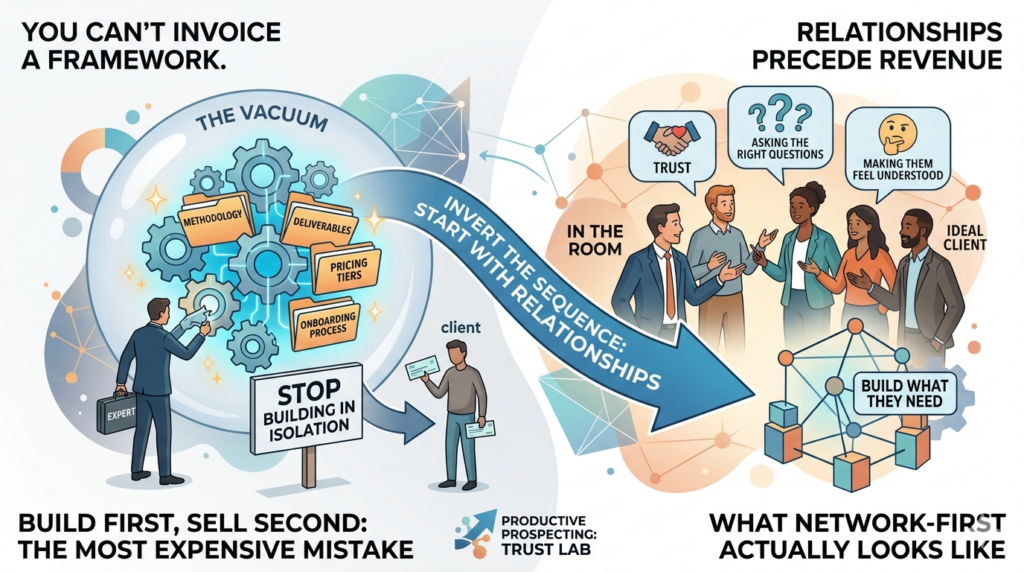
The fractional marketplace doesn’t reward the best framework sitting in a Google Drive. It rewards the person in the room, building trust, asking the right questions, and making the right people feel understood. Relationships precede referrals. And referrals precede revenue.
No amount of methodological elegance replaces a conversation that makes your future client feel like you already understand their problem.
The Desperate Client Problem
When you build first and sell second, you don’t attract ideal clients — you attract whoever shows up. And whoever shows up when you’re early and unproven is often someone who couldn’t attract better options either.
That’s not a judgment. That’s math.
Ideal clients — the ones who value your expertise, respect your process, and are positioned to get real results — choose their partners carefully. They’re watching who shows up consistently. Who knows their world. Who other people they trust are talking about.
They are not trolling the internet hoping to stumble onto your downloadable methodology PDF.
The person who signs your contract in month three of you building in isolation is likely someone who had limited options. And when the results are underwhelming — because the fit was off, the trust wasn’t built, and the context was wrong — that becomes your case study. Whether you like it or not.
A referral gets you a meeting. Influence gets you a client. Neither one starts with a framework document.
Now for the Part That Should Make You Uncomfortable
Here’s what I find genuinely fascinating about the person I spoke with this week — and about the pattern I see over and over in this space.
They are confident they can figure out their sales problem on their own. After months of building solo. After one client who wasn’t the right fit. After results that didn’t land.
They are going to try harder. Do more research. Rethink the strategy. On their own.
Because that’s the path to success, right?
And yet — they are actively trying to convince other people to hire them. To bring them in as a trusted advisor. To trust their expertise in a domain where the client has already been struggling.
Read that again.
They won’t invest in help for their own problem. But they want to be paid to solve the same class of problem for someone else.
That is not a sales strategy. That is a credibility gap. And it is exactly why so many fractionals say they hate sales — because deep down, they know they’re asking someone to do something they wouldn’t do themselves. And that feels manipulative. Because it is.
What Network-First Actually Looks Like
I’m not telling you to never build anything. I’m telling you to invert the sequence.
Step one: Get into rooms.
Not virtual networking purgatory. Actual strategic relationships with people who either are your ideal client or know them. Show up consistently. Add value before you ask for anything. Build the reputation before you need it.
Step two: Listen for the problem.
The conversations you have in those rooms will tell you exactly what your ideal client is struggling with right now. Not what you imagine they’re struggling with. Not what you built your offer around six months ago. What they’re actually losing sleep over today.
Step three: Build what they’ll pay for.
Once someone with a checkbook says “This is exactly what I need, the structure fits my organization, the budget is what I’m willing to spend and I’m ready to engage you” that is your signal to build. Not before. You now have a real scope, a real context, and a real human being whose success you are accountable to. That is when your methodology matters.
This sequence isn’t just more efficient. It’s more ethical. You’re building something for a real person with a real problem — not hoping a real person appears who happens to fit the thing you already built.
The Harder Question
If you are a fractional executive who believes in the power of expert guidance — who built a career around helping organizations do hard things better — I want to ask you something directly:
When is the last time you invested in expert guidance for yourself?
Not a podcast. Not a book. Not more LinkedIn content. A real investment in the kind of support you sell.
Because how you buy is how you sell. And if you’re unwilling to do it, you will feel that unwillingness every time you ask someone else to write the check.
You can’t close with conviction you don’t carry.
Ready to Stop Building in a Vacuum?
Freeway to Fractional is a 4-week cohort program designed for fractional executives who are done hoping clients appear — and ready to build the relationships that make them inevitable. [Learn more and join the waitlist → LINK HERE]
Or if you want to talk through where you are right now, book a Clarity Call. No pitch. Just a real conversation. [LINK HERE]