

Happy Weekend!
You know the moment.
Someone looks at you across a coffee table and says, “I’d love to refer you.” And you believe them. The goodwill is genuine. The relationship is real. You leave the meeting feeling like your pipeline is about to shift.
And then nothing happens.
Not because they didn’t mean it. Not because the opportunity never came up. Because when the moment arrived — someone at a dinner table, someone in a meeting, someone saying “I need help” — they opened their mouth and the words weren’t there.
The hesitation was. And the moment passed.
They’re Not Overlooking the Opportunity. They Can’t See It.
It’s easy to assume your referral partners are waiting for the right moment and missing it. That they’re distracted, or not thinking about you, or just not trying hard enough.
The truth is more uncomfortable — and more fixable.
They can’t see the opportunity because they don’t fully understand what they’re looking for. You can’t recognize a problem you’ve never been taught to identify. And without a clear picture of who you help and what that moment of need looks like, your best referral partners are scanning every room they walk into without knowing what signal to look for.
And when they do take a swing — when they make an introduction that turns out to be the wrong company size, the wrong stage, the wrong problem — something worse happens. They feel like they wasted everyone’s time.
Professionals understand the value of time above almost everything else. A bad introduction doesn’t just fail — it creates risk. It puts their judgment on the line. It makes them less likely to try again.
The hesitation you’re experiencing from your referral partners isn’t apathy. It’s self-protection. And it’s your positioning problem to solve — not theirs.
Why Fractionals Are Genuinely Hard to Explain
Here’s the honest challenge: the fractional model is genuinely confusing to people who haven’t lived it. And let’s face it, even if you’re living it, you understand how the role is delivered in a way aligning with individual talents and skills. (And THAT is very challenging to define and the reason our course Freeway to Fractional offers multiple lessons on defining this.)
Here are a few considerations:
Part-time but senior-level. Embedded but not permanent. Strategic but not on the org chart. It doesn’t fit the mental models most buyers and referrers already carry. When someone tries to explain it, the words “consultant” or “interim” come out — and neither is accurate, and neither creates the right impression.
Unlike an attorney, an accountant, or a realtor, there’s no universally understood job description to anchor to. Those professions come with built-in mental shortcuts. Fractional doesn’t — yet.
The breadth of what most fractionals do only makes it harder. “I work with growing companies on finance and operations” is not a referral-ready sentence. It’s a conversation-ender disguised as a description.
And most fractionals make it worse by leading with their title and credentials instead of the problem they solve. Your referral partner is not going to workshop your positioning in the moment. They’ll hedge, they’ll generalize, and then they’ll move on. The moment will pass — again.
The One-Sentence Test
Here’s a question most fractionals have never asked:
If your best referral partner had to describe what you do to a room full of your ideal clients right now — what would they actually say?
Not what you’ve told them. Not what’s on your website. What has actually stuck.
Try this: hand someone who knows you well a blank piece of paper and ask them to write down what you do and who you do it for — without looking anything up, without asking clarifying questions, in sixty seconds or less.
What comes back is not a reflection of your work. It’s a reflection of your positioning.
And it will tell you exactly how referred you’ll actually be.
This isn’t about your elevator pitch. Elevator pitches are for strangers. This is about what lives in someone else’s head about you — the version that gets spoken when you’re not in the room. That’s the only version that matters for referrals.
Building a Referral-Ready Description
The description that actually travels has a specific structure:
I help [specific buyer] who [is experiencing this problem] to [achieve this outcome] — without [the thing they’re most afraid of].
Simple enough to remember. Specific enough to recognize. Compelling enough to repeat.
The test is not whether it sounds good coming out of your mouth. The test is whether your referral partner can say it confidently at a dinner table — without notes, without hedging, without it sounding like a pitch they’re reciting.
Most fractionals go through three or four iterations before they land on the version that actually works. The first draft is almost always too broad. The second is usually too technical. The third starts to get interesting. The fourth is the one that travels.
This is the first thing we work through in Trust Lab — because nothing else in your referral strategy works until this is solved. You can’t activate a partner around a description that doesn’t land.
Equipping Your Partners — Not Just Informing Them
Telling someone what you do once is not equipping them. It’s informing them. And information fades.
Equipping looks different. It means your partner understands the problem you solve deeply enough to recognize it when they hear it described — even when the person describing it doesn’t know that’s what they need. It means they know exactly what to say in the moment and feel confident enough in your work to say it without hesitation.
The difference between a partner who mentions you occasionally and one who champions you consistently is almost always whether the equipping conversation happened.
Give them language. Give them a trigger. Give them a specific ask:
“When you hear someone say [this specific thing] — that’s my person. Here’s exactly how to make the introduction, and here’s what I’ll do from there.”
You are not waiting for a champion to appear. You are building one — deliberately, one conversation at a time.
The Compounding Effect
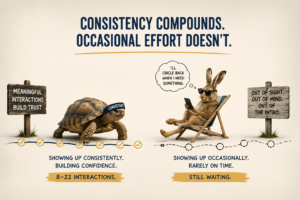
When one referral partner can explain you clearly, they refer you once.
When five referral partners can explain you clearly, know exactly who to look for, and feel confident enough to make the introduction without second-guessing themselves — your pipeline starts to feel fundamentally different.
This is what influence looks like at scale. Not more networking events. Not a better LinkedIn profile. Not a more polished pitch deck. More people who can champion you with precision — in the rooms you’re not in, at the moments that matter most.
The fractionals who have full practices aren’t necessarily better at what they do than the ones grinding through Q2 wondering why their pipeline is inconsistent. They’ve simply made it easier for the right people to talk about them. That’s the whole game.
Come Test It in the Room
Nobody refers someone they can’t explain. That’s not a flaw in your network — it’s a gap in your positioning infrastructure. And it is one of the most fixable problems in professional services.
It starts with one sentence. Getting that sentence right changes everything that comes after it.
We’re hosting an upcoming Speed Networking event specifically designed to help you do exactly that — test your Transformation Statement in a live room, in front of real professionals who will tell you honestly whether it lands.
Come with a draft. Walk the room. Have the real referral partner conversations that tell you whether your description is working — before you find out the hard way that it wasn’t.
Leave with language that actually travels.
Register here: [SPEED NETWORKING EVENT LINK]
To your influence,
Breandan