
FREEWAY TO FRACTIONAL • SATURDAY EDITION
Expertise Doesn’t Travel
There’s a particular kind of frustration that doesn’t have a name yet. It lives in the gap between what you’ve accomplished and what your pipeline currently reflects.
You have the résumé. The track record. The decades of results that any reasonable person would look at and say, yes, this is someone worth knowing, worth hiring, worth trusting with a significant problem. You are, by any measure, the real deal.
And yet. The phone isn’t ringing the way it should. The conversations that are happening aren’t converting the way they used to. You find yourself doing things—LinkedIn outreach, coffee meetings with near-strangers, following up on introductions that go nowhere—that feel vaguely beneath you, and not because you’re arrogant. Because you know what you’re worth, and nothing about your current reality is reflecting it back at you.
This isn’t a confidence problem. It isn’t a positioning problem. It isn’t even a pipeline problem, though that’s how it usually gets diagnosed.
It’s a portability problem.
The Institution Did the Work
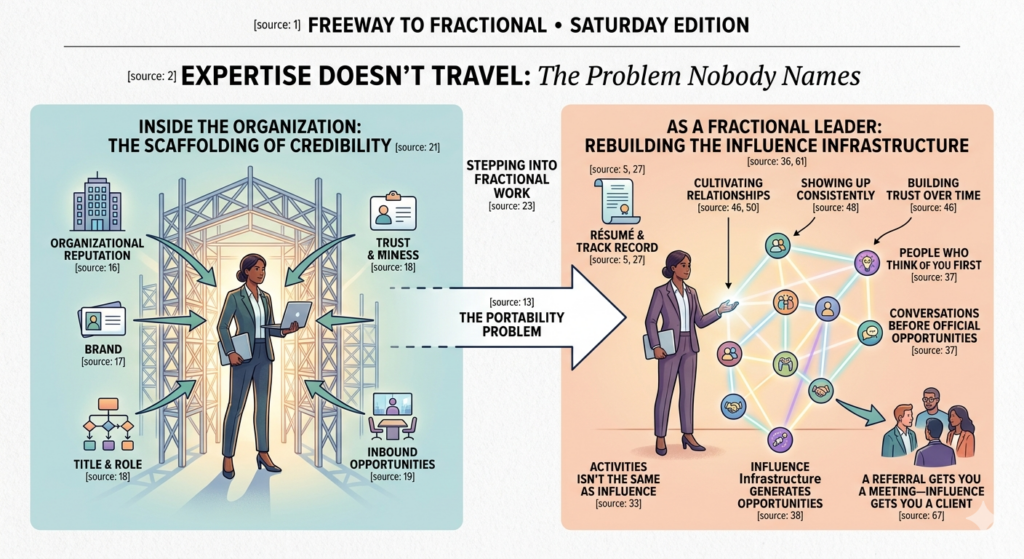
For most of the people reading this, the majority of your career was spent inside organizations. And inside organizations, a remarkable thing happens that nobody ever points out until you leave: the institution builds your credibility for you.
Your title introduces you before you say a word. The brand on your business card opens doors. The org chart routes opportunities in your direction based on your function, not your reputation. You didn’t have to earn the meeting—the meeting came to you because of the role you occupied.
None of this means your success wasn’t real. It absolutely was. You delivered results. You built relationships. You earned the respect of the people around you. But there was an invisible scaffolding holding all of it up—the structure of the organization itself—and you probably never noticed it because you never had to.
Most high performers never realize this until the scaffolding is gone.
The Portability Myth
When experienced professionals step into fractional work, they carry a quiet assumption that almost nobody says out loud: my track record will speak for itself.
It won’t. Not automatically. Not in a new market.
This isn’t a judgment about the quality of what you’ve built. Your track record is real and it matters—but reputation is contextual. The people who trusted you inside your previous organization trusted you there, in that context, with the weight of that institution behind you. The market you’re now trying to reach is being asked to trust someone they don’t yet know, without any of that scaffolding in place.
Expertise is your qualification. It is not the relationship. And in the fractional world, the relationship is the business.
This is the thing that trips up the most talented people making this transition. They spend 18 months, 24 months, sometimes longer doing all the right activities—networking, speaking, writing, connecting—and wondering why the results don’t match the effort. It’s because activity isn’t the same as influence, and influence doesn’t transfer. It has to be rebuilt, deliberately, in the new context.
The Problem Nobody Names
What most fractionals are actually dealing with isn’t a pipeline problem or a sales problem. It’s an influence infrastructure problem.
Influence infrastructure is the ecosystem of relationships that surrounds you—the people who think of you first when a relevant need arises, who bring you into conversations before there’s an official opportunity, who make introductions with such specificity and conviction that the person on the other end shows up already leaning toward yes. This is what generates consistent, high-quality opportunities without cold outreach. This is what makes your phone ring.
Most people who have this don’t know how they got it. They built it gradually, over years, inside contexts where the conditions were favorable. They can’t reverse-engineer it for you because they’ve never had to think about it. It just… happened.
It didn’t happen. It was built. They just weren’t paying attention to how.
What Building It Actually Looks Like
Here’s what it’s not: more LinkedIn posts. A better elevator pitch. A bigger contact list. Another coffee meeting with someone who might know someone.
Building influence infrastructure is a practice—methodical, intentional, and learnable. It’s about understanding how trust compounds over time and designing your relationship activity around that compounding, rather than around the transaction in front of you. It’s about knowing which relationships belong in which tier of your attention and effort. It’s about showing up in the right rooms in the right way consistently enough that the market begins to form a picture of who you are and what you stand for.
The fractionals who crack this aren’t necessarily the most credentialed ones in the room. They’re the ones who figured out—either by instinct or by design—that influence is a practice, not a personality trait. It can be learned. It can be systematized. And once it’s in place, it does the work that no amount of cold outreach ever will.
What We Just Proved
We graduated our first Trust Lab cohort this week.
I don’t say that to celebrate the program. I say it because thirteen weeks ago, the people who walked into that cohort were exactly who I just described: talented, credentialed, experienced professionals whose pipelines weren’t reflecting what they were actually worth. Some were newer to the fractional world. Some had been at it for years. All of them were working harder than they should have had to for results that felt inconsistent.
What shifted over thirteen weeks wasn’t their expertise—they already had that. What shifted was the architecture around it. How they talk about their work. How they show up in relationship conversations. How they think about the long game of trust-building versus the short game of transaction-chasing. The calls they stopped dreading. The ones they started making on purpose.
The beta is officially closed. We proved what we set out to prove: that influence infrastructure is learnable, transferable, and transformational for the right person willing to do the work.
The first official Trust Lab cohort is forming now.
If your résumé is impressive and your pipeline doesn’t reflect it, that gap has a name. And it has a solution.
Ready to build what your expertise deserves? Let’s talk. → [LINK HERE]
Breandan Filbert is the founder of SalezWorks and creator of Trust Lab, a 13-week influence-building program for fractional executives and professional services leaders. She believes a referral gets you a meeting—influence gets you a client.