
CONTRACTOR SALES MASTERCLASS | JUNE 4TH
The Race to the Bottom Starts Before the Bid. Here’s Where.
Most contractors think the race to the bottom starts when the bid goes out.
It doesn’t.
It starts earlier. Quietly. In a process the contractor is completely invisible to — and by the time they get a call, the race is already over.
Understanding where it actually starts is the difference between being the contractor who gets called and the contractor who gets invited to bid.
The Buyer Journey Nobody Taught You About
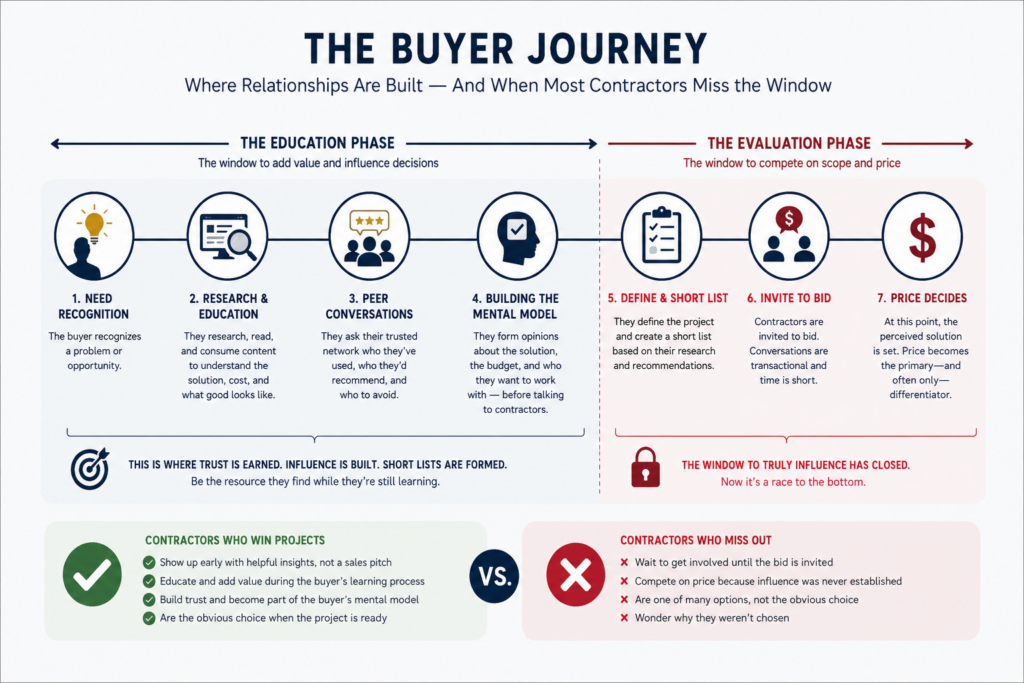
Here’s what actually happens before a project goes out for bid.
The owner — the facility director, the property manager, the developer, the campus operations lead — recognizes a need. Something needs to be built, upgraded, expanded, or fixed. The decision to do something has been made.
What happens next has nothing to do with contractors.
They research. They read. They consume content online — articles, case studies, industry resources, anything that helps them understand what the solution should look like, what it should cost, and what good execution actually means. They form opinions. They build a mental model of the project before they’ve talked to a single person who could build it.
Then they turn to their peer network. They ask the people they trust — other facility directors, fellow developers, colleagues who’ve navigated similar projects — who they used, who they’d recommend, who they’d avoid.
And here’s where the race to the bottom gets locked in.
Because by the time a contractor’s name comes up in that peer conversation, the buyer has already decided what they need and what it should cost. They haven’t evaluated contractors against each other in any meaningful way. They haven’t had a conversation that revealed the difference between a contractor who understands their objectives and one who just executes scope.
The only differentiator left is price. So that’s what gets used.
The Window Most Contractors Never See
The window to differentiate doesn’t open at the bid. It opens during the buyer’s education phase — the weeks or months before they’ve decided who to call.
This is where the short list actually gets built. Not in a formal evaluation. In the buyer’s head, as they’re forming their mental model of the project. The contractors and GCs who show up in that process — through content, through visibility, through being the resource the buyer encounters while they’re still learning — become the benchmark everything else gets measured against.
The contractor the buyer already has a mental relationship with is not competing the same way everyone else is. They’re confirming a decision that was already forming.
Everyone else is competing to change a mind that’s mostly made up.
Why Most Contractors Bail Out Too Soon
Here’s the pattern I see constantly in the trades.
A contractor gets into an early conversation with a potential buyer. The project isn’t defined yet. There’s no timeline. No budget has been discussed. Nothing feels imminent.
So they move on. More pressing opportunities. More immediate work. The buyer wasn’t ready, and there’s no point investing time in something that might not happen for six months or more.
Except while they were gone, someone else stayed.
That contractor kept showing up — with a relevant insight, a resource the buyer hadn’t found yet, an answer to a question the buyer was still forming. Not selling. Contributing. Becoming the resource the buyer’s thinking got built around.
By the time the project was ready, the buyer already knew who they wanted. The peer recommendation just confirmed it. The bid was a formality.
“Not ready yet” is not a reason to disengage. It’s the exact moment your influence is most available — and your competitors are least present.
The contractors who understand this stop treating early conversations like qualification exercises and start treating them like what they actually are: the most valuable real estate in the entire buyer journey.
Delivering Value During the Education Phase
Showing up during the buyer’s education phase doesn’t mean selling. It means being the most useful resource in the room when the buyer is still forming their thinking.
It looks like content that answers the questions your ideal buyer is already asking — before they know to ask you directly. Case studies that speak to the outcomes they care about. Insights that help them think through decisions they’re navigating. A perspective that reframes a problem they didn’t know how to name. Resources to help them get their project moving from a dream to reality.
It looks like the trusted trade partner who makes an introduction at exactly the right moment — not when the project is ready, but when the buyer is still figuring out what the project should be.
It looks like being the contractor who, when a buyer asks their peer network for a recommendation, already has a name recognition that makes the referral feel obvious rather than random.
None of this requires a proposal. None of it requires a price. All of it builds the kind of trust that means when the project is finally defined and ready to move — your name was already on the list before the list existed.
Marketing gets you upstream. Relationships get you the introduction. Showing up with value during the education phase is what makes the bid a formality.
The Complete System — June 4th
This is exactly what Dan Stalp of Sandler Training and I are building at the Contractor Sales Masterclass on June 4th.
Part 1 is mine: how to get visible during the buyer’s education phase, how to build the trade partner relationships that create upstream access, how to find your buyer’s ONE thing and deliver value to it before you ever pick up a pencil, and how to stay in the conversation when nothing feels imminent — because that’s precisely when the short list is being built.
Part 2 is Dan’s: once you’re in the conversation, how to surface what’s really driving the decision, how to have the budget conversation without killing the relationship, how to map the full decision process before investing in a proposal, and the one question that separates contractors who close from contractors who keep submitting proposals that don’t.
Getting upstream gets you the conversation. Knowing how to qualify it converts the conversation into a contract.
One afternoon. Free. Live. One week away.
REGISTER FOR JUNE 4 — CONTRACTOR SALES MASTERCLASS WITH DAN STALP — [LINK]
Forward this to the best contractor in your network. The seat is free and the room gets better with the right people in it.
The bid is a formality for the contractor the buyer already decided to use. June 4th is where you build the system that makes that your reality.
To your influence,
Breandan