
Business Development | Professional Services
You’re Not Bad at Getting Clients. You’re Missing a System.
Most professionals are working far harder at business development than they need to — and getting far less in return. Here’s what changes when you stop hustling and start building.
Let me describe your business development situation, and you tell me how close I am.
You are good at what you do. Your existing clients would refer you in a heartbeat. You show up at the right events, you stay in touch with your network, and every so often a great opportunity lands in your lap through someone who knows someone. You close it, you deliver, and then you go back to hoping the next one shows up the same way.
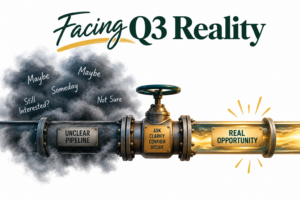
The pipeline is inconsistent. The referrals are unpredictable. And if you’re being honest, most of your business development activity — the coffees, the LinkedIn posts, the follows-up — doesn’t feel like it’s compounding into anything.
You’re not doing it wrong. You’re doing it without a system.
The difference between activity and infrastructure
Most professionals confuse business development activity with business development infrastructure. Activity is what you do. Infrastructure is what works when you’re not doing anything.
Activity gets you a meeting. Infrastructure gets you a client — and then another, and another, because the system that brought you the first one is still running.
The professionals who consistently grow their practices aren’t working harder than you are. They have built something underneath their relationships that turns goodwill into referrals, referrals into clients, and clients into advocates who send more clients. That structure doesn’t happen by accident. It gets built deliberately, one layer at a time.
| A referral gets you a meeting. Influence gets you a client. |
The distinction matters more than most people realize. Referrals are transactional — someone passes your name because you came to mind. Influence is structural — people send you business because of what they understand about you, what they’ve experienced alongside you, and what they believe you’ll do for the people they care about.
Influence is built. Referrals are received. One is a strategy. The other is luck.
What the data actually shows
I work with professional services leaders — consultants, advisors, fractional executives, specialists — who commit to building this kind of infrastructure over time. Here is what becomes possible in a focused 12-week period when someone works a real system:
| 35+ net new contacts in 12 weeks | 22 existing relationships deepened | 9 new referral partners at tier one | 75% of BD work eventually carried by systems |
These are not outliers. These are the results of people who decided to stop winging it and start building — people who, by their own admission, had been in professional services for decades and were still operating on hope-based business development.
The common thread is not talent. It is sequence.
Why sequence matters more than strategy
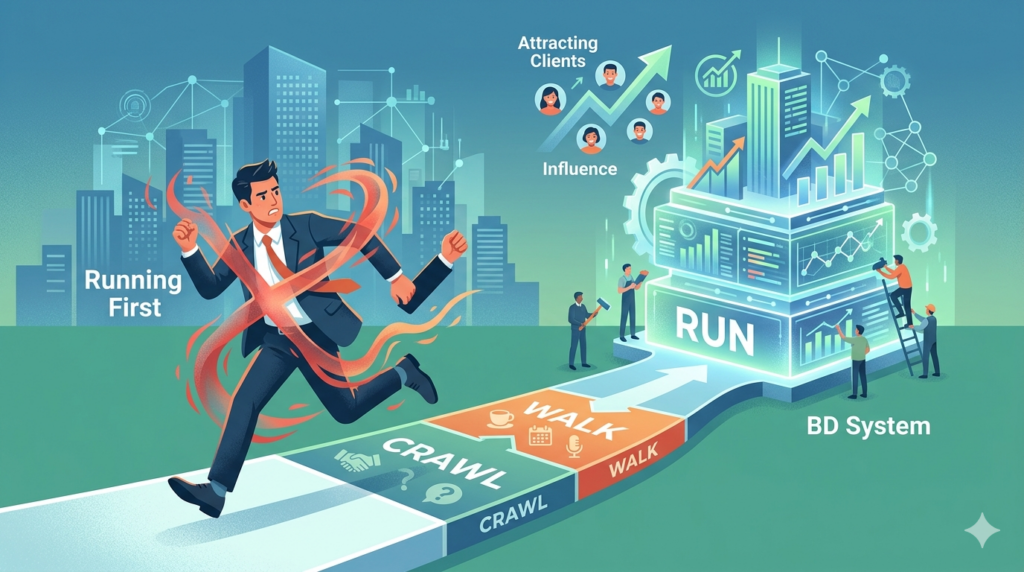
The single most expensive mistake professionals make in business development is trying to run before they can walk. They invest in content, campaigns, and visibility before they have a clear foundation. They chase referral partners before they know how to activate them. They build a lead magnet before they know what problem their ideal client is losing sleep over.
The result is a lot of motion with very little momentum.
The framework I use with clients is deceptively simple:
| The Forward Motion Framework | |
| Crawl | Cultivate your best existing client relationships first. Clarify how you communicate what you do. Build a simple first offer and a repeatable process for bringing on referral partners. This is the only foundation that holds. |
| Walk | Activate your partner network. Monthly conversations with your top referral relationships. One new lead magnet per quarter that makes it effortless for others to send people your way. Quarterly events with clients. KPIs on all of it. |
| Run | Let the system do the heavy lifting. Content strategy fed by real client conversations. Outbound campaigns running in the background. AI organizing your insights and surfacing your next move. At this stage, most of your business development runs without you. |
Most professionals are attempting the Run stage on a foundation they haven’t built yet. That’s not a motivation problem. That’s a sequencing problem.
The insight that changes everything
At some point in this work, something shifts. You stop seeing business development as a series of tasks and start seeing it as a system pointed at a destination. You look at a relationship and know exactly where it is, what it needs, and what move comes next. You stop guessing and start navigating.
That shift doesn’t come from reading about the framework. It comes from working it long enough that the logic becomes intuitive. And when it does, the effort required drops dramatically — because you’re no longer reinventing your approach every quarter. The system carries you.
| You will overestimate what you can do in a year. You will dramatically underestimate what you can do in ten. |
Business development built on influence is not a campaign. It is a compounding asset. The relationships you build with intention today are the ones that refer you effortlessly three years from now. The reputation you establish in your market this year is the one that makes cold outreach unnecessary in five.
This is a decade-long investment with returns that accelerate over time. The professionals who understand that — and build accordingly — are the ones who eventually stop chasing business entirely.
One practical place to start
If you want to start building rather than hustling, begin with one question:
What does everything that feels like work have in common?
Make a list. Every client delivery task that drains you, slows you down, or gets perpetually pushed to next week — write it down. That list is your outsourcing roadmap and your first signal about where your real zone of contribution lives.
These are also your partner opportunity signals.
The goal is not to do more. It is to do the right things, in the right order, and let systems handle the rest.
You’re not bad at getting clients. You’re closer than you think.
| “A referral gets you a meeting. Influence gets you a client.” If this is resonating, let’s talk. My work is built around helping professional services leaders stop chasing business and start attracting it — through influence, relationships, and systems that compound over time. |