

Nobody talks about the lag.
They talk about referrals. They talk about relationships. They talk about staying visible and adding value and building trust. All of that is true. All of that matters.
But nobody talks about the part where none of it pays off for three to six months — and what that actually means for how you need to be working right now.
So let’s talk about it.
Here’s the mechanics of how a fractional engagement actually originates. Someone in your network — a referral partner, a former colleague, a connection who’s been watching your content — has a conversation with someone who has a problem. In that conversation, your name comes up. Not because you pitched yourself. Because you’ve been present, relevant, and trusted long enough that you’re the person they think of when that specific pain enters the room.
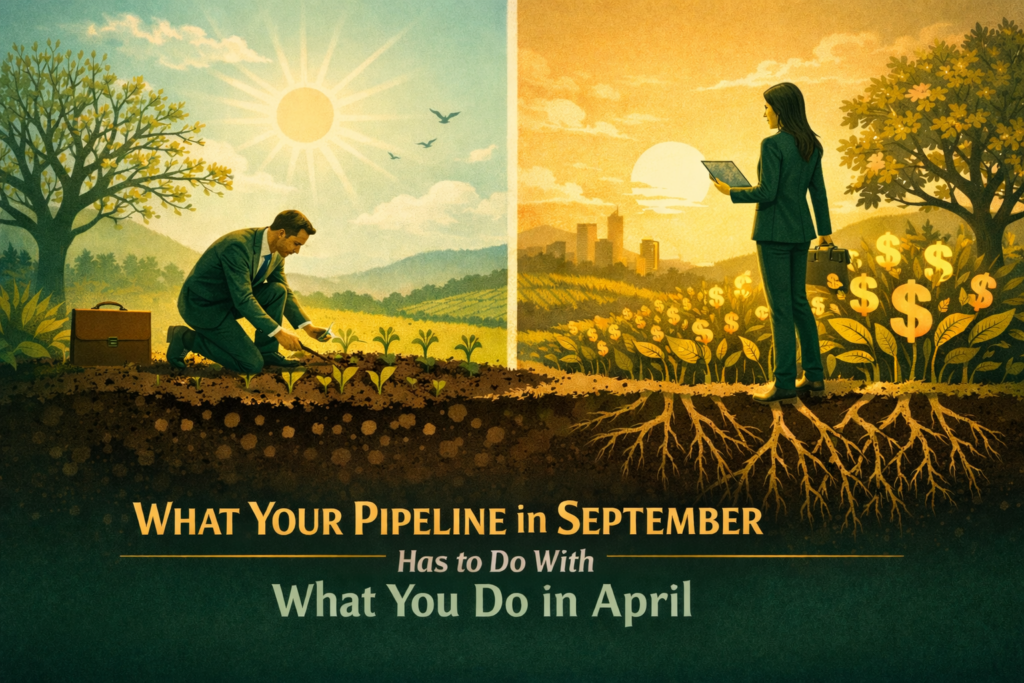
That moment — the moment your name comes up — doesn’t happen overnight. It is the result of a relationship that has been actively cultivated, in most cases, for somewhere between three and six months before the referral surfaces.
Which means the pipeline you’re sitting in this September is a direct reflection of the relationship work you did or didn’t do this spring.
Read that again.
The opportunities coming to you in the fall are being determined right now. Not by your track record. Not by your LinkedIn profile. Not by how good you are at what you do. By whether you are actively, intentionally building influence with the right people today.
Most fractionals understand this intellectually. Almost none of them act on it operationally.
Here’s why. The lag makes the feedback loop invisible. When you prospect consistently and a client shows up four months later, your brain doesn’t connect those dots. You remember the referral conversation, the meeting, the proposal — not the coffee you had in April that planted the seed. So the prospecting work feels disconnected from the result, and disconnected work is the first thing that gets deprioritized when the calendar fills up.
And the calendar always fills up.
This is the feast-and-famine cycle in its truest form. You get busy delivering. The relationship-building stops because there’s no immediate pressure to do it — you’re booked. Then the engagement ends, you look up, and the pipeline is empty. So you scramble. You have a flurry of coffee meetings and outreach and visibility efforts. And then you wait. Because the lag is real. And by the time the next engagement materializes, you’ve lost four months you didn’t have to lose.
The fractionals who break this cycle are not the ones who prospect harder when things get slow. They’re the ones who never stop prospecting when things are good.
Let’s make this concrete.
If you want a full pipeline in September, the work starts now. Not in June when you finish your current engagement. Not in July when you “have more time.” Now. Because the relationships you’re not building in April won’t show up as opportunities until October at the earliest — and that’s if you start today.
So here’s the question worth sitting with: who are the five people in your network right now who have the proximity and the credibility to refer you into your next ideal engagement? Not who could theoretically send you someone someday. Who specifically, with a name and a face, is positioned to do that — and what are you actively doing to stay relevant and valuable to them right now?
If you can’t answer that with five specific names and five specific answers, you don’t have a referral strategy. You have a hope strategy.
And hope, as a pipeline management tool, has a terrible track record.
There’s another dimension to the lag that doesn’t get enough attention.
It’s not just about when the referral surfaces. It’s about influence — the depth of trust your name carries when it does. A referral gets you a meeting. Influence gets you a client. The difference between those two outcomes is almost entirely determined by what happened in the months before the referral conversation — how present you were, how valuable, how specific your positioning was in the mind of the person who mentioned you.
If you’ve been maintaining — showing up occasionally, staying generally warm — you might get the mention. But the mention will be soft. “You should talk to Breandan, she knows about this stuff.” That’s a meeting.
If you’ve been cultivating — adding specific value, creating genuine moments of relevance, building a real influencer relationship — the mention sounds different. “You need to call Breandan. She is exactly who you need for this. Let me make the introduction.” That’s a client.
The work you do in the next 90 days determines which version of that conversation happens about you this fall.
This is exactly what Productive Prospecting: Trust Lab is built around. Not tactics. Not scripts. A system for building the kind of influence-based relationships that create consistent, predictable referral flow — with a clear understanding of the lag and how to work with it instead of being blindsided by it every cycle.
The next cohort starts April 7th. Which means if you enroll now, you’ll be building the relationships in April and May that show up as pipeline in July and August.
The lag works in your favor — but only if you start.
→ Learn more and reserve your seat at SalezWorks.com/TrustLab
Seats are limited to keep the cohort small and the work meaningful. If you’ve been thinking about it, now is the right time — not because I’m telling you it is, but because the calendar is.
Breandan Filbert is Managing Partner of SalezWorks and creator of Productive Prospecting: Trust Lab — a 13-week program for professionals building referral-based revenue through influence.