
Mark Twain once said, ‘there are 3 kinds of Lies: Lies, Damned Lies and Statistics’. This quote is at the forefront of my mind as I’m reviewing ALL the data that is talking about what’s happening in sales. And much like reality TV has it offers a skewed perspective of life that has nothing to do with reality, many of these reports *really* don’t apply to you and me.
Buried in the data lies insight that is important to how we choose to operate our businesses, large or small, in the coming year.
Where this started: My first year building this happened on a blustery winter morning in 2019, and my first ‘published’ report in 2020 launched just a few short months before the world changed. This is the insight that determines my direction and focus of marketing for the upcoming year.
While much of the published data is geared towards enterprise teams and large companies, there are gems hidden within once you get past the bias. That’s what my report summarizes. Along with my personal observations, which coupled with $5.75 will buy you a cup of coffee.
Damn inflation.
Let me name a few stats that matter to you:
Salesforce’s State of Sales report (7th edition, 4,050 sales professionals, fielded August to September 2025) found that 94% of companies now use partner selling, up from 86% in 2024. And 89% say it is increasingly important for hitting revenue targets.
Referrals and partnerships are no longer a side channel. They are *the* channel to predictable growth in today’s crazy market.
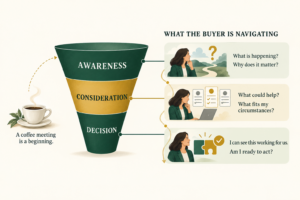
Who knew those endless coffee meetings would lead to more than just jitters?
Take a minute to think about what that number actually measures. It counts how many companies sell through partners. It does not measure how well.
This is where small players can dominate with a selling strategy.
What most people call partner selling
In my experience, most of what gets called partner selling is a casual introduction: I’ll think of you, you’ll think of me. It can open a door. But it does not create influence, and it rarely produces a steady flow of business.
What partner selling really means
Real partner selling is deeper. It means understanding your partner’s clients as well as your own, working out where your work and theirs meet, and creating something together that neither of you could offer alone.
That might be:
- A joint diagnostic for a situation you both see in your clients
- A roundtable for a client group you share
- A combined offering that gives the client one better answer than they could find independently
- A resource you build for the people you both serve
Three scenarios, and what separates them
The traditional team: A financial advisor, an estate planning attorney and an accountant. They refer clients to each other, share information and coordinate when a client needs all three. That is valuable, and many clients are well served by it. But notice what happens if you swap one out. A different attorney, a different accountant, and the client’s outcome is largely the same. Three services run side by side. It is a strong referral network, not a joint offer. This approach presents the opportunity to share leads, but doesn’t provide a bridge to the partner offering. It presents friction, and friction kills deals.
The construction version: A commercial real estate professional brings a general contractor and a designer into the conversation with the client from the start, before a site is chosen or a lease is signed. The CRE professional knows the market and what a site can support. The designer helps the client imagine the space. The GC says what it will take to build it, and what it will cost for build out. The client gets one vision with a real number attached, instead of three separate conversations and three separate bids. Take the designer out and the idea changes. Take the GC out and the number does. The offer only exists because all three built it together. It also removes friction for the CRE professional in helping a customer evaluate a major purchase. Everyone wins.
The IP version: Say you have built an initial assessment you use at the start of every client engagement. It is your method, your questions, your way of reading what you find. Now pair it with a partner who is a software designer. Together you give the client a dashboard with KPIs built from their actual data, not a one-time report that goes in a drawer. Without your work, the developer has a dashboard with nothing meaningful to measure. Without the developer, you have a method and no system to run it. Neither of you could sell it alone, and neither of you could easily be swapped out. And within the IP lies recurring revenue you can both realize while providing even more value to the client.
The difference in all three comes down to one question: can you swap a partner out and still deliver the same thing? If yes, you have a good network. If not, you have built something together.
The test
Could either of you sell this on your own?
If yes, you have a referral marketing arrangement. If no, you have a partnership.
Partnerships built this way give the client a better answer. They give each partner a reason to talk about the other. And they make each partner harder to replace.
If you are still building your client base
This matters most for firms still building. If you have few clients, cross-referring each other’s work will not go far. There is only so much to trade.
The better question is what the two of you can go win together.
Try this week
Start with three questions you can ask your partner over coffee:
- Who are the clients we both serve? Name two or three.
- Where does my work end and yours begin? That handoff is usually where the client feels the gap.
- If we presented as one firm for that client, what would we offer? That answer is your first draft.
Choose one partner whose clients are your clients. Not five. One. Learn what they need, and sketch one thing the two of you could create that neither could offer alone. A diagnostic, a roundtable, a shared resource. It does not have to be big. It has to be something that is not just a name swap.
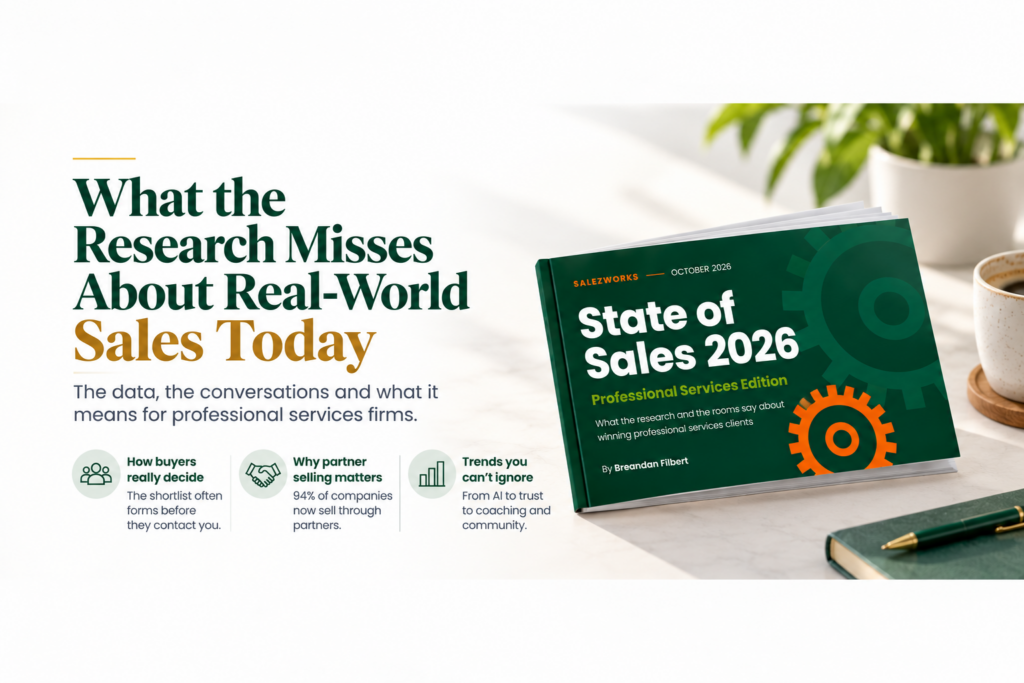
That is move five in the 2027 playbook in my State of Sales 2026 report, and it ties directly to the first-call test: when your partner’s client asks who to call, you want to be the answer because of something you built, not because you were next on a list.
Within my report I share not only the data, but what matters to small teams, solopreneurs and independent consultants (and contractors) to help you develop your own marketing direction for the coming year.
Your coffee habit will thrive in 2027, but let’s make sure the conversations provide much needed traction.
The State of Sales 2026: Professional Services Edition tests the research against what I hear in rooms every week, and tells you what to do about it. 40 pages, including the First-Call Test and a six-move 2027 playbook.