

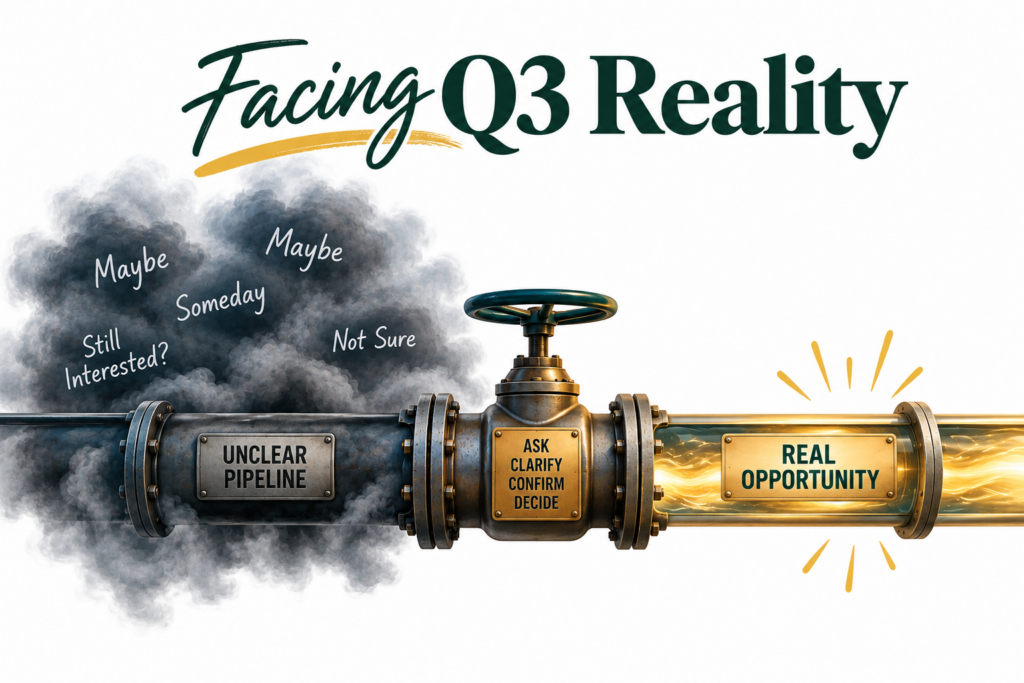
Is It Actually Still Happening, or Are You Just Hoping It Is?
When you’re a full sales team, a stalled deal is a line item. When you’re a practice of one, a stalled deal is a piece of your own mental bandwidth, quietly occupied by something that might not be real anymore.
That distinction matters more than it sounds like. A larger team can afford to let some pipeline sit ambiguous while other people chase other things. When it’s just you, every conversation you’re still mentally counting as “possible” is also a conversation taking up space you could be spending somewhere else, on a genuinely live opportunity, on rest, on the parts of running a practice that actually need your attention.
So here’s the honest question worth sitting with today: how much of what you’re currently counting on is actually still moving, and how much of it is just something you’re hoping is still moving, because it’s easier than admitting it might not be?
I want you to really think about this one.
Why This Costs a Solo Practice More Than It Costs Anyone Else
If you’re the only one generating business development activity, an unresolved prospect doesn’t just sit quietly in a CRM somewhere. It occupies space in your head. You think about it when you’re deciding how hard to push elsewhere. You factor it into how urgent your other prospecting feels this week. You’ve probably, at some point, held off on a harder conversation or a harder ask because some part of you was still counting on this other thing to come through.
That’s the real cost of unresolved pipeline when you’re the whole operation. It’s not just a missed number on a spreadsheet. It’s the energy and attention you didn’t spend elsewhere, because part of you was still holding space for something that may have already quietly ended.
Find the Friction. Don’t Just Wait to See What Happens.
The instinct, when something stalls, is often to wait. Give it time. They said they were interested, they’re probably just busy, it’ll come back around.
Sometimes that’s true. Often, waiting is just a more comfortable way of avoiding a direct conversation that would actually tell you something useful.
Finding the real friction means asking, plainly, instead of guessing quietly. Not “just checking in,” which asks nothing and reveals nothing. An actual question: is this still something you’re planning to move forward with, and if so, what’s actually standing in the way right now?
The answer usually falls into one of a few categories, and each one tells you something different about what to do next. Sometimes the friction is timing, genuinely real, genuinely temporary, and worth staying patient for. Sometimes it’s budget, which may be solvable with a different scope or structure. Sometimes it’s a shift in priorities on their end that has nothing to do with you, and no amount of patience or persistence will change it. And sometimes, if you’re honest, the friction is that the person you’ve been talking to never actually had the authority or intention to move this forward in the first place.
You can’t tell which of these you’re dealing with by waiting quietly and hoping. You can only tell by asking.
Some of What You’re Counting On Isn’t Coming
This is the harder part, and it deserves to be said plainly rather than softened. Some of what’s sitting in your pipeline right now, some of what you may be quietly counting toward this quarter or this year, isn’t going to materialize. Not because you did anything wrong. Because timing shifted, priorities changed, or the opportunity was never as solid as the early conversation made it feel.
Holding onto that hope past the point where it’s realistic doesn’t cost you nothing. It costs you the clarity to redirect your limited time toward something that could actually move. Letting go of something that was never going to happen isn’t giving up. It’s making room for the effort to go somewhere it can actually do something.
What I’d Do This Week
Go through what you’re currently counting on, everything you’d list if someone asked what’s in your pipeline right now. For each one, ask honestly: have I actually confirmed this is still moving, or am I just assuming it is because the alternative is uncomfortable?
For anything you can’t answer honestly, have the direct conversation this week. Not a check-in. An actual question about what’s standing in the way. Whatever the answer is, even if it’s not what you were hoping for, it gives you something waiting quietly never will: the ability to actually decide what to do next, instead of continuing to hold space for a maybe.
If you want a second, honest set of eyes on your own pipeline, someone to help you sort what’s real from what’s just hope wearing a hopeful label, that’s exactly the kind of conversation worth having directly.
[Grab a spot on my calendar →]
This is part of a short series I’m running this month on what’s actually sitting in your pipeline, and what it’s costing you to leave it unresolved.