

Nobody joins a professional services firm because they love business development.
You joined because you’re good at the work. The advising, the building, the solving — that’s the part that made you want to do this in the first place. Business development is the tax you pay to get to do more of it.
And most people pay that tax reluctantly, inconsistently, and — the data says — for about three contacts before they quietly stop.
The Numbers Don’t Lie, and They’re Not Kind
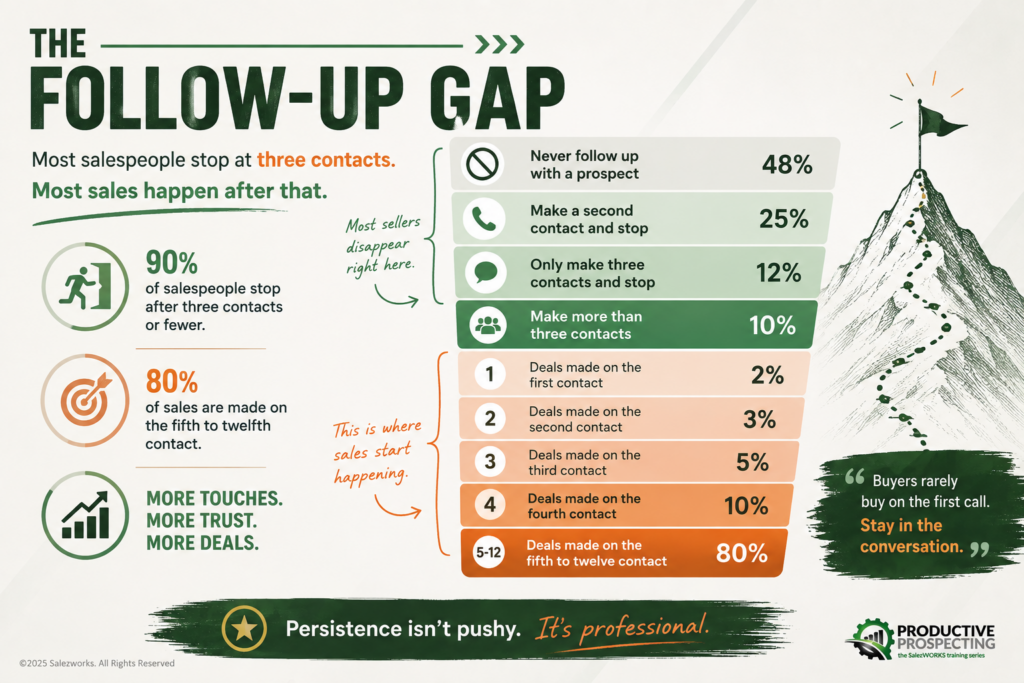
90% of salespeople stop after three contacts or fewer. Only 10% ever make a fourth attempt.
Meanwhile, 80% of deals close somewhere between the fifth and twelfth contact.
Sit with that for a second. Nine out of ten people are quitting in the exact range where almost nothing gets closed — and abandoning the relationship right before it was about to start paying off.
This isn’t a knowledge problem. Everyone reading this already knows persistence matters. The gap isn’t information. It’s execution under discomfort, week after week, with no guarantee any specific contact will be the one that lands.
Why It’s So Hard to Stay in the Conversation
A few reasons this keeps happening, even to smart, capable people:
Every follow-up feels like an imposition. After the second unanswered email, it starts to feel like you’re bothering someone. That feeling is almost never accurate — but it’s persuasive enough to make people stop.
There’s no visible progress. Unlike client work, where you can see a deliverable taking shape, business development often looks identical from contact to contact. Nothing seems to be building. It’s hard to stay disciplined toward a payoff you can’t see coming.
The work that pays your bills today crowds out the work that pays your bills in six months. A client call always feels more urgent than a fourth follow-up to a prospect who hasn’t responded. So the follow-up gets pushed. Then it gets forgotten.
Rejection, even silent rejection, costs something. An unanswered email isn’t technically a “no.” But it feels like one enough times, and most people would rather stop asking than keep hearing it.
None of these are character flaws. They’re just what happens when the work is emotionally taxing and the reward is delayed and uncertain.
Part of the Problem Is What You’re Actually Saying on Contact Four
Here’s a layer underneath the discomfort: a lot of people who do push past contact three are still sending the same message they sent on contact one. Different subject line, same pitch. “Just following up.” “Wanted to circle back.” Then the credentials again, the capability again, the ask again.
No wonder it feels exhausting to send and easy for the buyer to ignore. It’s not persistence at that point — it’s repetition.
Sales opens the door. That’s the job of the first contact: earn the next conversation. But marketing’s job — every touch after that — is to build confidence that you’re the right resource, not to keep restating that you’re great at what you do. Those are different jobs, and most follow-up sequences only know how to do the first one.
Think about where the buyer actually is instead of where you wish they were:
- Early contacts — they don’t know yet whether you understand their specific problem. Content here should demonstrate understanding of their situation, not showcase your capability.
- Middle contacts — now they’re evaluating whether you can actually deliver. This is where a relevant case study or a specific proof point earns its place.
- Later contacts — only here does it make sense to talk scope, next steps, what working together looks like.
A firm that runs the same “look how great we are” pitch at every single touch is asking a buyer who isn’t ready yet to respond as if they were. That mismatch is a big part of why the fourth, fifth, and sixth contact feel so hard to send — you’re not actually building anything new, you’re just repeating yourself louder and hoping persistence alone closes the gap.
It won’t. But a sequence that meets the buyer where they actually are will.
What Changes When You Know Where the Gap Actually Is
The data points to something specific: the relationship-building isn’t failing in the first contact or the second. It’s failing in the silence after the third, right where the deal was about to start moving.
That reframes the whole problem. You don’t need to become a different kind of person to close more business. You need a system that keeps you in the conversation past the point where instinct tells you to stop — because instinct is tuned to protect you from discomfort, not to optimize for outcomes five contacts away.
Persistence isn’t pushy. It’s professional. The firms and practitioners who treat the fourth, fifth, and sixth touch as the actual job — not the awkward overreach — are the ones showing up in that 80%.
This is the exact gap we spend real time on inside Trust Lab — not because follow-up is complicated, but because sustaining it without a system is genuinely hard. More on that soon.