
PROFESSIONAL SERVICES SERIES | AUGUST 12, 2026
There is a moment in a professional services sales conversation where the buyer goes quiet.
Not because they’re uninterested. Because they’re afraid.
They’ve been here before. They hired someone who promised transformation and delivered a report. They brought in an expert who spoke in frameworks and left them with a binder. They invested in a solution that worked beautifully in the proposal and disappeared in practice.
They’ve bought air. And it didn’t work.
So when you sit across from them — with your credentials, your case studies, your genuine capability — they smile and nod and tell you they’ll think about it. And they do think about it. They think about the last time they trusted someone like you.
This is the reality of selling professional services today. And most practitioners are responding to it in exactly the wrong way.
More Proof Doesn’t Close the Trust Gap
The instinct when buyers are skeptical is to add more evidence. More testimonials. More case studies. A longer track record. A more impressive client list.
None of it works the way you think it does.
Here’s why: today’s buyer doesn’t doubt that you’ve done great work for someone else. They doubt that you can do great work for them. Specifically. In their situation. With their constraints, their team, their history, and their particular version of the problem.
That’s not a credentials problem. That’s a trust gap — and credentials don’t close trust gaps. Experience does.
The buyer needs to feel what it’s like to work with you before they can commit to working with you. They need a taste of how you think, how you solve, and how you show up — before they write a check for the whole engagement.
Most professionals never give them that chance. They go straight from introduction to proposal and wonder why the conversion rate is low.
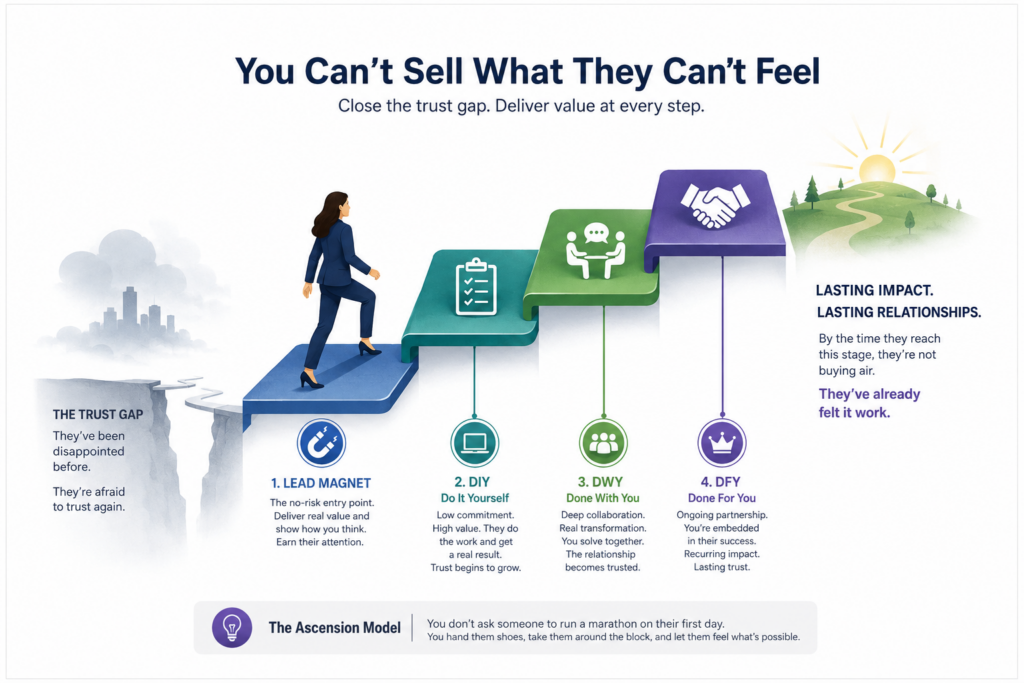
The professionals who build thriving retained practices understand something different: you don’t ask someone to run a marathon on their first day. You hand them shoes, take them around the block, and let them feel what’s possible.
That’s the Ascension Model. And it changes everything about how professional services gets sold.
The Ascension Model — Four Stages, One Direction
The Ascension Model is a deliberately designed client journey. Each stage delivers enough value that the next stage becomes obvious — not a hard sell, not a pitch, but a natural next step that the buyer can see for themselves.
It works because it closes the trust gap in layers. By the time a client reaches the deepest level of engagement, they’re not buying air. They’ve already breathed it. They know what it does for them. They’ve felt the transformation beginning.
Here’s how it works:
- Lead Magnet — The entry point is free, and it has to be genuinely valuable — not a thinly veiled sales pitch dressed up as content. A lead magnet that demonstrates how you think is worth a hundred cold calls. It gives the skeptical buyer a no-risk way to experience your expertise. A well-crafted lead magnet answers a real question, creates a real insight, and leaves the reader thinking: “I want more of how this person thinks.” That’s the only job it has. If it does that job, the next stage sells itself.
- DIY — Do It Yourself — The first paid stage is low commitment and high value. The buyer does the work; you provide the structure, the framework, the roadmap. Think workshops, bootcamps, courses, or guided assessments at an accessible price point. This is where the trust gap starts to close in a meaningful way. The buyer invests something — time, money, attention — and gets a real result. They experience your methodology firsthand. They see that it works. And because they did the work themselves, they own the result in a way they never could from a case study. The DIY stage is not a loss leader. It’s proof of concept for both of you. And for some buyers it will be enough to get the result they are looking for – right now. But now they’re in your universe as a client. And remember someone who buys from you once is 5 X more likely to buy again as their need expands or evolves.
- DWY — Done With You — This is the transformation stage. Strategy development, deep collaboration, the real work of change. You’re not handing them a framework anymore — you’re in it together. The buyer brings the context; you bring the expertise. This is where the relationship deepens from transactional to trusted. Done With You engagements are where most of the meaningful work begins, and where the buyer begins to see you not as a vendor but as a thinking partner. They’re not buying a deliverable. They’re buying access to how you solve. That shift in perception is everything. This may be coaching, paid board member roles or other ongoing advisory services.
- DFY — Done For You — This is the retained fractional relationship. The buyer has experienced enough of your thinking, your methodology, and your results that they want you embedded – not project by project, but as an ongoing part of how they operate. Done For You is where recurring revenue lives. It’s where the deepest client relationships are built. And it’s where the professionals who understand the Ascension Model separate themselves from everyone else. They’re not reselling every quarter. They’re already inside the work.
Why Skipping Stages Costs You the Client
The most common mistake professionals make with high-value buyers is moving too fast.
They meet someone who seems like a perfect fit and go straight to the DFY conversation. They send a proposal for a six-month retained engagement to someone who has never experienced their work. They ask for a marathon commitment from someone who hasn’t laced up their shoes yet.
The buyer says they’ll think about it. And they do. And then they don’t call back.
It’s not that the proposal was wrong. It’s that the trust wasn’t there yet. The relationship hadn’t earned that conversation.
The Ascension Model works because it respects the buyer’s psychology. It gives them a way to say yes to something small before they’re asked to say yes to something significant. Each stage reduces the perceived risk of the next. Each stage builds the emotional confidence that the investment will pay off.
Skipping stages doesn’t speed up the sale. It kills it.
The professionals who understand this don’t push for the biggest engagement upfront. They design the journey so that the biggest engagement becomes the obvious, logical, desired next step — for the buyer, not just for them.
The Ask That Earns Itself
Here’s what happens when a client moves through the full ascension.
They experienced your insight at the lead magnet stage and it changed how they saw their problem. They did the work at the DIY stage and got a result they can point to. They built something real with you at the DWY stage and felt what it’s like to have a genuine thinking partner. And now, at the DFY stage, you’re embedded in how they operate.
That client doesn’t just stay. They send people.
Not because you asked. Because they have a story. A specific, personal, felt story about what changed for them and why. And when someone in their network has the same problem, your name comes out of their mouth before they even think about it.
That’s the referral that comes from the Ascension Model. Not a transaction. Not a favor. An introduction from someone who genuinely wants to see you win — because you helped them win first.
And when that moment comes, when the trust is deep and the results are real — that’s when you make the ask. A specific introduction to a specific person. Not a general “let me know if you know anyone.” A real, focused request.
The Ascension Model builds the relationship that makes that ask feel natural. Everything before it is the groundwork.
Freeway to Fractional
If you’re a professional services practitioner or knowledge worker ready to stop selling project by project — Freeway to Fractional is where the Ascension Model gets built into your practice. Your lead magnet, your DIY entry point, your DWY engagement, your DFY retained service. Structured, priced, and ready to sell.
Stay tuned for a special workshop to explore an Ascension Model in your client experience.