
Most professionals think their pipeline problem is a visibility problem. Get in front of more people. Post more content. Refine the pitch. Run more ads. Optimize the website.
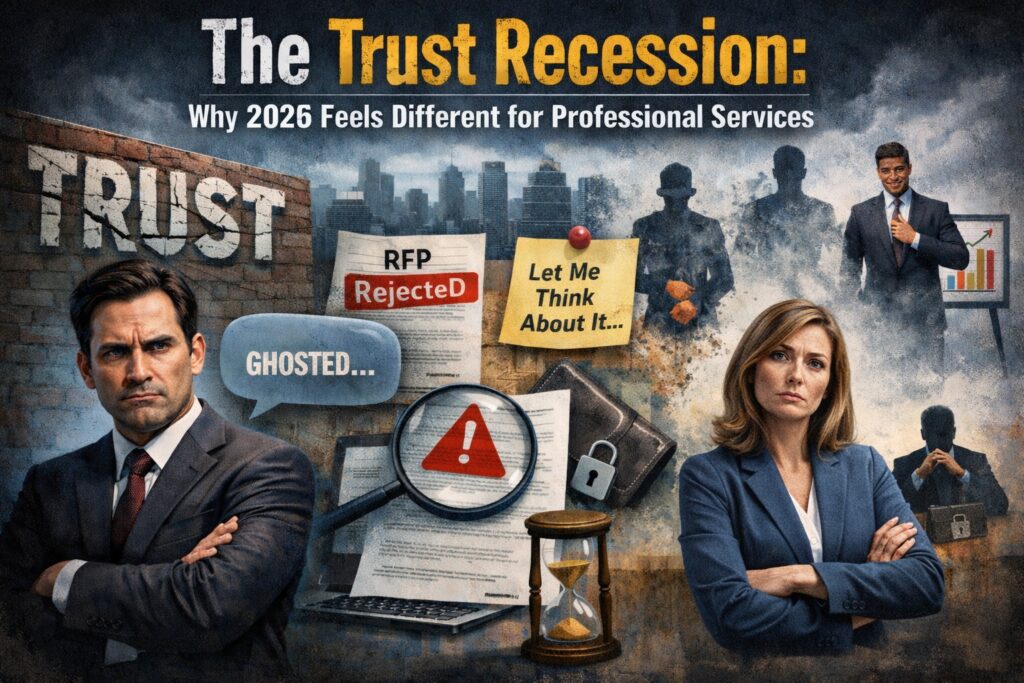
But here’s what most professionals miss: this isn’t a temporary market downturn. It’s a trust recession.
And no amount of exposure fixes a trust problem. Buyers see you just fine. They’re reading your content, visiting your website, and even taking your calls. They’re just not convinced that hiring any professional is worth the risk. Because the last three consultants they hired overpromised and underdelivered—and now you’re paying the price for their mistakes.
What Is a Trust Recession?
A trust recession happens when the default setting for buyer behavior shifts from “open to possibilities” to “skeptical of everyone.”
It’s not that buyers don’t need help. They do—desperately, in many cases.
It’s that they’ve been burned too many times by:
- Consultants who over-promised and under-delivered
- Agencies who disappeared after the contract was signed
- “Experts” who delivered cookie-cutter solutions dressed up as custom strategy
- Fractional executives who treated interim roles like auditions for their next thing
The result? Buyers now approach every professional conversation with their guard up, their BS detector on high alert, and their wallet firmly closed until you prove—really prove—that you’re different.
The Post-Pandemic Buying Behavior Shift
Pre-2020, professional services buying followed a relatively predictable pattern. A company identified a need, they’d take a few meetings, check references, and make a decision within a reasonable timeframe.
Post-pandemic, that pattern shattered.
Our State of Sales research [grab it here] revealed something striking: buyers are taking 40% longer to make decisions about professional services than they did three years ago. But they’re not taking longer because they’re doing more due diligence on you. They’re taking longer because they’re questioning whether they should hire anyone at all.
Here’s what changed:
They learned to live without you. During lockdowns, companies figured out how to survive with skeleton crews, delayed projects, and DIY solutions. That muscle memory remains. The question isn’t just “Should we hire you?” It’s “Should we hire anyone?”
They got comfortable with uncertainty. When the world turned upside down, waiting and watching became the default strategy. That patience—or is it paralysis?—hasn’t left. Buyers are more comfortable sitting in indecision than they’ve ever been.
They can smell desperation. With everyone’s pipeline thinning, the market is flooded with professionals trying harder to win work. And buyers can feel it. The more you push, the more they pull back. The more “strategies” you deploy, the less they trust you.
Why Buyers Are More Skeptical Than Ever
The trust recession isn’t just about economic uncertainty. It’s about pattern recognition.
Buyers have been conditioned to expect disappointment from professional services providers. They’ve sat through too many discovery calls that felt like interrogations. They’ve received too many proposals that read like Mad Libs with their company name swapped in. They’ve been told “we’re different” by people who are exactly the same.
And here’s the uncomfortable truth: most of that skepticism is earned.
The professional services industry has trained buyers to be skeptical by:
- Leading with methodology instead of outcomes
- Talking about “our process” before understanding their problem
- Offering solutions before establishing trust
- Treating every conversation like a transaction instead of a relationship
When everyone shows up the same way—polished pitch deck, case studies, three-step process—buyers default to the lowest common denominator: price. Because if you all sound the same, why not just hire the cheapest option?
What This Means for How You Need to Show Up
If the default is skepticism, your job isn’t to overcome objections. Your job is to earn trust before you ever mention your services.
That means:
Stop leading with what you do. Buyers don’t care about your methodology until they believe you understand their world. Lead with insight, perspective, and questions that make them think differently about their situation.
Accept that the sale starts long before the sales conversation. Trust is built in the margins—the article that made them think, the recommendation from someone they respect, the perspective you shared that had nothing to do with your services.
Embrace disqualification as an act of service. The fastest way to build trust in a trust recession? Tell people when you’re NOT the right fit—and then introduce them to someone who IS. This is what separates professionals from Trusted Advisors. Anyone can say “we’re not right for this.” A Trusted Advisor says “we’re not right for this, but let me connect you with someone who is.” That single act—putting their success above your revenue—earns you a reputation that opens doors for years.
Recognize that your reputation is your only real asset. In a world where buyers default to skepticism, the only thing that opens doors is a reputation for integrity, results, and saying no when you should.
The trust recession isn’t going away. The buyers who emerged from the pandemic aren’t going back to the old way of making decisions.
Which means the professionals who thrive won’t be the ones with the best pitch. They’ll be the ones who never needed to pitch in the first place.
What patterns are you seeing in your own pipeline? Let’s talk about it.
If you’re navigating this trust recession and want to connect with other professionals who are rethinking how they build pipeline, join our SolutionsXChange Community on LinkedIn—a space we’re building for honest conversations about what’s actually working in professional services.
And if you’re ready to build a pipeline that doesn’t depend on cold outreach or “spray and pray” tactics, join us for our free webinar on Monday, January 13: “Building a Referral-Based Pipeline That Actually Works.” We’ll walk through the frameworks that help professionals create consistent revenue without the hustle. Register here.
![An illustrative infographic, divided vertically, compares two business approaches: "THE OLD WAY: COMMODITY BID LIST" (left) and "THE NEW WAY: PARTNERSHIP LEVERAGE" (right). On the left side, under a banner title of "The Bid List Isn’t a Relationship. Here’s What Is," a line of construction workers, some appearing frustrated, are waiting with stacks of bid forms in a queue to a counter labeled "GENERAL CONTRACTOR" with "SUBMIT BID" and "LOW PRICE WINS" signs. A very large pile of generic bid forms is shown next to them. Accompanying text labels state: "Being on the bid list feels like progress", "Most of the time, you lose", "It's a commodity position", "Levers: price, schedule", and "Auditioning, not differentiating". On the right side, labeled "THE NEW WAY: PARTNERSHIP LEVERAGE," a group of diverse professionals are seated at a modern table, collaborating over a blueprint. They are shaking hands over a central handshake icon, which is labeled "TRUST." A thought bubble above them contains four icons: "EARLY CONVERSATIONS" (phone and calendar), "SOLVING PROBLEMS" (gears and question mark), "REFERRALS" (connected arrows), and "JOINT STRATEGY" (gears and team). Through a large window behind them, a multi-story building is actively under construction, with a large tower crane visible. Right-side text labels list the benefits: "Called before the bid goes out", "Deeper in fewer relationships", "Most trusted, not cheapest", "Attract work, don't chase", and "Make the bid irrelevant". In the bottom-right corner, a button reads "BOOK CALL" and next to it, "[BOOK YOUR 20-MINUTE CALL]](https://salezworks.com/wp-content/uploads/2026/04/Gemini_Generated_Image_euv2bheuv2bheuv2-300x164.png)