

If you’re a fan of The Princess Bride, you know the line. Inigo Montoya, exasperated, finally says what we’ve all wanted to say to someone at least once: “You keep using that word. I do not think it means what you think it means.”
I have that same reaction almost every week — except the word isn’t “inconceivable.” It’s “referral.”
Because what most professionals call a referral isn’t one. And the confusion isn’t just a vocabulary problem. It’s costing you months of effort, hours of wasted meetings, and a pipeline full of people who were never going to buy.
The Scenario You Know By Heart
You’re at a networking event. A client lunch. A happy hour. Someone says, “Oh, you should talk to so-and-so — I’ll send them your info.” Or maybe it’s a LinkedIn message: “Hey, I mentioned you to a friend. I’ll connect you two.”
You walk away feeling great. You got a referral!
Except you didn’t.
What You Actually Got: A Lead
Someone shared your name. Maybe they passed along a card, fired off a text, or made a loose email introduction. It feels good to receive. It feels generous to give. But here’s what was missing: there was no context about your specific impact, no connection to the prospect’s specific situation, and no transfer of trust.
It’s a name-drop, not an endorsement. And it converts at roughly 10–15%.
Why? Because when you show up to that meeting, you’re still a stranger. A stranger with a slightly warmer handshake, sure — but a stranger nonetheless. You still have to establish credibility. You still have to prove relevance. You still have to make the case that this meeting is worth their time.
You’re selling from scratch.
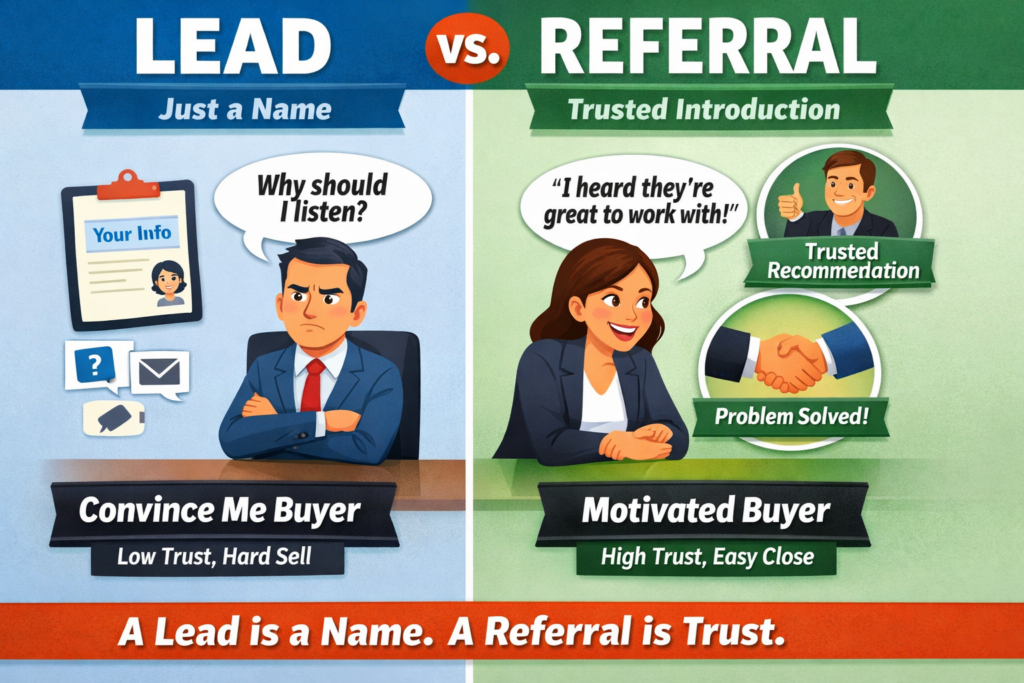
Meet the “Convince Me” Buyer
This is who’s sitting across the table when you chase a lead disguised as a referral. They took the meeting because someone they know mentioned your name and they were being polite — or mildly curious. But they showed up skeptical. Arms crossed, figuratively or literally.
Convince me you’re credible. Convince me you’re relevant. Convince me this is worth my time.
You’re auditioning. You’re competing against every other name that got tossed their way. And you’re spending months trying to earn trust that could have been transferred in a single sentence from the right person.
That’s the real cost of the “convince me” meeting — not just the hour in the room, but the weeks and months that follow. The follow-up emails. The proposal revisions. The slow dance of proving yourself to someone who never showed up ready to buy.
Now Here’s What a Referral Actually Is
A referral happens when someone who knows your work shares a specific situation where you made an impact — and relates that story directly to the prospect’s current challenge. Then they put their own influence behind it:
“Based on what you’re dealing with, I’ve seen them solve exactly this. I believe they could help you. It’s well worth your time to explore.”
That’s not a name-drop. That’s a transfer of trust.
The person making the referral has done three things a lead never does: they connected your capability to the prospect’s need, they shared context that makes your relevance undeniable, and they put their own credibility on the line as an endorsement.
Meet the Motivated Buyer
This is who shows up when a real referral has been made. They’re not skeptical. They’re leaning in. Someone they trust told them you could help — and explained why.
Your credibility has been pre-established. The relevance of your work has been pre-connected to their situation. They’re not evaluating whether to trust you — someone they already trust has done that work for them.
The conversation doesn’t start with “so tell me what you do.” It starts with “I’ve heard about what you did for [person/company] and I think we might have a similar situation.”
That’s not an audition. That’s a collaboration. And the distance between the first meeting and the signed agreement? It just collapsed by months.
The Real Cost of the Confusion
When you can’t tell the difference between a lead and a referral, everything downstream gets distorted. You overestimate your pipeline. You underinvest in the relationships that actually produce revenue. You spend your energy asking for introductions instead of earning advocacy.
You fill your calendar with “convince me” meetings that stall out instead of conversations with motivated buyers who are ready to move.
And worst of all, you start to believe that business development is supposed to feel this hard — that the grind of chasing, persuading, and following up is just the cost of doing business.
It’s not. You’re just working the wrong side of the equation.
The Bottom Line
A lead is asked for. A referral is earned.
One gives you a name. The other gives you influence. One fills your pipeline with “convince me” meetings. The other fills it with motivated buyers who chose you before you ever walked in the room.
The difference isn’t semantics. It’s months off your sales cycle, hours back in your week, and clients who show up ready to work with you — not ready to be convinced.
So which one are you building your business development around?
If you’re ready to stop collecting leads and start earning real referrals, the Trust Lab — Builder Edition is launching soon. This is where we teach you to build the strategic relationships that produce motivated buyers, not “convince me” meetings. [Join the waitlist →]