
A client came to me recently with a network most professionals would kill for. Senior leaders, decision-makers, people who genuinely liked and respected him. Years of relationships built on real trust. And none of it was producing business. He didn’t need more connections — he needed to learn how to be referable. Because the people who wanted to help him simply didn’t know how.
He’d made a career pivot. New direction, new value proposition, new kind of client he was serving. But every conversation with his network still started the same way: “So, are you still doing [old thing]?”
And every time, he’d correct them. Explain the new direction. Walk them through it. They’d nod and say “that’s great, I’ll keep you in mind” — and then nothing. No introductions. No mentions in rooms he wasn’t in. Not because they forgot about him. Because they couldn’t place him.
He had all the right relationships. He just hadn’t given them anything they could work with.
Here’s something most professionals never stop to consider: being well-connected and being referable are two completely different things.
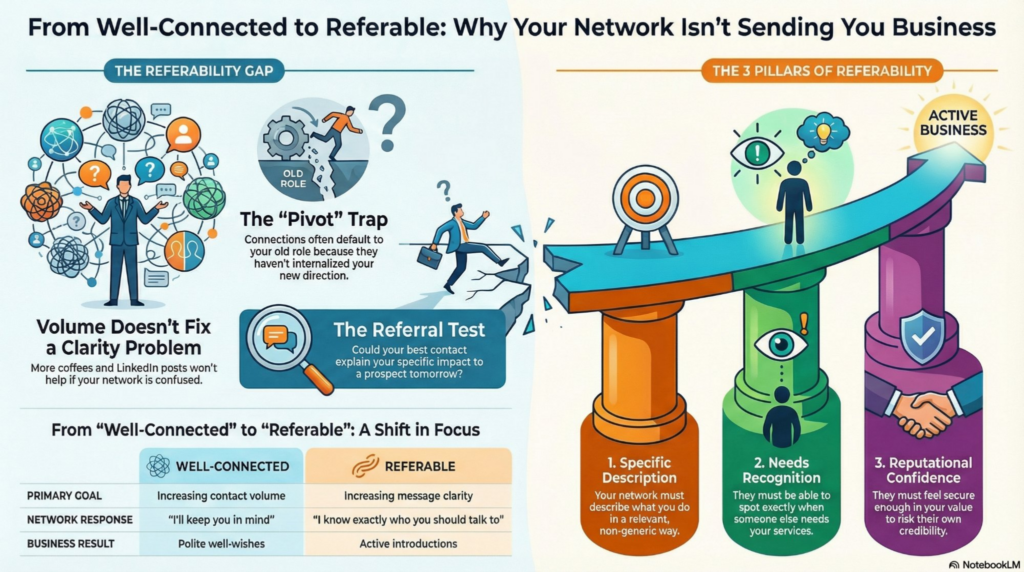
Referable means the people in your network can do three things without you in the room. They can describe what you do in a way that’s specific and relevant. They can recognize when someone they’re talking to actually needs what you offer. And they feel confident enough in their understanding of your work to put their own name behind the introduction.
If any one of those three breaks down — even one — you don’t get referred. You get wished well. You get “I know someone, let me think about it” which is the polite way of saying “I don’t know how to connect what you do to anyone I know.”
And that’s not their failure. That’s yours.
The instinct when business isn’t coming through your network is almost always the same: do more. More events. More coffees. More LinkedIn posts. More “just checking in” emails that both of you know are really “please think of me” emails.
But volume doesn’t fix a clarity problem. If the ten people who know you best can’t articulate your value in a way that connects to someone else’s specific situation, adding fifty more contacts to the mix won’t change a thing. You’ll just have more people who like you, respect you, and have no idea what to do with you.
That’s not a networking problem. That’s a referability problem. And most professionals don’t even know the difference because nobody ever told them there was one.
So here’s the question I want you to sit with this week.
Think about your best contact. The one who knows you, trusts you, and would go out of their way for you if they could. Now imagine they get a call tomorrow from someone who is a perfect fit for what you do. Could they explain — clearly, confidently, without fumbling — why that person should take a meeting with you?
Not your title. Not your background. Not “they’re really great, you should talk to them.”
Could they describe the specific impact you create, and connect it to that person’s specific situation, with enough conviction to put their own credibility on the line?
If the answer is “probably not” — you’re not alone. Most professionals can’t pass that test. And it has nothing to do with how good you are at what you do.
It means the people who want to help you simply don’t have what they need to do it.
That’s not something you fix with a better elevator pitch or a sharper LinkedIn headline. It goes deeper than that. And next week, I’m going to show you what this looks like from the other side — from the perspective of the people you’re hoping will refer you. What they experience when they want to make an introduction but can’t quite get there.
It might change how you think about every relationship in your network.
The Trust Lab — Builder Edition is launching in March. If you’re a professional who’s tired of being well-connected but under-referred, this is what we work on. [Join the waitlist →]
![An illustrative infographic, divided vertically, compares two business approaches: "THE OLD WAY: COMMODITY BID LIST" (left) and "THE NEW WAY: PARTNERSHIP LEVERAGE" (right). On the left side, under a banner title of "The Bid List Isn’t a Relationship. Here’s What Is," a line of construction workers, some appearing frustrated, are waiting with stacks of bid forms in a queue to a counter labeled "GENERAL CONTRACTOR" with "SUBMIT BID" and "LOW PRICE WINS" signs. A very large pile of generic bid forms is shown next to them. Accompanying text labels state: "Being on the bid list feels like progress", "Most of the time, you lose", "It's a commodity position", "Levers: price, schedule", and "Auditioning, not differentiating". On the right side, labeled "THE NEW WAY: PARTNERSHIP LEVERAGE," a group of diverse professionals are seated at a modern table, collaborating over a blueprint. They are shaking hands over a central handshake icon, which is labeled "TRUST." A thought bubble above them contains four icons: "EARLY CONVERSATIONS" (phone and calendar), "SOLVING PROBLEMS" (gears and question mark), "REFERRALS" (connected arrows), and "JOINT STRATEGY" (gears and team). Through a large window behind them, a multi-story building is actively under construction, with a large tower crane visible. Right-side text labels list the benefits: "Called before the bid goes out", "Deeper in fewer relationships", "Most trusted, not cheapest", "Attract work, don't chase", and "Make the bid irrelevant". In the bottom-right corner, a button reads "BOOK CALL" and next to it, "[BOOK YOUR 20-MINUTE CALL]](https://salezworks.com/wp-content/uploads/2026/04/Gemini_Generated_Image_euv2bheuv2bheuv2-300x164.png)