
The Race to the Bottom Is a Choice. Here’s the Exit.
There’s a conversation happening in every developer’s inbox right now. It usually sounds something like this:
“Send me your number. We’ll compare.”
And somewhere in that process, a general contractor who is excellent at their craft — who delivers on time, manages trade partners effectively, protects the owner’s relationship and timeline — drops their margin to win work they’ve already earned the right to. Again.
This is not a market problem. It’s a relationship problem. And it has a solution.
What Your Best Clients Actually Want From You
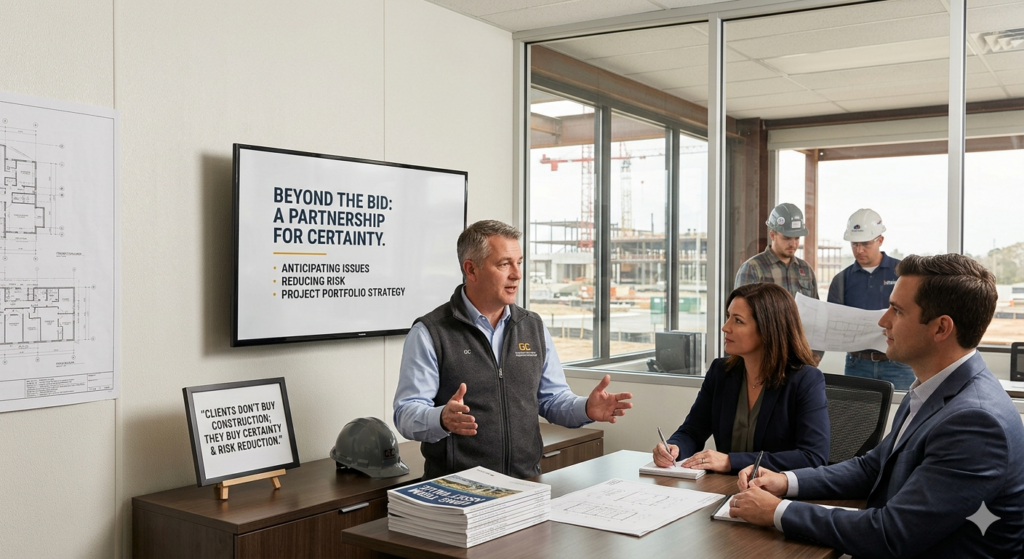
Developers and investment groups are not buying construction services. They’re buying certainty.
They’re buying a GC who understands their portfolio, anticipates problems before they become change orders, and makes their projects run so smoothly that handing you the next one is the obvious decision. They want someone who reduces their risk, protects their reputation with tenants and investors, and makes their job easier across every project — not just the one currently under contract.
The GCs who understand this don’t compete on price. They compete on partnership.
And there’s a meaningful difference.
A sticky GC relationship means the developer’s project lead is calling you before the RFP goes out — because they already know how you work. It means you’ve been inside enough of their projects to anticipate the issues they haven’t thought of yet. It means when something surfaces at 4pm on a Friday, you’re the first call they make. Not because you’re the cheapest. Because you’re the most trusted.
That doesn’t get built with a low number. It gets built with intention, over time — through relationship rhythms that keep you in their world between projects, not just when you’re actively billing.
The Math Most GCs Miss
Here’s a data point worth sitting with: a previous client is five times more likely to hire you again than a new prospect is to choose you for the first time.
Five times.
And yet most GCs spend the majority of their energy chasing new relationships — unfamiliar developers, cold bid opportunities, owners who don’t know them yet — while their existing client base quietly considers other options on the next project because no one stayed in the conversation.
The most efficient growth move available to you right now isn’t a new marketing strategy. It’s a better relationship strategy with the people who already know how you perform.
The Recurring Opportunity Most GCs Are Sitting On
Here’s where it gets more valuable.
Developers and investment groups are not one-project clients. They are building, renovating, expanding, and redeveloping — continuously, across multiple assets, often simultaneously. A regional developer with six active projects a year isn’t a prospect. They’re a pipeline. A single strong relationship with the right investment group can generate more predictable revenue than a dozen one-off bids ever could — with a fraction of the selling cost, because the trust is already established.
These clients are not hard to serve. But they are selective about who stays in their ecosystem.
They have seen every version of the GC who wins the first job on price and quietly inflates the next one. They’ve watched contractors disappear after punch list and reappear only when a new bid is circulating. They know every move.
What they will pay a premium to keep is the GC who shows up as a business partner — one who understands their portfolio strategy, brings proactive thinking to each project, and makes their relationship with tenants, investors, and asset managers stronger. That GC doesn’t have to compete on price. They’re already embedded.
But here is the catch: if the only thing you’ve ever led with is a sharper number, that’s the only thing they will ever ask you for. You’ve set the terms of the relationship yourself. They’ll expect a discount every time — right up until someone offers a bigger one.
The race to the bottom isn’t something that happens to you. It’s something you opt into, one underpriced bid at a time.
Your Trade Partners Are Part of This
Here’s a dimension of GC partnership strategy most contractors never fully leverage: your trade partners.
The best trade relationships aren’t transactional — they’re collaborative. When your electrical contractor knows a developer’s facilities inside and out, when your mechanical team has an ongoing service relationship with the property, when your trades are embedded at the asset level between projects — your position as their GC gets stronger. You’re not just delivering construction. You’re delivering an ecosystem of trusted partners who protect the owner’s asset year-round.
That’s a value proposition no bid sheet can compete with.
Creating relationship rhythms with your trade partners — regular communication, shared client insight, collaborative problem-solving — means that when your developer client has a facilities issue at 9pm on a Tuesday, your team handles it. You become the first call not just for construction, but for everything that touches the building. That kind of embedded presence is what transforms a project client into a long-term partner.
This Is What the Builder Edition Is Built For
The Trust Lab — Builder Edition was designed for the GC who is done working harder for smaller margins and is ready to build the kind of business where the right opportunities come to them.
We’ve launched — and this year, the shift is available to you.
If you want to understand what a referral partnership strategy actually looks like in your market — and what it’s worth — let’s have a conversation.
👉 [Book a discovery call here] — the easier path is real, and it starts with knowing what’s already within reach.
![An illustrative infographic, divided vertically, compares two business approaches: "THE OLD WAY: COMMODITY BID LIST" (left) and "THE NEW WAY: PARTNERSHIP LEVERAGE" (right). On the left side, under a banner title of "The Bid List Isn’t a Relationship. Here’s What Is," a line of construction workers, some appearing frustrated, are waiting with stacks of bid forms in a queue to a counter labeled "GENERAL CONTRACTOR" with "SUBMIT BID" and "LOW PRICE WINS" signs. A very large pile of generic bid forms is shown next to them. Accompanying text labels state: "Being on the bid list feels like progress", "Most of the time, you lose", "It's a commodity position", "Levers: price, schedule", and "Auditioning, not differentiating". On the right side, labeled "THE NEW WAY: PARTNERSHIP LEVERAGE," a group of diverse professionals are seated at a modern table, collaborating over a blueprint. They are shaking hands over a central handshake icon, which is labeled "TRUST." A thought bubble above them contains four icons: "EARLY CONVERSATIONS" (phone and calendar), "SOLVING PROBLEMS" (gears and question mark), "REFERRALS" (connected arrows), and "JOINT STRATEGY" (gears and team). Through a large window behind them, a multi-story building is actively under construction, with a large tower crane visible. Right-side text labels list the benefits: "Called before the bid goes out", "Deeper in fewer relationships", "Most trusted, not cheapest", "Attract work, don't chase", and "Make the bid irrelevant". In the bottom-right corner, a button reads "BOOK CALL" and next to it, "[BOOK YOUR 20-MINUTE CALL]](https://salezworks.com/wp-content/uploads/2026/04/Gemini_Generated_Image_euv2bheuv2bheuv2-300x164.png)