

I was talking with a prospect the other day. Smart guy. His favorite thing in the world is building software products. Not engaging strangers. Not qualifying them. Not convincing anyone to buy from him. Building his solution.
I can’t imagine why anyone wouldn’t love sales. Isn’t that everyone’s favorite part of business?
(That was said in my best sarcastic voice, not sure it came through in print)
He told me his plan for growing the company:
“I just have to spend the amount of time building content that it takes to get me in front of the right audience.”
So I asked him a simple question. “Where did your best clients come from over the past twelve months?”
He didn’t even pause.
“Referrals.”
And so, naturally, the answer is to go build more content.
Head…desk…head…desk
Really I’m not picking on him. I’ve been him.
If you grow by referral, you probably know this feeling. Business comes in through people, but people feel unpredictable, and a content calendar feels like something you can control. You can schedule it, measure it and finish it. A relationship can’t be checked off.
We want to do the thing that feels like progress. We write the post, build the page and record the video, and the pipeline stays exactly where it was.
Here’s what took me too long to accept. Content is great at a few specific jobs:
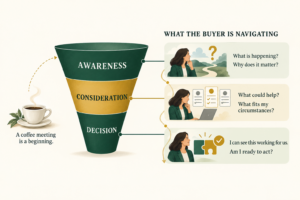
- Validation. It helps someone who is already considering you feel good about the decision.
- Understanding. It helps people see your perspective and approach, and get comfortable with your process and the result it’s meant to produce.
- Internal selling. It helps your contact build a timeline inside their own company and gives their stakeholders the same perspective they heard from you.
Those are real jobs, and they matter. But look at what’s missing from the list.
It doesn’t generate leads. Oh, how I wish it did.
The confession
I spend about three times as many hours building content as I spend generating leads. I’m not telling you to stop creating it. I’m telling you that it isn’t what fills my pipeline.
What fills it is the relationships. I’ve invested decades in them, and they consistently and predictably send me the right people. The content then does its job for those people when they show up, helping them say yes with confidence.
Here’s the good news. It doesn’t take decades. It takes hours, invested with the right people, building a relationship of trust.
And the research backs up where that trust does its work. In its 2025 Buyer Experience Report, 6sense found that in 95% of purchases the winning vendor was already on the buyer’s Day One shortlist. The decision is shaped in a conversation you’re not even in. The only question is whether someone in that conversation says your name.
What an hour with the right person actually looks like
Picture a Tuesday morning. You’re across a table from an attorney whose clients are your clients. You’ve known each other a while, but you’ve never really talked about how the two of you work with your respective clients.
You skip the pitch about your business. You ask what problems she sees within her clients that keep her from getting the results the clients are looking for. What obstacles does she have to overcome that are ‘outside of her lane’. And when she refers, how does she decide who to send a client to when they need help. She pauses, because nobody has asked her these questions before, and then she tells you. She probably also shares what makes her nervous about making an introduction, what went wrong the last time, and what she wishes the people she refers would understood.
You just learned more about how to earn her referrals in twenty minutes of conversation than a month of posts could have told you. You also did something a piece of content can’t do. You showed her you care about her clients and her reputation as much as your own pipeline.
That’s the meeting, and you can repeat it with the next person and the one after that. Do it with the right handful of people and the way your business grows begins to change.
Start here: the First-Call Test
When I wrote our State of Sales 2026: Professional Services Edition, I wanted to end the research with something you could do in an afternoon, not another thing to read. That’s Chapter 5, the First-Call Test. It takes about an hour. Here it is in plain language:
- Name them. List the three or four advisors your best clients already trust: a wealth advisor, an attorney, an accountant, a banker. Whoever comes up when your clients talk about who helps them.
- Ask the question. Over coffee or on a call, ask one of them: “If one of your clients faced a big decision about their business, who would you send them to? What would you say about me?” Then stop talking. This is the hard part, and it’s also the part that teaches you the most.
- Make yourself easy to describe. Can they explain what you do, who you help and who you’re not for, all in one sentence? If they can’t, they can’t pass you along, no matter how much they like you.
- Give them something to repeat. Advisors can’t share confidential client stories, so give them language, not names: a short, anonymous account of the kind of situation you help with. A good story gets repeated. A service list does not.
- Be useful before there’s a decision. Send a question set, a short checklist or an introduction with nothing attached. Lead with value, every time.
- Show up where they gather. Trust is built in rooms and across tables, not in inboxes. Find the small gatherings where your advisors already spend time, or host one yourself.
What you’ll hear
- A precise description of you. Protect it. Ask what kind of client they’d feel most comfortable sending your way, then make it easy for them to do it again.
- A vague one. This is the most common result. “She does good work” is a compliment, not a referral. Go back to Step 3 until your one-sentence description could be repeated to a stranger without notes.
- Nothing at all. Don’t take it personally. You’ve just found the gap, and now you know where the next hour goes.
Whichever one you hear, you’ll know something this afternoon that you didn’t know this morning. Most of us run a pipeline on assumptions. This replaces one assumption with something an advisor your clients trust actually said.
Then do something with what you hear
The answer is only useful if you act on it within the week. Write down their exact words, and don’t clean them up. Then compare them with how you’d describe yourself. The distance between the two is your real marketing project for the quarter, and it’s a lot smaller and more useful than “build more content.”
Send a short thank-you that repeats one thing they said that was useful to you. Then offer something that helps their clients, with no ask attached. That’s how a conversation becomes the start of a relationship.
Before you build the next piece of content, spend one hour on the First-Call Test.
Get the State of Sales 2026 report: [REPORT LINK]
Chapter 5 is where the work begins.
Source: 6sense, 2025 B2B Buyer Experience Report (winning vendor on the Day One shortlist in 95% of purchases).