

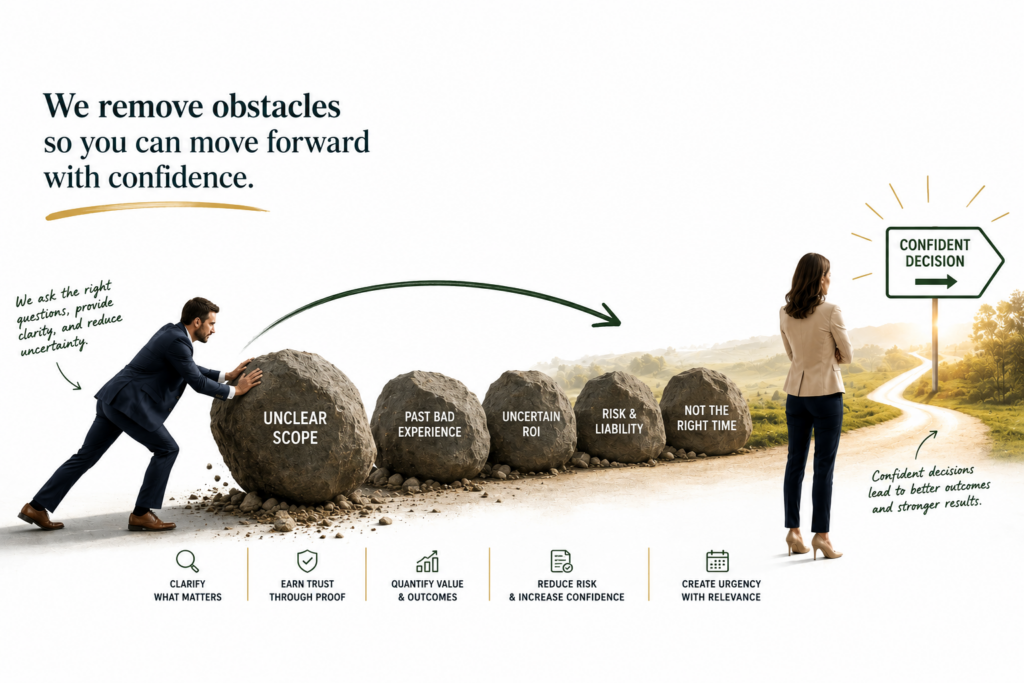
There’s a quiet belief a lot of professional services firms carry without ever saying it out loud: the work speaks for itself. Good firms don’t need to sell. Reputation does the heavy lifting. Being too visible about marketing yourself is almost a little declassé, a sign you’re not busy enough or not good enough to be sought after instead.
I hear the practical version of this constantly. “I follow up a couple of times, and then they know where to find me when they’re ready.”
That sentence sounds like patience. It sounds professional, even dignified. But it’s not actually a strategy. It’s a decision, made quietly and usually without realizing it, to let something other than you decide whether your firm grows. The market. Timing. Whether a prospect happens to remember your name on the right afternoon.
That decision used to be survivable. I don’t think it is anymore, and here’s why.
The Buyer on the Other End Has Changed
The buyer you’re waiting to come find you isn’t the buyer this approach was built for.
Today’s buyer is less loyal than they used to be. Relationships that once carried someone through a slow decision, or brought them back around after a quiet stretch, don’t have the same pull they did a decade ago. People switch, compare, and walk away from long-standing vendor relationships more easily than they used to.
At the same time, that same buyer is more cynical about hiring consultants and professionals than ever. Most of them have been burned. A bad engagement, an overpromised outcome, a consultant who talked a great game and delivered a mediocre one. That history doesn’t disappear. It sits underneath every new decision they make, whether they say it out loud or not.
Put those two things together and you get a buyer who needs real confidence before they’ll commit to anything, and who has very little patience left to build that confidence on their own.
When They’re Not Confident, They Don’t Push Back. They Disappear.
Here’s the part that trips up the “they know where to find me” approach completely: an uncertain buyer today doesn’t come back with objections you can answer. They don’t call and say “I’m still not sure about X.” They just go quiet.
Ghosting isn’t rudeness. It’s usually the buyer’s honest signal that they never got confident enough to say yes, and saying no directly felt like more effort than just letting the conversation fade. If your process assumes silence means “not ready yet, I’ll wait,” you’re misreading exactly what happened. Silence usually means the confidence was never built, and nothing you did after the pitch gave them a reason to believe it would be.
“They know where to find me” assumes the buyer is doing something productive with the time between your last conversation and their eventual decision. Getting more informed. Getting more ready. Building conviction on their own.
Most of the time, that’s not what’s happening. They’re getting more cynical, not less, the longer a decision sits unresolved with no new information coming in. Time alone doesn’t build confidence. It usually erodes it.
The Real Job Isn’t Staying Top of Mind. It’s Building Confidence.
This is where the passive version of follow-up gets the job wrong. It treats every touch as a reminder: I’m still here, don’t forget about me. That might keep your name in rotation, but it does nothing to address the actual thing standing between the buyer and a decision, which is usually doubt, not forgetfulness.
The buyers who eventually say yes aren’t the ones who simply remembered you existed. They’re the ones who got more confident over time, because something in the process actively reduced their uncertainty. A specific answer to the exact risk they were quietly worried about. A relevant proof point that spoke to their situation, not a generic case study. A conversation that helped them think through the decision instead of just repeating why you’re a good choice.
That’s a fundamentally different job than staying visible. It requires knowing what the buyer is actually uncertain about, and being willing to address it directly, even the parts that are uncomfortable or make the sale harder in the moment.
“I Don’t Want to Seem Pushy or Desperate”
I heard this exact sentence from someone last week, and I think it’s worth addressing head on, because it’s the real reason a lot of firms default back to “they know where to find me” even after they can see the logic against it.
Here’s the distinction that actually matters: pushy and desperate are about what the follow-up is for. A touch that exists to serve your need, closing the deal, hitting a number, getting an answer either way, reads as pushy no matter how it’s worded, because the buyer can feel whose interest it’s actually serving. “Just checking in” and “wanted to circle back” are pushy specifically because they carry no new information. They only exist to remind the buyer that you’re still waiting on them.
A touch that exists to serve the buyer’s need doesn’t read the same way, even if it happens just as often. Sending a specific answer to a concern they raised. Sharing something relevant to a challenge they mentioned. Offering a perspective on a risk they hadn’t considered, before they have to ask about it. None of that feels like pressure, because it isn’t pressure. It’s useful, on its own, whether or not it moves them closer to a decision this week.
The volume of contact was never actually the problem. Buyers don’t get uncomfortable because they heard from you five times. They get uncomfortable when all five contacts were about you wanting an answer, and none of them were about helping them get to one. Desperation isn’t a frequency. It’s an absence of anything new to offer.
Passive Isn’t Neutral. It’s a Choice, and It’s a More Expensive One Now
Letting the work speak for itself, waiting for buyers to come around, following up twice and then stepping back, none of that is a neutral non-decision. It’s an active choice to let someone else, or nothing at all, decide whether your pipeline moves forward.
In a market where buyers had more loyalty and more patience, that choice was survivable. It just meant slower growth. In a market where buyers are quicker to walk and slower to trust, the same choice means something closer to invisible attrition: prospects quietly going cold, not because they decided no, but because nobody ever gave them a reason to get to yes.
The firms building real, durable growth right now aren’t the loudest or the most aggressive. They’re the ones who stopped assuming confidence would build itself, and started designing for it on purpose.