
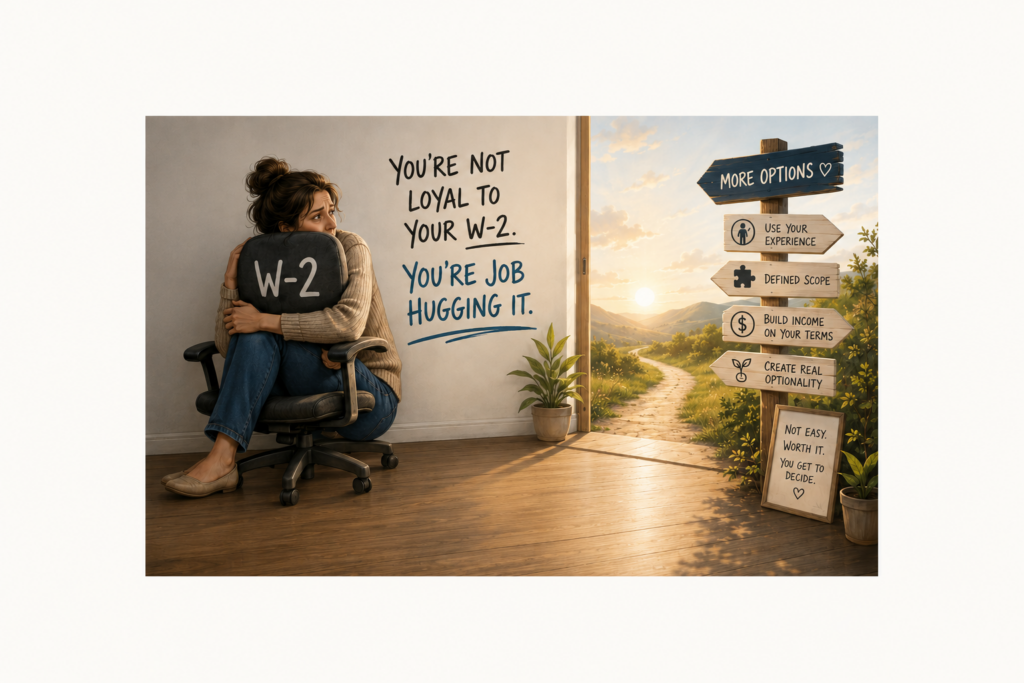
There’s a term for what’s happening in the job market right now, and once you hear it, you’ll recognize it everywhere: job hugging.
It’s the opposite of the Great Resignation. A few years ago, workers had leverage and used it — people left jobs in search of better pay, better flexibility, something different. That era is over. The data on where things stand now is stark: by early 2026, more than half of American workers identified as job huggers, up sharply from less than a year earlier. Most of them aren’t staying because they’re happy. They’re staying because they’re scared — of layoffs, of AI quietly eating their role, of a hiring market gone cold enough that leaving feels like walking off a cliff with no idea what’s below.
So people stay. White-knuckled. Hoping the ground holds a little longer.
If that’s you right now, I want to say something directly: I see it, and I don’t think you’re wrong to be scared. But I also don’t think gripping tighter is actually the safe move you think it is.
“Is This My Only Option?”
Here’s the question I know a lot of you are quietly asking yourselves, even if you haven’t said it out loud: is my W-2 my only option?
You’re watching headlines about layoffs in your industry. You’re wondering if the role you’re hugging so tightly is going to let go of you before you ever get the chance to let go of it. And underneath that fear is a real, legitimate uncertainty about what else is even possible.
I think that uncertainty is exactly why so many of you haven’t taken the next step toward exploring fractional work, even after a friend or colleague mentioned it to you. It’s not that the idea isn’t appealing. It’s that job hugging doesn’t leave a lot of room to seriously consider letting go of anything — even a job you don’t fully trust — for a path you’re not sure about yet either.
I get it. But I want to be honest about something: holding on tighter to a job that might not hold on back isn’t actually safety. It just feels like safety, because it’s familiar.
What Staying Stuck Actually Costs You
Here’s the part nobody’s saying out loud: staying still isn’t free. It just hides its price tag better than leaving does.
Your market value doesn’t hold steady while you wait. It erodes. The skills, relationships, and reputation that make you valuable outside your current company don’t maintain themselves just because you’re showing up every day. They need active use to stay sharp. A year of staying quiet and keeping your head down is a year those muscles don’t get exercised.
Your negotiating leverage goes the same direction. The best time to build a fractional practice, a network, a second income stream is before you desperately need one — not after a layoff forces the timeline. Waiting until you’re pushed doesn’t just delay the work. It strips out your leverage to do it on your own terms.
Fear compounds. The longer you stay somewhere out of fear rather than choice, the harder it gets to picture yourself anywhere else. Confidence, like a muscle, atrophies from disuse. People who’ve been job hugging for a year or more often aren’t more ready to make a move than they were twelve months ago — they’re less ready, because the fear had longer to settle in.
And here’s the part that should actually worry you most: staying doesn’t remove the risk you’re afraid of. It just removes your control over it. The layoff, the restructuring, the role quietly disappearing underneath you — none of that becomes less likely because you gripped tighter and stopped preparing for it. You’re not eliminating the risk. You’re just choosing not to be the one who decides when and how you respond to it.
That’s not safety. That’s just a different kind of exposure — one where someone else holds the timeline instead of you.
Nothing Is Easy Right Now. That’s Not a Reason to Do Nothing.
I’m not going to pretend fractional work is the easy button. It’s not. It requires real hustle — the same effort you’re already putting in, redirected toward building something that’s actually yours instead of something you could lose with one restructuring email.
Nothing is easy in this post-COVID world. Not staying. Not leaving. Not building something new. That’s just true, and I’d rather say it plainly than pretend otherwise.
But here’s what I do believe: doing the work to build real optionality — even slowly, even part-time, even just exploring what it would look like — is a fundamentally different position than gripping a job out of fear and hoping the ground holds. One of those is active. The other is just waiting to find out what happens to you.
You Have More Options Than You Think
Fractional work isn’t a leap off a cliff. It’s a way to take the real, hard-won experience you already have and redirect it — on your own terms, with defined scope, without betting everything on one employer’s decision about your future.
It’s not guaranteed. Nothing is right now. But it is a real option, built by people who’ve been exactly where you are — job hugging, wondering if this was the only path, and deciding to find out if it wasn’t.
If you’ve been wondering whether there’s another way, the 5 Days to Fractional Bootcamp starts Monday, August 24th. Five days, five exercises, built to give you an honest answer — not a sales pitch, an honest answer — about whether this path is actually yours.
You don’t have to let go of anything to find out. You just have to stop assuming holding on tighter is the only move you have.
5 Days to Fractional Bootcamp starts Monday, August 24th. [Register here].