
Picture the contractor who has everything going for them.
Skilled crew. Solid reputation. Quality work that genuinely speaks for itself. Past clients who would recommend them without hesitation. A track record that should be producing more work than they can handle.
And still — every quarter — there’s a version of the same conversation. Where is the next job coming from? What happens when this one wraps up? How long before the gap between projects becomes a problem?
Not because the market is bad. Not because the competition is better.
Because being great at construction and being great at building a pipeline are two completely different skills. And almost nobody in this industry ever taught the second one.
What Most Contractors Think a Pipeline Is
Most contractors think a pipeline is a list of bids out and jobs in progress.
It isn’t.
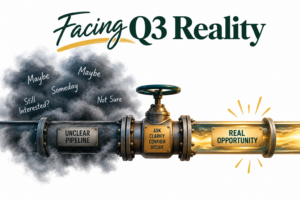
That’s a workload. A workload tells you how busy you are right now. A pipeline tells you how busy you’ll be in 90 days — and whether you have any real say in the answer.
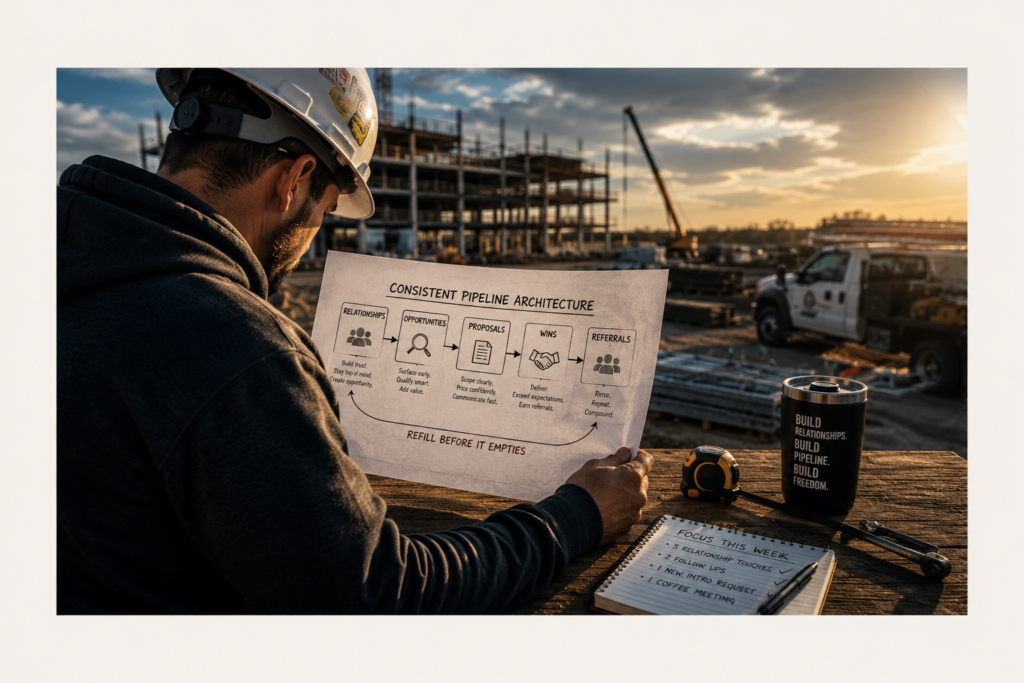
A real pipeline is a predictable, compounding flow of opportunities that refills before it empties. One where the next job isn’t a question mark at the end of the current one — it’s already in motion. Already in a conversation. Already in a relationship that’s been deliberately cultivated.
Most contractors are managing workload. Very few are building pipeline. And the difference between those two realities is the difference between a contractor who plans six months out and one who wonders what comes next.
What a Consistent Pipeline Actually Requires
It is not more bids. It is not a better website. It is not more social media activity or a bigger presence at industry events.
A consistent pipeline requires three things — and most contractors are missing at least one of them.
Relationships that produce opportunities before they go to bid. Not cold bids. Not bid boards. Owner and facility manager relationships that surface work before it ever becomes a competitive process. The decision-maker who calls you before the RFP goes out because they already know who they want. This takes time to build — and almost no time to maintain once it’s in place.
A referral architecture that runs in the background. Activated partner relationships. Quarterly conversations with past clients. A network of GCs, owners, and facility managers who know exactly when to say your name — and have been equipped to say it confidently. Not hope. Not occasional outreach. Infrastructure that produces introductions consistently.
A communication and follow-through system that keeps you visible without constant manual effort. The touchpoint that arrives before the client had to wonder where you were. The follow-up that happens because it’s built into the process — not because you remembered to do it between jobs. The system that holds the relationship in place even when you’re head-down on a project.
Why Most Contractors Never Build It
The first reason is the one everyone knows: they’re too busy doing the work to build the system that would bring more of it. Every time the pipeline looks full, business development stops. And by the time it runs dry, it’s too late to start. The cycle repeats every year.
The second reason is less obvious: most contractors mistake activity for architecture. They attend the events, hand out the cards, follow up occasionally — and call it business development. Without the underlying system that makes the activity compound, it produces a trickle of inconsistent results and a lot of wasted effort.
But the deepest reason — the one that almost nobody says out loud — is this:
Nobody taught them this part.
The trades teach craft. The industry teaches bidding. Apprenticeships teach how to do the work. Associations teach how to price it. Nobody teaches pipeline architecture. Nobody teaches how to build owner relationships before there’s a job on the table. Nobody teaches the referral system that makes the short list feel inevitable rather than accidental.
The contractors who figure it out do so by accident, over years, at significant cost. The ones who never figure it out keep bidding and wondering why the results stay inconsistent despite the quality of their work.
What the Contractors With Consistent Pipelines Do Differently
They treat business development as a practice — not an event, not a campaign, not something they do when work slows down. It is a non-negotiable part of the week regardless of how full the schedule looks.
They have a short, deliberate list of high-value relationships they invest in consistently. Not dozens of loose connections — a handful of people with real proximity to their ideal owner, developer, or facility manager. And they have specific conversations with those people on a regular cadence, not whenever they happen to remember.
They have a system for staying in front of past clients, current service relationships, and referral partners — without it requiring manual effort every single week. The follow-up runs. The touchpoints happen. The relationship stays warm without anyone having to fight for time to maintain it.
They show up before there’s a job on the table — so when there is one, they’re already trusted. Already known. Already on the list that never goes to bid.
From the outside, it looks effortless. From the inside, it’s a system that was built once and has been compounding ever since.
The Gap Nobody Talks About
Here’s what I’ve watched play out across contractor businesses for years.
Most contractors know what a consistent pipeline requires. They’ve heard it. Read about it. Nodded along at industry events when someone described exactly this.
And their pipeline is still inconsistent.
That is not a knowledge problem. It is a system problem. And a system problem requires a completely different solution than more information.
The contractors who close that gap don’t do it by learning more. They do it by building — with structure, with accountability, and with a specific set of tools that hold the work in place when life gets busy. Which in construction, is always.
Something Is Coming
A consistent pipeline is not the result of working harder. It is the result of building something that works while you work.
The contractors who have it aren’t luckier or better connected. They built it — deliberately, specifically, in a way that compounds over time and doesn’t fall apart when the next big job demands every hour they have.
In the first week of June I’m hosting a live masterclass built specifically for contractors and professionals who are ready to stop wondering where the next job is coming from — and start building the system that answers that question permanently.
Not more information to consume. A live, structured experience that takes you from knowing to building — with the tools, the system, and the accountability to make it stick.
The invitation is coming. Stay close.
To your influence,
Breandan