
Most contractors treat the service call as the least glamorous part of the business.
It’s reactive. It’s small. It’s not the job you brag about at the association meeting. When the service truck rolls out, most owners are thinking about margins, not momentum.
But the contractors who have figured out what’s actually happening on a service call — and who’s on the other side of it — have discovered something the bid-chasers never will.
The service call is not an interruption to business development.
It’s the best version of it. And for the GCs paying attention, it’s also the most underutilized pipeline tool in their entire ecosystem.
Who’s Actually in the Room
On a construction project, you’re one of a dozen trades working for a GC. The owner is a distant figure behind a glass conference room. You might see them at the groundbreaking and the ribbon cutting. Maybe.
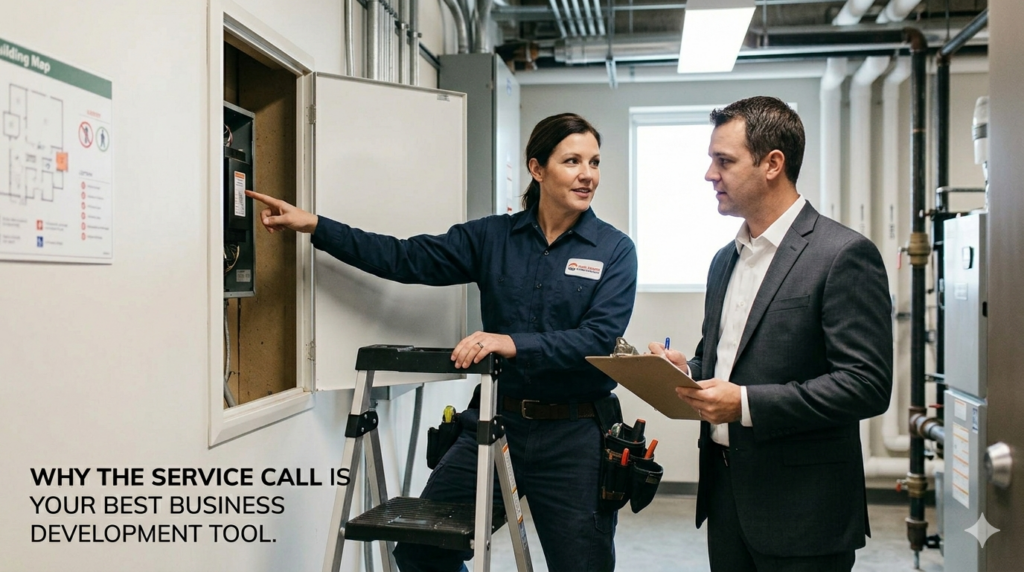
On a service call, you’re alone in the building.
With the facility manager. The director of operations. The property manager. Sometimes the owner themselves. The exact people who decide who gets called first, who gets recommended to the board, who gets the next capital project — who gets quietly added to the short list before a job ever goes out to bid.
You didn’t have to bid to get there. You were already trusted enough to be let in the door.
Most contractors walk out without ever recognizing who they just spent two hours with.
The Intelligence You’re Sitting On
Every service call is a facility diagnostic.
You’re seeing things the owner doesn’t know to look for. Aging infrastructure. Deferred maintenance. Inefficiencies that are quietly costing them money. Safety concerns they’ll be embarrassed about when someone else finds them first. Code exposure they don’t know they have.
You see it because you know what to look for. That knowledge is valuable.
Most contractors keep it to themselves, fix what they were called for, and leave.
The contractor who pauses at the door and says “hey, while I was here I noticed a few things you should probably be aware of” is not upselling. They’re doing something far more valuable than that.
They’re becoming a trusted advisor. And that is a completely different relationship than vendor.
The Conversation That Changes Everything
What does the facility manager actually lose sleep over?
Budget pressure. Tenant complaints. A deferred maintenance list that keeps growing no matter how many things get checked off. A board asking questions they don’t have clean answers to. The feeling that they’re always one failure away from a bad day that becomes a very public problem.
Your job on the service call is not just to fix the problem. It’s to understand the larger context it lives in.
Two questions that open everything:
- “What else has been giving you trouble lately?”
- “What’s coming up in the next year that you’re already thinking about?”
Most contractors never ask. The ones who do are rarely forgotten. You are not pitching. You are listening your way into a relationship that will outlast any single job.
From Service Client to Referral Source
A facility manager who trusts you doesn’t just call you back. They introduce you.
They sit on committees. They know other facility managers. They talk to their peers at industry events, at association meetings, over lunch, about who they use and who they trust. When someone in that circle asks “who do you call for electrical?” or “who do you trust for fire alarm?” — they answer without hesitation.
One well-handled service relationship in a senior living facility, a commercial property, an institutional building can open an entire vertical. Not because you pitched it. Because you earned it, one service call at a time.
The referral doesn’t come from the bid. It comes from the service call that became a relationship. That’s not an accident — it’s what happens when you treat every service call like the business development opportunity it actually is.
The GC Who Gets It — And the Subs Who Make It Possible
Here’s what most GCs are missing.
Their best subs are walking in and out of owner relationships every single week. Facility managers. Directors of operations. Property owners with three buildings and a capital improvement budget. And nobody is capturing that intelligence or leveraging those relationships.
A GC who intentionally partners with service-oriented trades creates something most of their competitors have never thought to build: a referral network that runs quietly in the background. Subs are nurturing owner relationships, surfacing new construction opportunities, TI work, capital projects — and bringing them back to the GC they trust.
That’s not a subcontractor relationship. That’s a business development partnership.
For the GC, the play is straightforward: identify which subs are already in front of owners, equip them with language about what you do and what you’re looking for, and create a rhythm where those conversations get shared. Give them something to bring back to you.
Introduce them to your clients when the work is finished as the sub who you worked with to build their project – they know it, they should maintain it after the project is completed. This is a powerful retention strategy, the sub is there to nurture the relationship and remind them of you and your value.
For the trade contractor, the move is equally clear: when you surface a TI or new construction opportunity through a service relationship, bring it to your GC. That one conversation changes your position in that relationship permanently.
You’re no longer waiting to be called. You’re the one making the call. That’s the unfair advantage both sides of this equation have been sitting on without knowing it.
What to Do Differently Starting Tomorrow
This doesn’t require a new system, a new hire, or a new marketing budget. It requires a different mindset walking through the door.
- Walk in knowing who you’re meeting — not just what you’re fixing. Take two minutes before you arrive. Know the name, know the role, know something about the facility.
- Fix the problem completely and professionally. That’s the price of admission, not the differentiator. It earns you the right to the next step.
- Before you leave, share one observation. Something you noticed that they should know about. Not a pitch — a heads up from someone who knows buildings.
- Ask the two questions. What else has been giving you trouble? What’s coming up in the next year? Then listen. Actually listen.
- Follow up within 48 hours. Not with a proposal. With the information you promised, the answer to something they mentioned, or a resource that’s genuinely useful to them.
- If you surface a bigger opportunity, bring it to your GC. New construction, TI, capital project — whatever it is. That conversation changes your relationship with them permanently.
Three years from now, that facility manager is either your best referral source or someone who doesn’t remember your name. The difference is what you do in the first 30 minutes of every service call.
The Pipeline Is Already There
The bid list is crowded because everyone is fighting for the same jobs in the same way.
The service relationship is yours if you want it — because almost nobody is treating it like what it actually is. And for GCs and trades alike, the most underutilized pipeline in commercial construction is already sitting in your existing relationships. It just hasn’t been activated.
The contractors who build consistent pipelines aren’t the ones who bid the most. They’re the ones who serve the best, show up like trusted advisors, and bring their GC partners into the opportunities they surface.
That’s not a hustle. That’s architecture. And it compounds.
Trust Lab: Builder Edition is where that positioning gets built — the owner relationships, the referral architecture, and the conversations that turn a service client into a referral engine. [BUILDER EDITION LINK]