
What It Looks Like When the Network Activates
I want to tell you about a week that stopped me in my tracks.
One of my current Trust Lab participants — a financial advisor — didn’t do his homework this week. Not because he lost interest. Not because life got in the way. But because five referral partners sent him scoped opportunities in seven days. He was fielding calls, having real conversations, and putting together proposals for people who came to him already primed. He told me this almost apologetically, like he owed me an explanation.
I had to laugh. Because that’s not a failure to complete the curriculum. That’s the curriculum working.
Meanwhile, another participant — an organizational development consultant who coaches senior leaders at nonprofits — spent the early weeks of this program genuinely unsure whether any of this applied to him. His clients don’t look like the contractors and fractional CFOs sitting beside him in the cohort. His work is relational and deeply human, not transactional. He’d built what he called a “rickety raft in the backyard — it floats, but I’m not sure it’ll get me to the island.”
He’s building his island now. And the raft is holding.
These two men have almost nothing in common professionally. One advises companies on capital structure and growth strategy. The other helps mission-driven organizations navigate leadership transitions and executive burnout. And yet they’re experiencing the same breakthrough — not in spite of their differences, but in a way that makes those differences irrelevant.
Here’s what that tells me.
The most common objection I hear from fractionals considering this kind of investment is some version of: “I’m not sure this is for someone like me.”
The financial advisor didn’t say it out loud, but the hesitation was there early on. He came into the program through Freeway to Fractional, which means he trusted the relationship enough to come back — but still wasn’t certain the business development framework would translate to his world. His work is sophisticated. His clients are discerning. Surely there’s something different about how trust gets built at the level he operates.
There isn’t. Not structurally. The principles don’t change. What changes is the vocabulary, the timeline, and the texture of the conversations. But the underlying architecture — how influence gets built, how referrals deepen from a name drop into a genuine voucher, how partners move from knowing what you do to actively investing their reputation in introducing you — that’s consistent across every professional service I’ve ever seen.
The OD consultant figured this out when he stopped trying to build his partner strategy and his prospecting approach before he’d gotten clear on who his platinum client actually was. He was constructing the house before the foundation was poured. Once he identified the right anchor relationship — a nonprofit he’s been serving and could expand within — every other piece of the framework suddenly had a place to land. The draft pick conversations started making sense. The partner funnel made sense. The first dollar offer made sense.
The system doesn’t care what you do for a living. It cares whether you can get honest about who you serve at your highest level, and then build deliberately from there.
I’ll tell you what prompted me to write this today.
Years ago, I had a client relationship in the construction space that I let go dormant. Not intentionally — it just moved to the background the way things do when life gets busy and your attention pulls toward whatever’s loudest. I assumed that chapter was complete.
It wasn’t. That relationship came back to life, and in the process of re-engaging it, everything accelerated. That contractor became my platinum client for my recent construction industry engagement. The work we’ve done together opened a vertical I wasn’t actively pursuing at this time and moved away from years ago. And the results we’ve generated — using exactly the methodology I teach, combined with AI tools that didn’t exist ten years ago — have been some of the most concrete, measurable wins of my career.
That dormant relationship didn’t just produce a client. It changed my trajectory.
I say this because I think a lot of fractionals have relationships sitting in exactly that condition right now. Transactional clients who haven’t been developed as Transformational because nobody showed them the path. Referral partners who send something occasionally but don’t really understand the full scope of what you do or who you serve at your best. A connection from two years ago who’s now in a position to introduce you to exactly the right room — and doesn’t know you’d want to be there.
These aren’t dead relationships. They’re incomplete ones.
The question I keep coming back to isn’t whether the framework works in your industry. At this point, I have enough evidence across enough verticals to say with confidence: it does.
The question is whether you’re willing to do what the framework actually requires, which is to slow down long enough to get the foundation right before you build anything else on top of it.
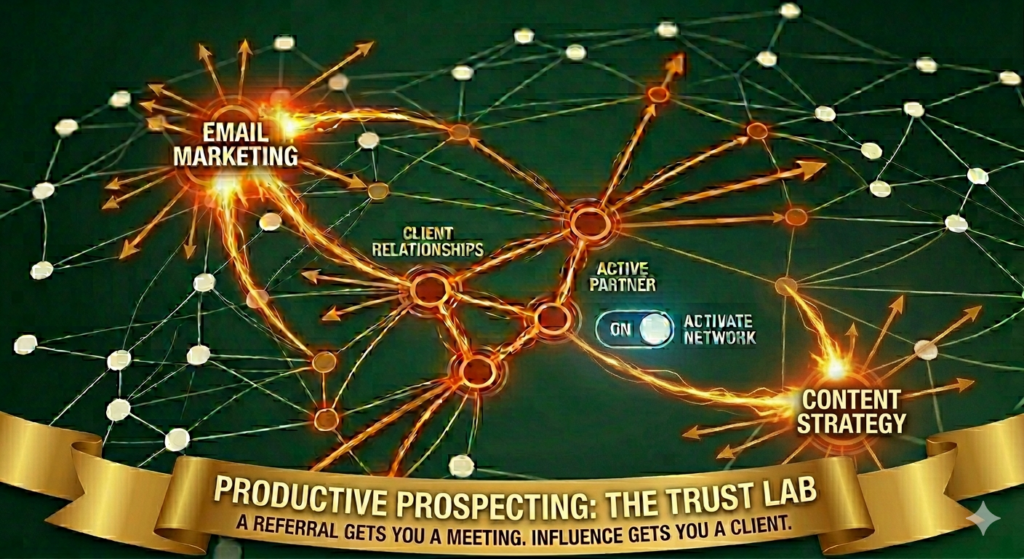
Most fractionals I work with are talented, credentialed, and have more relationship capital than they realize. What they’re missing isn’t access. It’s activation. There’s a difference between a network that knows you exist and a network that actively moves on your behalf. Closing that gap isn’t about more coffee meetings or a better LinkedIn strategy. It’s about building a system that teaches the people around you how to help you — and then maintaining that system with consistency.
The financial advisor figured this out. His pipeline didn’t fill up this week because he posted more content or attended more events. It filled up because he spent the past several weeks doing the unglamorous work of tiering his relationships, having real partner conversations, and getting clear on exactly who he serves and how he wants to be introduced.
The OD consultant is doing that work right now. And I can already see what’s coming for him on the other side of it.
The system doesn’t care what industry you’re in. It only asks one thing: are you willing to work it?
Trust Lab opens this week. If you’ve been wondering whether it applies to your world — it does. Details HERE
![An illustrative infographic, divided vertically, compares two business approaches: "THE OLD WAY: COMMODITY BID LIST" (left) and "THE NEW WAY: PARTNERSHIP LEVERAGE" (right). On the left side, under a banner title of "The Bid List Isn’t a Relationship. Here’s What Is," a line of construction workers, some appearing frustrated, are waiting with stacks of bid forms in a queue to a counter labeled "GENERAL CONTRACTOR" with "SUBMIT BID" and "LOW PRICE WINS" signs. A very large pile of generic bid forms is shown next to them. Accompanying text labels state: "Being on the bid list feels like progress", "Most of the time, you lose", "It's a commodity position", "Levers: price, schedule", and "Auditioning, not differentiating". On the right side, labeled "THE NEW WAY: PARTNERSHIP LEVERAGE," a group of diverse professionals are seated at a modern table, collaborating over a blueprint. They are shaking hands over a central handshake icon, which is labeled "TRUST." A thought bubble above them contains four icons: "EARLY CONVERSATIONS" (phone and calendar), "SOLVING PROBLEMS" (gears and question mark), "REFERRALS" (connected arrows), and "JOINT STRATEGY" (gears and team). Through a large window behind them, a multi-story building is actively under construction, with a large tower crane visible. Right-side text labels list the benefits: "Called before the bid goes out", "Deeper in fewer relationships", "Most trusted, not cheapest", "Attract work, don't chase", and "Make the bid irrelevant". In the bottom-right corner, a button reads "BOOK CALL" and next to it, "[BOOK YOUR 20-MINUTE CALL]](https://salezworks.com/wp-content/uploads/2026/04/Gemini_Generated_Image_euv2bheuv2bheuv2-300x164.png)