

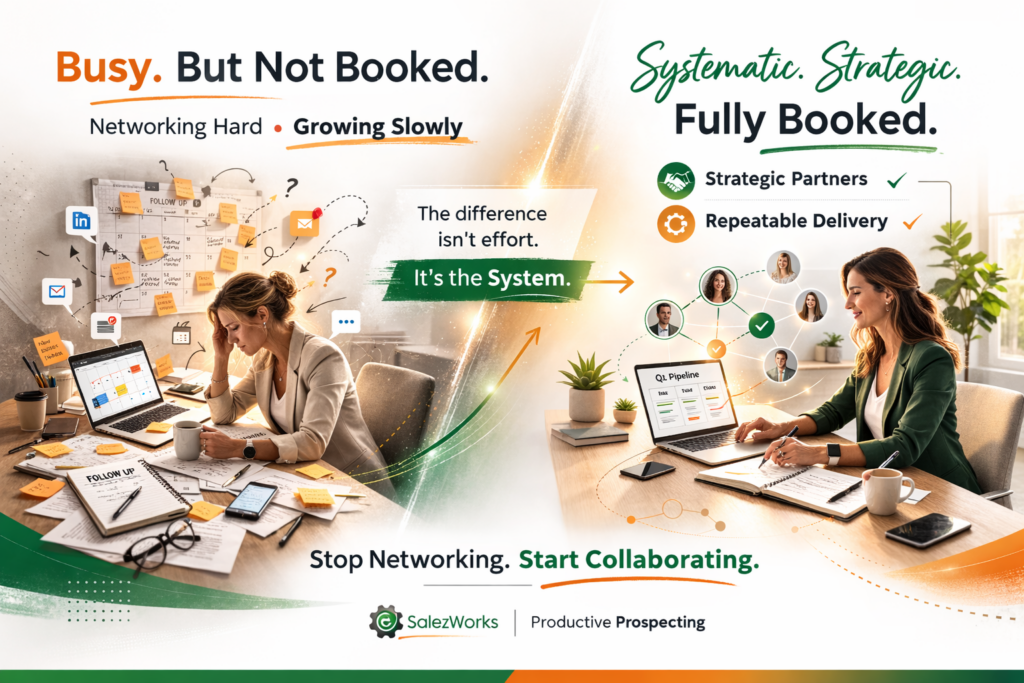
You left corporate with a track record that would make most people envious. Decades of delivering results. A network you built over years. The confidence that comes from knowing your craft at a level most people never reach.
So why does building your fractional practice feel so hard?
If you’re like most of the fractionals I talk to, the honest answer sounds something like this: you’re meeting plenty of people. You’re showing up to the events, connecting on LinkedIn, grabbing the coffee. You’re busy. But the conversations aren’t converting into clients — and when they do, you’re delivering for each one as if you’re starting from scratch every single time.
Busy. But not booked. Working. But not growing.
This isn’t a competence problem. It’s a system problem. And until you name it clearly, you can’t fix it.
The Networking Trap Fractional Execs Fall Into
Here’s what I see happening with smart, capable knowledge workers over and over again.
They network like they’re still in corporate — showing up, being visible, collecting contacts. The implicit assumption is that if enough people know what you do, eventually the phone rings. And sometimes it does. But rarely with the consistency or the quality of client that actually builds a sustainable practice.
The problem isn’t effort. The problem is the question driving the conversation.
Most networking operates on one invisible question: “Can you do business with me?” Every interaction is quietly evaluated through that lens. And when the answer is “not right now,” the relationship stalls. You move on. They move on. The connection slowly goes cold.
| A referral gets you a meeting. Influence gets you a client. And the right collaboration partner gets you both — faster. |
But there’s a different question that changes everything: “Can I do business faster, with more ideal clients, if I collaborate with you?”
That question reframes the entire room. Instead of evaluating whether the person across from you can hire you, you’re asking whether they serve the same buyers you do — from a different seat. Whether their clients need what you do after, before, or alongside their engagement. Whether they carry a message your ideal buyer needs to hear from someone who isn’t you.
That’s not networking. That’s building a strategic partner network. And it’s the difference between hoping the phone rings and engineering the conditions that make it ring consistently.
The Second Problem Nobody Talks About
Let’s say the conversation does convert. A new client engages you. Great news — except now you’re back to a familiar pattern from the early days of your practice: treating every client engagement as a one-off.
Different onboarding conversation each time. Different way of scoping the work. Different check-in cadence. Different way of measuring and communicating results. You’re delivering well — but you’re recreating the wheel with every single engagement, which means you’re spending energy on the process rather than the work. And more importantly, you’re leaving almost no time or bandwidth for the business development that would bring in the next client.
This is the fractional’s trap in its fullest form. You land a client. You go heads-down. The pipeline dries up. You come up for air, realize you need to fill the gap, scramble back into networking mode — and the cycle starts again.
| The fractionals who build genuinely sustainable practices aren’t just better at the work. They’re better at building the system around the work. |
A systematic client delivery framework doesn’t just make your work more efficient. It frees up the cognitive bandwidth to stay present in your business development even when you’re fully engaged with a client. And it makes your results more repeatable, which makes your referral partners more confident sending people your way.
Because here’s the thing about referrals that most people miss: your partners aren’t just evaluating whether you’re good. They’re evaluating whether they can trust you with their reputation. Every time they send someone to you, their credibility is on the line. A fractional who delivers inconsistently — even if they deliver brilliantly — is a referral risk. A fractional with a clear, professional, repeatable process is a partner people feel safe sending their best clients to.
What Actually Changes When You Have a System
When I work with fractionals on their business development, the breakthrough rarely comes from finding new places to network. It almost always comes from two places:
First, getting clear on who the right collaboration partners are — the people who serve the same buyers from a different angle, who can amplify a message your client needs to hear from a different voice, who naturally sit upstream or downstream from your work in the client journey.
Second, building enough structure around delivery that business development doesn’t stop when a client engagement begins.
These two things together — a strategic partner network and a systematic delivery model — are what separate the fractionals who are always scrambling from the ones who have a practice that grows even when they’re fully engaged.
Neither of these is complicated. But both require intentionality. And most fractionals, trained by years in corporate where someone else handled these systems, have never had to build them from scratch.
Where to Start
The most practical place to begin is with the conversations you’re already having — but with a different lens.
Instead of walking into a networking event asking “who can hire me,” walk in asking: “Who in this room serves my ideal buyer before I do, after I do, or at the same moment — and could we create momentum for each other?”
Start noticing what moves your ideal client from stuck to ready. What headlines are creating urgency in their world? What limiting beliefs are keeping them from investing in the help they need? Who else carries a message that reinforces what they need to hear before they’ll act?
And start paying attention to what happens after you deliver — what your clients need next, and whether there are partners in your world who could pick up that handoff naturally.
That’s not a networking strategy. That’s the beginning of a referral engine.
| The fractionals winning right now aren’t working harder at networking. They’re working smarter at collaboration. |
If this is resonating — if you recognize yourself in the busy-but-not-booked cycle, or you’re realizing your client delivery could use more structure — I’d love to have this conversation live.
We’re hosting a Speed Networking event built specifically around this framework. Not the usual “tell me what you do” rounds. A structured conversation designed to help you identify exactly who in the room belongs in your strategic partner network — and why.
Come ready to think differently about who you’re building relationships with and why. Leave with 1-2 real collaboration opportunities and a clear next conversation to have.
| Ready to stop networking and start collaborating? Join us for Speed Networking — a virtual event designed specifically for fractionals and knowledge workers who are done with surface-level conversations and ready to build the strategic partnerships that actually move their business. Reserve Your Spot → [REGISTRATION LINK] |
Breandan Filbert is the founder of SalezWorks and creator of the Productive Prospecting: Trust Lab and co-creator of Freeway to Fractional with Mark Blackton. She helps fractional executives and professional services firms build referral-based revenue systems and strategic partnerships — moving clients away from cold prospecting toward systematic relationship building.
![An illustrative infographic, divided vertically, compares two business approaches: "THE OLD WAY: COMMODITY BID LIST" (left) and "THE NEW WAY: PARTNERSHIP LEVERAGE" (right). On the left side, under a banner title of "The Bid List Isn’t a Relationship. Here’s What Is," a line of construction workers, some appearing frustrated, are waiting with stacks of bid forms in a queue to a counter labeled "GENERAL CONTRACTOR" with "SUBMIT BID" and "LOW PRICE WINS" signs. A very large pile of generic bid forms is shown next to them. Accompanying text labels state: "Being on the bid list feels like progress", "Most of the time, you lose", "It's a commodity position", "Levers: price, schedule", and "Auditioning, not differentiating". On the right side, labeled "THE NEW WAY: PARTNERSHIP LEVERAGE," a group of diverse professionals are seated at a modern table, collaborating over a blueprint. They are shaking hands over a central handshake icon, which is labeled "TRUST." A thought bubble above them contains four icons: "EARLY CONVERSATIONS" (phone and calendar), "SOLVING PROBLEMS" (gears and question mark), "REFERRALS" (connected arrows), and "JOINT STRATEGY" (gears and team). Through a large window behind them, a multi-story building is actively under construction, with a large tower crane visible. Right-side text labels list the benefits: "Called before the bid goes out", "Deeper in fewer relationships", "Most trusted, not cheapest", "Attract work, don't chase", and "Make the bid irrelevant". In the bottom-right corner, a button reads "BOOK CALL" and next to it, "[BOOK YOUR 20-MINUTE CALL]](https://salezworks.com/wp-content/uploads/2026/04/Gemini_Generated_Image_euv2bheuv2bheuv2-300x164.png)