
You know the drill.
A project comes up, you pull together the numbers, spend real time on the estimate, submit it — and then you wait. Maybe you get it. Maybe you don’t. And when you don’t, half the time you never even find out why. You just move on to the next one.
That’s the bid cycle. And for most contractors, it feels like business development. It’s not. It’s survival mode dressed up as a strategy.
Here’s what nobody talks about at the trade association meetings: the contractors who are growing the fastest — the ones with better projects, better margins, and a pipeline that doesn’t keep them up at night — have quietly stopped depending on bids to drive their business. Not because they got lucky. Because they built something most contractors never think about.
The Bid Trap
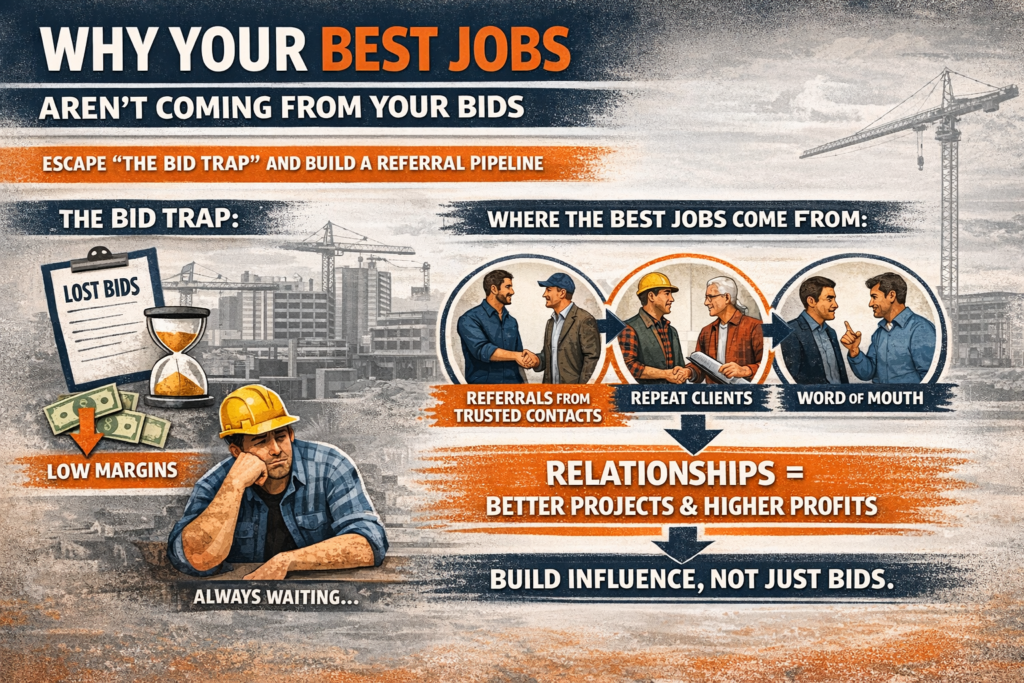
Bidding is reactive by nature. By the time a project hits your desk as a bid opportunity, the relationships that will determine the outcome have usually already been formed. The GC already knows who they want to work with. The owner already has someone in mind. You’re often there to fulfill a requirement — to be the third bid that makes the process look competitive.
When you win purely on a bid, you almost certainly won on price. Which means you started a job already squeezed. Which means the margin you needed to run a healthy business got left on the table before the first shovel hit the ground.
And yet the cycle continues, because bidding feels productive. It feels like you’re doing the work of building a business. The hours go in, the proposals go out, and at least there’s activity.
But activity isn’t the same as momentum.
Where the Best Jobs Actually Come From
Ask any contractor who’s had a banner year to trace where their best projects actually came from. Nine times out of ten, the answer sounds something like this:
“A guy I’ve worked with for years called me. We never even talked about price until the contract.”
“My concrete supplier mentioned my name to a developer he knew. I got a call out of nowhere.”
“I’d done two jobs for this client back in 2019. They called me for something three times the size.”
The best jobs — the ones with better scope, better margins, and clients you actually enjoy working with — come from people who already trust you. They come from relationships where the decision was made before a bid was ever issued.
There’s a distinction worth burning into your brain: a referral gets you a meeting. Influence gets you a client.
A referral is when someone passes your name. That’s valuable. But influence is what happens when someone has watched you work, understands what you bring, and is willing to go to bat for you. That’s a different level entirely — and it only comes from intentional relationship building over time.
The Relationship Equity Gap
Here’s the part that’s frustrating once you see it: most contractors already have the raw material for a referral pipeline. They just don’t have a system to work it.
Think about your own world for a second. You have past clients who loved your work — and haven’t heard from you since the punch list was signed. You have GC project managers you’ve built a real rapport with over multiple jobs. You have suppliers, engineers, architects, and trade partners who interact with decision-makers every single week. You have colleagues in adjacent trades who regularly run into opportunities they can’t take — but could hand off.
That’s not a small network. That’s a referral ecosystem sitting dormant.
There’s a concept worth introducing here: emotional equity. It’s the accumulated goodwill, trust, and positive association someone holds for you based on every interaction they’ve had with you over time. Every job well done, every problem handled with integrity, every time you showed up when you said you would — that’s a deposit. Every time you went silent, dropped the ball on communication, or let a relationship go cold — that’s a withdrawal.
Most contractors in this industry have built significant emotional equity without ever realizing it. They’ve done great work for great people and never thought strategically about what to do with that goodwill. Emotional equity doesn’t stay liquid forever. It depreciates when you’re not in contact. The relationship that was warm eighteen months ago has cooled — not because anything went wrong, but because life moved on and you weren’t there to stay part of the story.
The gap isn’t relationships. It’s the system to nurture them. Without a system, even your best relationships go cold. You’re busy running jobs, managing crews, handling everything that comes with running a contracting business. Staying in front of your network falls off the list — not because you don’t care, but because there’s no structure to make it happen consistently.
And while you’re heads-down on the job site, someone else who does have a system is having lunch with the GC you worked with last year.
What the Shift Looks Like
You don’t have to blow up your business development approach to start changing this. The shift starts with a few intentional moves.
Identify your top referral relationships. Who are the ten to fifteen people in your world who interact regularly with the kinds of clients and projects you want more of? GCs, past owners, commercial real estate contacts, adjacent trade partners — start there.
Get back in front of them with no agenda. A check-in call. A coffee. An article you thought they’d find useful. Not a pitch, not a “just wanted to see if you had anything coming up” — genuine engagement. The goal is to remind them you exist and reinforce what you’re known for.
Start giving referrals before you ask for them. Nothing accelerates trust faster than being the person who sends business to someone before asking for anything in return. Pay attention to what the people in your network need, and connect them when you can. That’s the currency that keeps relationships warm.
Make it consistent, not occasional. The contractors who run the strongest referral pipelines aren’t doing heroic networking. They’re doing small, regular things that keep them visible and valuable to the right people over time. That’s what a system does — it takes what works and makes it repeatable.
The 3-6 Month Reality No One Talks About
Here’s the uncomfortable truth about slow seasons: they aren’t caused by what’s happening now. They’re caused by what you didn’t do three to six months ago.
The relationship work you do today — the lunch you schedule, the check-in call you make, the referral you pass to a GC contact — doesn’t pay off this week. It pays off in a conversation that happens in March when someone says, “You know who’d be great for this? That contractor I had coffee with back in the fall.” You won’t be in the room when that happens. Your name will come up because you did the work when there was nothing immediate to show for it.
This is why discipline matters more than motivation in business development. Motivation gets you moving when things are slow and you’re worried. Discipline keeps you moving when things are busy and it feels unnecessary. The contractors who never experience a “slow season” aren’t lucky — they’re the ones who kept nurturing their referral relationships even when the phones were already ringing.
If you’re in a strong season right now, that’s the exact moment to invest in the relationships that will sustain it. If you’re in a slow season right now, the work you do today won’t fix this quarter — but it will protect the next one.
Your Pipeline Should Work When You’re On the Job Site
Your business shouldn’t depend on you having spare time to do business development. Because that time rarely comes. When you’re in a strong season, you’re too busy. When you’re in a slow season, you’re scrambling.
A referral system changes that equation. When you’ve built real influence with the right people — when you’ve accumulated genuine emotional equity across your network — your pipeline generates activity even when you’re not actively working it. Calls come in. Names get passed. Opportunities surface before they ever hit a bid list.
That’s not luck. That’s what happens when you’ve done the relationship work consistently enough, and early enough, that your network is genuinely invested in your success.
If you’re ready to build that system — not just understand it, but actually put it in place for your business — Trust Lab Builder Edition launches in March. It’s built specifically for contractors who are done leaving their pipeline to chance.
Join the waitlist now and you’ll be first in line for all the details, updates, and launch information as we get closer: Get on the waitlist →
Breandan Filbert is the founder of SalezWorks and creator of Productive Prospecting: Trust Lab, a referral partnership program for contractors and professional services firms. She has spent more than 20 years helping companies build revenue systems based on influence, not cold outreach.
![An illustrative infographic, divided vertically, compares two business approaches: "THE OLD WAY: COMMODITY BID LIST" (left) and "THE NEW WAY: PARTNERSHIP LEVERAGE" (right). On the left side, under a banner title of "The Bid List Isn’t a Relationship. Here’s What Is," a line of construction workers, some appearing frustrated, are waiting with stacks of bid forms in a queue to a counter labeled "GENERAL CONTRACTOR" with "SUBMIT BID" and "LOW PRICE WINS" signs. A very large pile of generic bid forms is shown next to them. Accompanying text labels state: "Being on the bid list feels like progress", "Most of the time, you lose", "It's a commodity position", "Levers: price, schedule", and "Auditioning, not differentiating". On the right side, labeled "THE NEW WAY: PARTNERSHIP LEVERAGE," a group of diverse professionals are seated at a modern table, collaborating over a blueprint. They are shaking hands over a central handshake icon, which is labeled "TRUST." A thought bubble above them contains four icons: "EARLY CONVERSATIONS" (phone and calendar), "SOLVING PROBLEMS" (gears and question mark), "REFERRALS" (connected arrows), and "JOINT STRATEGY" (gears and team). Through a large window behind them, a multi-story building is actively under construction, with a large tower crane visible. Right-side text labels list the benefits: "Called before the bid goes out", "Deeper in fewer relationships", "Most trusted, not cheapest", "Attract work, don't chase", and "Make the bid irrelevant". In the bottom-right corner, a button reads "BOOK CALL" and next to it, "[BOOK YOUR 20-MINUTE CALL]](https://salezworks.com/wp-content/uploads/2026/04/Gemini_Generated_Image_euv2bheuv2bheuv2-300x164.png)