
I spent Thursday evening in a room with construction and trades principals — people who have built companies doing $10M, $20M, and more. Real revenue. Real teams. Real expertise.
And one thing became unmistakably clear:
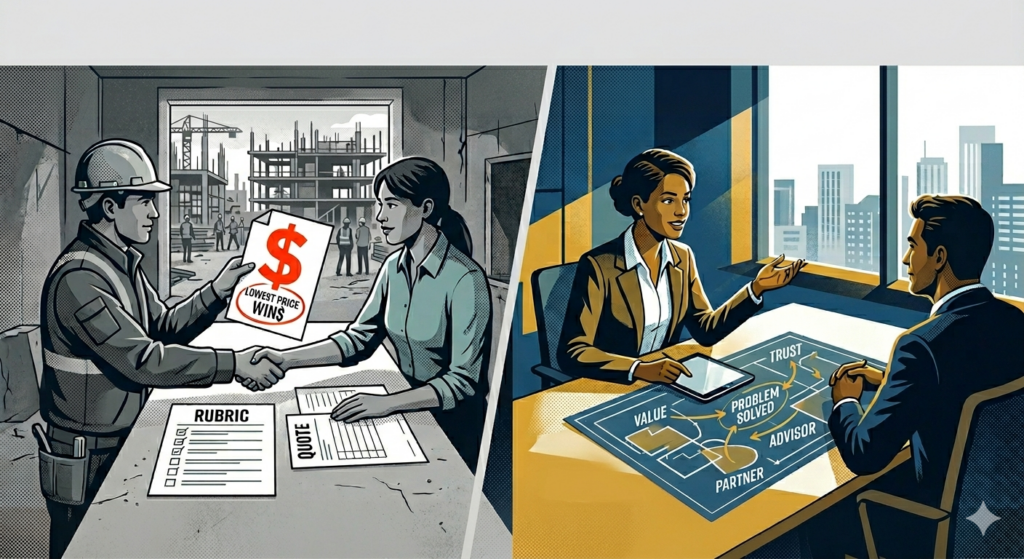
Construction didn’t get commoditized. It commoditized itself.
One bid process at a time. One lowest-price-wins decision at a time. One “just send me a quote” at a time.
The industry spent decades handing buyers a rubric — and then couldn’t figure out why it kept getting evaluated on price.
I’m not picking on construction. I’m warning you.
The Bar Isn’t High. That’s the Problem.
There’s a contractor I work with who stands out dramatically in his market. Not because he’s competing against brilliant relationship builders. Not because the field is crowded with people who deeply understand trust as a business strategy.
He stands out because the bar is on the floor.
His competitors taught buyers to expect the minimum: show up when called, submit a number, wait to hear back. The entire interaction is transactional by design — designed by the industry itself, not the buyer.
So when someone shows up and actually builds a relationship before the bid, follows up with something other than a lower number, and operates like a trusted advisor instead of a line item — they don’t just win the project. They reframe the entire buying experience.
That’s not extraordinary skill. That’s the absence of bad habits the rest of the industry normalized.
I get it, the industry during Covid had more work than they had people, and they didn’t have to be better, there were more projects than contractors. As competition heats up, projects remain abundant but now the field is crowded.
Just like the field of professional service providers and knowledge workers.
Look at Your Own Industry.
If you’re a fractional executive, a consultant, or a professional services provider, I want you to think carefully about what your industry has trained buyers to expect.
When you open with your deliverables list — you’re handing the buyer a spreadsheet.
When you quote an hourly rate before you’ve established the value of your thinking — you’ve just told them this is a math problem.
When you lead with scope before you understand the real cost of the problem — you’ve framed yourself as a vendor, not a partner.
You didn’t mean to do any of that. But every professional who did it before you helped train the buyer to approach the relationship that way.
The question isn’t whether your buyer has been trained. They have. The question is whether you’re going to reinforce that training or disrupt it.
A Referral Gets You a Meeting. What You Do Next Determines Everything.
Most professionals think the referral is the win.
It’s not. It’s the door. What you do in the first two conversations either establishes you as someone worth trusting at a deep level — or quietly confirms that you’re someone to evaluate like a vendor.
The contractors who are losing to price didn’t lose at the bid. They lost at the first conversation when they accepted a transactional frame without even noticing it.
The same thing happens in your practice when you move too fast to the proposal. When you solve the easy problem instead of naming the expensive one. When you educate the buyer on your credentials instead of making them feel seen in theirs.
Influence isn’t a personality trait. It’s a practice. And it has to happen before the scope conversation — not during it.
Don’t Build the Bar on the Floor.
Construction built an entire culture around the bid — and now can’t escape it. You have a choice right now that they didn’t know they were making.
You can operate the way your industry has normalized — and benefit from the same low bar your competitors helped set.
Or you can build a deliberate system for earning trust before the proposal, so the question your buyer is asking isn’t “what’s the rate” but “what does working together look like.”
That’s the work Trust Lab is built around.
It’s a 13-week cohort for fractional executives and professional services leaders who are done letting their buyers set the frame. We’re building the influence engine that moves relationships from transactional to transformational — and keeps them there.
The Builder Edition cohort just opened. It’s intentionally small. If you’ve been reading this and recognizing your own industry in the construction story — let’s talk.
Book a 20-minute discovery call. Let’s find out if Trust Lab is the right next step for you.